
Occupational Safety and Photobiological Safety of Optical Radiation
Artificial optical radiation – incoherent UV, visible and infrared radiation from lamps, LEDs, arcs and radiation equipment – can cause photochemical or thermal damage to skin and eyes once irradiance, wavelength and exposure duration exceed certain limits. Photobiological safety is the systematic assessment of this hazard: classifying a source into risk groups under IEC 62471, comparing the spectrally weighted irradiance against exposure limit values, and deriving permissible exposure times or technical protective measures. The key quantities are actinic UV-weighted irradiance, blue-light-weighted radiance and infrared irradiance; the central challenge is that a lamp's electrical ratings – such as its power consumption – say nothing reliable about the actual optical hazard at the workplace.
How is the market or technology developing?
No standalone world market is tracked for “workplace photobiological safety”; reliable figures exist for adjacent markets from which the technological momentum can be inferred.
One market indicator is the LED lighting market, valued at roughly USD 97–109 billion in 2025 and growing 8–14 % p. a. depending on scope (Fortune Business Insights, 2026). What matters technically is less the absolute market size than the shift in the spectral makeup of the light sources deployed: for the same illuminance, LEDs emit a higher blue fraction than incandescent and halogen lamps, which makes the blue-light hazard under IEC 62471 a more relevant test criterion for general lighting than it was in the era of thermal sources. In parallel, the market for UV curing systems is growing to an estimated USD 4.6–6.7 billion (2024/2025) at CAGR values of 6.5–17 % depending on market definition (Mordor Intelligence, 2026) – a driver for more open and partially open UV radiation sources on industrial production lines that personnel can access.
The ongoing displacement of broadband mercury-vapour lamps by LED systems in curing, lighting and disinfection is shifting typical workplace spectral profiles from continuous towards narrowband, multi-peak emissions; the consequence is that blanket assessments based on “typical” UV spectra increasingly have to be replaced by source-specific spectral measurement. The debate around far-UVC disinfection (200–230 nm) in occupied indoor spaces led, in 2022, to a fundamental revision of the exposure limits for this wavelength range and, with IEC 62471-6:2022, to a dedicated product standard for germicidal UV lamps; the consequence for occupational safety is a growing need for spectrally resolved measurement technology in precisely this historically under-studied band. On the regulatory side, the European safety standard EN 12198 requires machinery with function-related radiation emission to carry a documented assessment and reduction of radiation risks as part of CE conformity; the consequence is that photobiological risk assessments are increasingly being integrated into machine builders' technical documentation, not only into the operator's hazard assessment. Finally, the continuing automation of production lines means that one-off spot measurements are increasingly supplemented by integrated, permanently installed sensing that detects deviations during ongoing operation.
How does the photobiological hazard of optical radiation work?
Optical radiation damages tissue through two fundamentally different mechanisms. Photochemical damage occurs when photons of sufficient energy are absorbed directly by molecules and break chemical bonds or generate reactive intermediates: UV radiation damages skin DNA and proteins this way (erythema, photokeratitis) and, in the blue spectral region, damages the retina via photosensitisers in the retinal pigment epithelium (including lipofuscin/A2E), generating reactive oxygen species. Thermal damage, by contrast, arises from an energy input faster than the tissue can dissipate as heat, causing protein denaturation once certain temperature thresholds are crossed; it dominates at high irradiance in the visible and infrared range and with very short, high-energy pulses. Which mechanism prevails depends on wavelength, irradiance, pulse duration and the penetration depth of the radiation into the tissue in question – a blanket rule of “more power means more danger” therefore falls short.
Which technologies are used for assessment?
Different measurement principles are available for assessing the hazard and classifying it under IEC 62471, each suited to a different question – screening, formal classification, or continuous monitoring.
| Technology | Characteristics | Advantages | Limitations | Typical use |
|---|---|---|---|---|
| Broadband radiometer (actinic-, UV-A- or blue-light-weighted) | Filter detector with a fixed, built-in weighting function (e.g. S(λ), B(λ)) | Fast, robust, low-cost, field-ready | Weighting curve is matched to a reference source; strongly deviating spectra (e.g. narrowband LEDs) can cause systematic measurement error | Quick plausibility check of known, spectrally stable sources |
| Spectroradiometer | Measures spectral irradiance wavelength-resolved via grating/detector array | Standard-compliant calculation of any weighting function from a single measured dataset; robust with mixed spectra and multi-chip LEDs | Higher acquisition and analysis effort; slower per-point measurement than a broadband sensor | Risk-group classification under IEC 62471, mixed light sources, disputed spectral ranges (e.g. far-UVC) |
| Imaging luminance/radiance measurement | Spatially resolved capture of the radiance distribution of an extended source | Captures the apparent source diameter, which is decisive for the blue-light limit formula (extended vs. point source) | More involved than a point measurement; higher calibration effort | Assessment of large-area luminaires, displays, LED panels |
| Personal dosimeter | Body-worn sensor with data logging over the shift | Captures the real, position- and movement-dependent individual dose instead of a single fixed-point measurement | Usually broadband, no spectral information; needs calibration to a reference source | Long-term monitoring of mobile tasks, e.g. welding, maintenance work |
| Inline/process sensor (PLC-coupled) | Permanently installed sensor with an analog or digital output to the plant control system | Continuous monitoring, automatic interlock triggering possible | Usually captures only one fixed measurement position and geometry; does not replace periodic full classification | Automated UV curing and disinfection systems |
Which process quantities are decisive?
Several physical quantities matter simultaneously for a photobiological assessment, because together they determine how radiant energy translates into a biological effect. The spectral distribution of the source decides which weighting function (actinic UV, blue light, IR) the measured irradiance must be evaluated against – a shift of only a few nanometres can change the effective hazard by orders of magnitude, because weighting functions such as S(λ) or B(λ) are strongly wavelength-dependent. The irradiance or radiance at the eye or on the skin, together with the exposure duration, determines the dose received; for blue light, the apparent source diameter (angular subtense as seen by the exposed person) also matters, because it decides whether the limit formula for extended or point sources applies. The distance to the source acts through the inverse-square law, but only for point sources, and is broken for extended or collimated sources (reflectors, collimators). Finally, the operating time or ageing of the source affects the real emission, since UV lamps and LEDs can drift in output power and spectral composition over their lifetime.
What limits the process or causes errors?
Recurring false assumptions in practical hazard assessments can lead to either falsely reassuring or falsely alarming conclusions.
A lamp's electrical power is not a measure of optical hazard: two lamps with the same electrical power consumption can have completely different efficiencies, spectra and beam patterns, so the weighted irradiance actually reaching a workplace cannot be derived from the nameplate – it must be measured. Likewise, looking at time alone is not sufficient: the blue-light limit system explicitly distinguishes between short exposures (dose-based, up to 100 s) and continuous exposure (irradiance-based, above 100 s), because the dominant damage mechanism changes with the time scale; assuming a single “safe” irradiance for all durations has no physical basis. The measurement location substantially changes the result: near-field measurements taken directly at a lamp opening differ from measurements at the actual position where personnel are present, and for extended sources the radiance additionally depends on the viewing angle. Material and geometry of the equipment change the spectrum: shielding, housing walls or protective screens filter UV components to differing degrees, so a hazard measured at the open source cannot automatically be applied to the real exposure behind a cover. Finally, every assessment is only valid under the assumed boundary conditions (operating state, distance, exposure duration); maintenance, fault or cleaning states with covers open require a separate assessment that routine measurements frequently overlook.
In depth: the influence of spectrum, material and geometry
The three factors above are closely linked. Spectrally, the weighting functions S(λ) (actinic UV hazard), B(λ) (blue-light hazard) and the IR hazard function each act only within their defined wavelength range and with a strongly non-linear profile; a broadband source with secondary peaks outside its main spectral range can therefore still contribute significantly in a narrow, heavily weighted band despite low total power. On the material side, ordinary window glass filters out almost all UV-B and UV-C but transmits most UV-A – shielding sufficient for erythema protection that leaves the blue-light hazard unaffected. Geometrically, the standard distinguishes small (point) from large-area sources by the angular subtense α, because for large-area sources the retinal image size, and hence the thermal distribution of the absorbed energy, differs from that of a point source with the same radiant power; the same light source can therefore count as “large” at 0.5 m distance and “small” at 5 m in the sense of the standard.
Expert note: the reciprocity law and its limits
For many photochemical effects, the Bunsen–Roscoe reciprocity law holds approximately: the biological effect depends primarily on the product of irradiance and time, i.e. on the dose (exposure) H = E · t, regardless of whether the same dose is applied briefly and intensely or over a long time at low level. For actinic UV-weighted irradiance, this simplifies to:
Eeff = ∫ E(λ) · S(λ) dλ
with E(λ) the spectral irradiance and S(λ) the actinic weighting function per ICNIRP/ACGIH. The permissible exposure duration follows from the 8-hour exposure limit value (ELV) as:
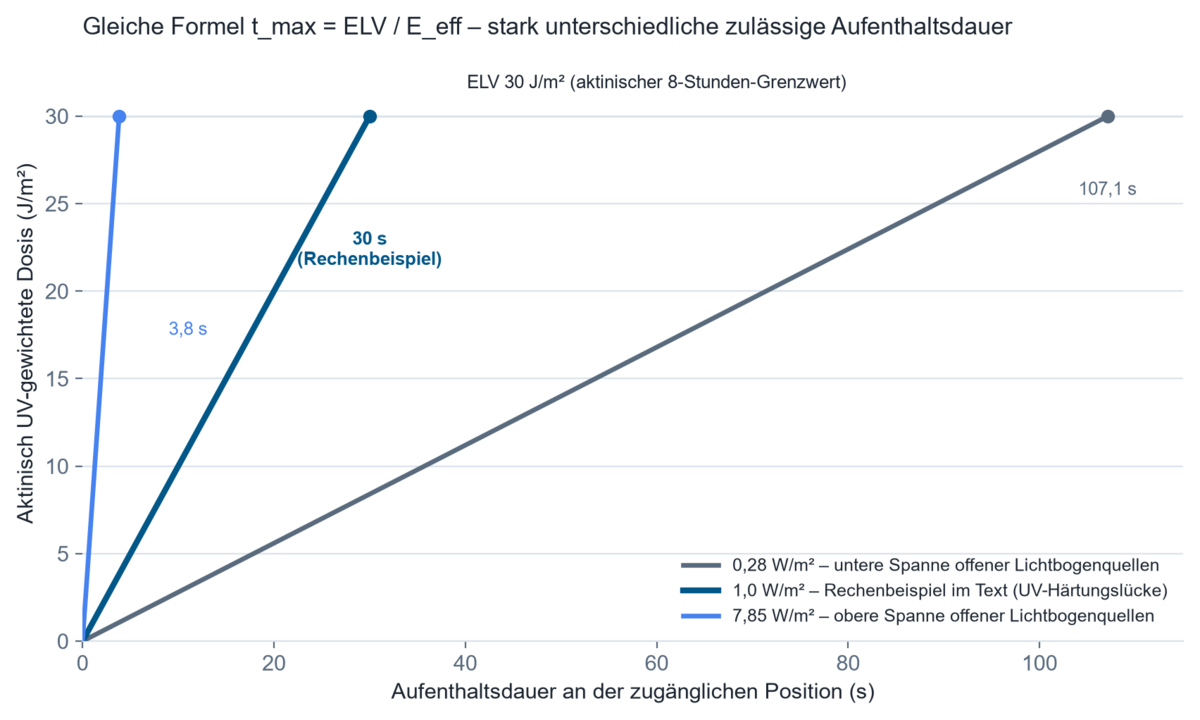
tmax = ELV / Eeff
with ELV = 30 J/m² (3 mJ/cm²) for actinic UV radiation as the established, widely recognised limit. This relationship does not, however, hold without exception: for the blue-light hazard, the limit formula switches above an exposure duration of 100 s from a dose-based (radiant exposure) quantity to an irradiance-based quantity – an indication that at longer exposures, retinal repair mechanisms break the simple additivity of dose. For very short, high-energy pulses (e.g. flash lamps), reciprocity also fails, because thermal damage mechanisms depend on peak power rather than integrated energy.
A further, currently debated example of the limits of established models concerns far-UVC radiation (207–222 nm), used for surface and air disinfection in occupied spaces. The classical actinic weighting function S(λ) was extrapolated largely from effect data above 250 nm, implying a comparable hazard at shorter wavelengths. However, more recent threshold studies show that radiation around 222 nm is almost completely absorbed in the dead outer layer of the skin (stratum corneum) and in the outermost cell layers of the eye before it reaches living, dividing cells – the actual penetration depth is markedly lower than for longer-wavelength UV-C radiation (Sliney & Stuck, 2021). On this basis, ACGIH substantially raised the limits for wavelengths below roughly 250 nm in 2022, relative to the previous system derived from the generic S(λ) curve, and reported them separately for eye and skin. In practice this means that an assessment of far-UVC sources based solely on the broadband S(λ) model can substantially overestimate the real hazard – a case where it was not the measurement but the underlying hazard model that had to be corrected.
Worked example: permissible exposure duration at an open UV curing line
Assumptions: at a gap in a UV drying line (e.g. during a web change or a repair), an actinic UV-weighted irradiance of Eeff = 1.0 W/m² is measured at the nearest accessible operator position – an order of magnitude comparable to published values for open arc sources (0.28–7.85 W/m² at 1 m distance) (pubmed.ncbi.nlm.nih.gov).
Formula/model: tmax = ELV / Eeff, with ELV = 30 J/m² (8-hour exposure limit value for actinic UV radiation).
Calculation: tmax = 30 J/m² ÷ 1.0 W/m² = 30 s.
Result: the permissible cumulative exposure duration at this position is 30 seconds per eight-hour shift.
Technical interpretation: even a brief manual intervention without shutdown or shielding – threading a web or clearing a fault, for example – can exceed the permissible daily limit. This is the technical reason why such equipment requires not spot checks, but interlocks and continuous inline monitoring.
Where is photobiological safety assessment used?
In industrial UV curing and UV bonding, operators can be exposed to open radiation while setting up, changing webs or performing maintenance; here, the actinically weighted irradiance at access openings is the critical quantity (see also UV Bonding, Potting and Encapsulation). In arc welding, broadband UV, visible and IR components arise with sometimes considerable irradiance at close range; UV-related skin damage in welders is discussed in the occupational-medicine literature, although the evidence for an elevated skin-cancer risk is inconsistent (Falcone & Zeidler-Erdely, 2018); in addition, photochemical UV keratoconjunctivitis (“welder's flash”) is a well-known acute hazard. In lighting technology (office, industrial and architectural lighting), LED luminaires must be classified for blue-light hazard under IEC 62471; studies show that general LED lighting, under normal conditions of use, is no more hazardous than classical light sources (Udovicic & Janßen, 2019). In UV disinfection of water, air and surfaces, alongside efficacy against micro-organisms, accessibility during maintenance and fault clearance is safety-relevant, especially with newer far-UVC systems intended for occupied rooms (see Safety of UV disinfection). In display technology (camera modules, lighting systems), photobiological classification is increasingly part of CE conformity assessment under the Machinery Directive wherever radiation is a function-related emission.
Which quantities must be measured or monitored?
Which measurement quantity is appropriate follows from the application. For an initial risk-group classification under IEC 62471, a single spectroradiometric measurement at the worst-case accessible position is often sufficient; for known, spectrally stable sources, a calibrated broadband radiometer with a matching weighting function can serve for ongoing checks. Where the composition of multiple sources, narrowband LED chips or disputed spectral ranges (e.g. far-UVC) must be assessed, a full spectral measurement is required, because broadband sensors can show systematic deviation when their weighting curve does not exactly match the real source spectrum. Spatial resolution becomes necessary once the size of the source itself determines which limit formula applies (extended vs. point source); time-resolved measurement is needed for pulsed or switching sources (flash lamps, PWM-dimmed LEDs), since RMS measurements can understate the peak load. For every measurement, the measurement uncertainty – comprising calibration traceability, the sensor's spectral bandwidth, cosine error at oblique incidence and positioning inaccuracy – must be documented, since it directly affects the safety margin to the limit value. A suitable instrument (radiometer, spectroradiometer) is a tool for meeting these requirements, not their starting point.
In automated UV curing and disinfection equipment, photobiological safety is increasingly secured through permanently installed, PLC-coupled sensors that continuously capture the irradiance at safety-relevant positions. The technical significance lies not primarily in the digital connectivity, but in the fact that lamp ageing, the failure of individual LED chips, or shielding out of position is detected promptly, before it results in a real overexposure – the sensing system thereby performs a function that a purely periodic, manual measurement during maintenance intervals cannot. If the measured irradiance exceeds a stored threshold, this can directly trigger an interlock, shutdown or warning, rather than leaving detection to operating personnel.
What does the scientific literature show?
David H. Sliney and Bruce E. Stuck, in “A Need to Revise Human Exposure Limits for Ultraviolet UV-C Radiation” (Photochemistry and Photobiology, 2021, Vol. 97, No. 3, pp. 485–492, DOI: 10.1111/php.13402), examined the biological basis of existing UV-C limits against newer threshold data for eye and skin and concluded that the previous limits below roughly 250 nm were substantially too conservative – a key basis for the revised 2022 ACGIH limits for far-UVC.
The ICNIRP statement “Light-Emitting Diodes (LEDs): Implications for Safety” (Health Physics, 2020, Vol. 118, No. 5, pp. 549–561, DOI: 10.1097/HP.0000000000001259) systematically assesses the health risks of UV, visible and infrared LEDs and finds that no acute retinal damage is to be expected under reasonably foreseeable conditions of use, while flicker and stroboscopic effects are named as genuinely documented effects.
L. M. Falcone and P. C. Zeidler-Erdely, in “Skin cancer and welding” (Clinical and Experimental Dermatology, 2018, Vol. 44, No. 2, pp. 130–134, DOI: 10.1111/ced.13783), reviewed the evidence on UV-related skin-cancer risk in welders; the available literature is considered limited and inconsistent, though one case-control study reported an elevated risk of basal-cell carcinoma of the head and neck in long-term exposed welders.
A. Torriglia et al., in “Retinal phototoxicity and the evaluation of the blue light hazard of a new solid-state lighting technology” (Scientific Reports, 2020, Vol. 10, Article 6733, DOI: 10.1038/s41598-020-63442-5), examined the retinal phototoxicity of conventional LEDs versus GaN-on-GaN LEDs in an animal model and showed that the established blue-light weighting function may underestimate the hazard of shorter-wavelength LED types.
L. Udovicic and M. Janßen, in “Photobiological safety of common office light sources” (Proceedings of the 29th CIE Session, Washington D.C., 2019, pp. 1256–1261, DOI: 10.25039/x46.2019.PO110), examined the blue-light hazard of LED, incandescent, halogen and compact-fluorescent lamps as well as laptop and smartphone displays under IEC/EN 62471 and showed that general LED lighting is not photobiologically more hazardous than conventional light sources.
What do customer publications show?
A search across all customer publications documented on the website found no result specifically addressing occupational hazard assessment of optical radiation itself. One thematically adjacent work, however, examines the same biological endpoint – actinic UV skin damage – from the dermatological protection perspective, irradiated with a BS-03 irradiation chamber:
Protective effects of sunscreen (50+) and octatrienoic acid 0.1% in actinic keratosis and UV damages
Pinto, Daniela, et al. “Protective effects of sunscreen (50+) and octatrienoic acid 0.1% in actinic keratosis and UV damages.” Journal of Investigative Medicine 70.1 (2022): 92–98.
Further work from adjacent fields of photobiology is listed under Publications by customers - by topic.
Technical background and further sources
The regulatory framework in Germany and the EU: the German Ordinance on Protection of Employees from Hazards due to Artificial Optical Radiation (OStrV), implementing EU Directive 2006/25/EC, the IEC 62471 / EN 62471 standard series (Photobiological safety of lamps and lamp systems) with the supplementary product standard IEC 62471-6:2022 for germicidal UV sources, the machinery safety standard EN 12198 for the assessment and reduction of radiation risks, and the guidelines of the International Commission on Non-Ionizing Radiation Protection (ICNIRP) on UV, visible/IR and LED radiation. An overview of the regulatory framework with the associated limit values is available under Guidelines, norms and standards in UV.
- OStrV (German Ordinance on Protection of Employees from Hazards due to Artificial Optical Radiation), last amended 18 Oct. 2017 (gesetze-im-internet.de)
- Directive 2006/25/EC (eur-lex.europa.eu)
- IEC 62471-6:2022 (webstore.iec.ch)
- ICNIRP UV Guidelines, 2004 (icnirp.org)
- ICNIRP LED statement, 2020 (icnirp.org)
- Machinery Regulation (EU) 2023/1230, Annex III No. 1.5.10–1.5.13 (eur-lex.europa.eu)
FAQ on occupational safety and photobiological safety
What is the difference between irradiance and radiance?
Irradiance (W/m²) describes the radiant power hitting a surface and is relevant for skin as well as for assessing point sources at the eye. Radiance (W/(m²·sr)) additionally accounts for solid angle and is needed for extended, large-area sources, because it reflects the area imaged on the retina. The formal definitions of irradiance, radiant exposure and fluence are given under radiometric quantities.
Why isn't a lamp's electrical power sufficient as a hazard measure?
Efficiency, spectrum and beam pattern differ substantially between lamp types, so two lamps with the same electrical power can produce very different optically effective irradiances. Only a direct measurement of the spectrally weighted irradiance provides a reliable answer. The general derivation – from electrical power through electro-optical efficiency to the measurand at the point of action – is given under radiometric quantities.
What risk groups does IEC 62471 define?
The standard distinguishes an exempt group and risk groups 1 to 3 of increasing hazard, derived from the spectrally weighted irradiance or radiance compared against defined exposure limit values. The classification determines which labelling and protective measures are required.
Does every light source in the workplace need to be measured?
Not necessarily every individual source, but every hazard assessment under OStrV requires an evaluation of whether relevant exposure can occur. Many certified standard luminaires already carry a manufacturer classification; for special applications, open sources or mixed spectra, a dedicated measurement is necessary.
What is currently changing in the limits for far-UVC (222 nm)?
Newer threshold data show that the shallow penetration depth of radiation around 222 nm into skin and eye implies a substantially lower hazard than the classical weighting function, extrapolated from longer wavelengths, would suggest. ACGIH substantially raised the corresponding limits in 2022 and reported them separately for eye and skin.
What legal basis applies in Germany?
The governing framework is the OStrV implementing EU Directive 2006/25/EC, supplemented by the IEC/EN 62471 standard series for the technical classification of lamps and EN 12198 for machinery with function-related radiation emission under CE conformity.
How often must a hazard assessment be repeated?
No fixed statutory interval exists; the OStrV requires an update whenever the equipment, work processes or the state of knowledge change materially. Ageing-related spectral and power changes in lamps argue for regularly repeating the measurement.
What role does an LED's spectral distribution play in the blue-light hazard?
LEDs with a high blue fraction in their emission spectrum – such as cool-white types with a high colour temperature – produce a higher blue-light weighted radiance than warm-white or thermal sources at the same illuminance. The actual hazard additionally depends on source size and viewing distance.
The central technical question
The practical question behind every hazard assessment of optical radiation is: what spectrally weighted irradiance or radiance is actually present at the real, accessible work position, and what exposure duration is permissible on that basis? A reliable answer requires a spectroradiometric or radiometric measurement appropriate to the source and the measurement location – not an estimate derived from electrical ratings.
Related application fields
Occupational safety and photobiological safety borders several neighbouring fields: medical phototherapy addresses the same physical quantities for medically prescribed rather than unintended exposure, Photobiology & Biotechnology studies the effect of radiation on living systems in research, and UV Bonding, Potting and Encapsulation is the application whose open equipment access points most often make a hazard assessment relevant. Constructive protective measures are frequently designed in from the start in special equipment engineering.
Author: Dr. Mark Paravia
Dr.-Ing. Mark Paravia is the managing director of Opsytec Dr. Gröbel GmbH in Ettlingen and heads the accredited calibration laboratory. Following his research on pulsed xenon excimer discharges at the Institute of Lighting Technology at KIT, his current focus is on optical radiation measurement technology. He is a recognized UV expert, vice-chair of the DIN Standards Committee FNL 7 “Optical Radiation,” and a member of the DVGW Project Group on UV Disinfection.
Your hazard assessment of optical radiation
For fast, robust on-site measurement of the actinically weighted irradiance at open equipment access points and maintenance gaps, the RMD Pro radiometer is suitable; for risk-group classification under IEC 62471 with mixed spectra, LED luminaires or disputed spectral ranges such as far-UVC, the SR900 spectroradiometer. For continuous, PLC-coupled monitoring of automated UV curing and disinfection equipment with limit-value alarming, the PLC.net UV sensor is available. For formal on-site assessment and CE classification under OStrV, 2006/25/EC and EN 12198, the accredited UV calibration laboratory carries out traceable measurements of optical radiation. Talk to us about your measurement task.