

UV Disinfection – Working Principle, Technologies and Process Parameters
UV disinfection uses short-wave ultraviolet radiation (UVC, roughly 200–280 nm) to physically inactivate bacteria, viruses, protozoa and other micro-organisms without adding chemicals to the treated medium. The goal is a defined, reproducible reduction of the germ count in water, air or on surfaces. The central technical challenge is that the effect is not determined by lamp power or exposure time alone, but by the radiant quantity actually reaching the micro-organism – the fluence. This depends on wavelength, irradiation geometry, the optical properties of the medium and the organism's path through the radiation field. The governing physical quantities are irradiance (W/m²), fluence or dose (J/m² resp. mJ/cm²), the UV transmittance of the medium (UVT) and the organism-specific dose-response curve. There is no universal “dose that kills germs”.
How is the UV disinfection market developing?
The global market for UV disinfection equipment has grown at double-digit rates for several years, though the absolute market size varies considerably depending on how analysts define its scope. Fortune Business Insights put the market for UV disinfection equipment at roughly USD 5.63 billion in 2025, with a projected CAGR of 12.1 percent through 2034. Other market analyses, for similarly named but more narrowly or more broadly defined segments, arrive at figures between about USD 1.5 and 6.4 billion for 2025 (GM Insights; Mordor Intelligence). This spread is itself technically informative: it shows that “UV disinfection” is not a uniformly bounded market, but a mix of water treatment, air treatment, surface disinfection and component manufacturing (lamps, LEDs, sensors) weighted differently by each definition.
Within this market, the UVC LED sub-segment is growing particularly fast. Fortune Business Insights puts the global UVC LED market at about USD 1.93 billion in 2025, with a CAGR of nearly 25 percent through 2034; other sources quote CAGR figures between 12 and 32 percent for comparable segment definitions. Technically, this growth reflects a genuine shift: solid-state UVC sources are increasingly replacing mercury-based discharge lamps, driven in particular by European RoHS regulation. The exemption for mercury in UV discharge lamps under Annex III of RoHS Directive 2011/65/EU expires on 24 February 2027; from that date, new lamps of this kind may no longer be placed on the EU market (Opsytec on RoHS and UV lamps). In parallel, the Minamata Convention sets internationally staggered phase-out dates for mercury-containing products.
In the German drinking-water sector, UV disinfection is the only physical disinfection method approved for public water supply under the list of permitted treatment substances and disinfection methods pursuant to § 20 of the German Drinking Water Ordinance (DVGW). The relevant standards are currently in transition: the former DVGW worksheets W 294-2 and W 294-3 for installations with medium-pressure UV lamps were fully replaced in 2026 by the new standards DIN 19294-2:2026-04 and DIN 19294-4:2026-04, after the corresponding rules for low-pressure lamps had already been transferred into DIN 19294-1 and DIN 19294-3 in 2020. This revision tightens the requirements for reference radiometers (linearity, angular and temperature response) and adds further operating scenarios to biodosimetry – a direct consequence for manufacturers and operators of drinking-water installations with medium-pressure lamps.
Three developments are visibly shifting the technology of UV disinfection. The electro-optical efficiency of commercial UVC LEDs currently reaches wall-plug efficiencies of about 4 to 8 percent in the germicidal range (259–280 nm), while laboratory work on neighbouring wavelengths already shows above 19 percent (critical review, 2024; Nichia, 2025) – the falling heat load per emitted UVC watt reduces thermal-management requirements and makes compact systems economical. Research into far-UVC at 222 nm for occupied spaces is at the same time shifting safety-related standardisation: frameworks such as ISO 15858 were developed for conventional UVC wavelengths and are being revised in light of new findings on penetration depth and ozone formation. And regulatory pressure to remove trace substances in wastewater treatment (fourth treatment stage) is extending classical disinfection with UV/H₂O₂ advanced-oxidation processes, which require considerably higher doses and therefore change plant design.
How does UV disinfection work?
UVC radiation in the range of roughly 200–280 nm is absorbed by nucleic acids (DNA, RNA) and by other cellular and viral components. Absorption is wavelength-dependent and peaks near 260–265 nm, the absorption maximum of the nucleic acid bases. The absorbed photons trigger photochemical reactions, in particular the formation of pyrimidine dimers (covalent links between adjacent thymine or cytosine bases) within the DNA or RNA strand. These lesions alter the molecular structure so that replication and transcription are disrupted; the micro-organism loses its ability to reproduce or to cause an infection, without the cell necessarily being destroyed immediately. The strength of this effect is not a constant – it depends on the organism, strain, physiological state, surrounding medium, wavelength and applied fluence. In addition, cellular repair mechanisms (photoreactivation, dark repair) can reverse part of the damage after treatment. This interplay is why a single “standard dose” is not valid for every application and target organism.
Which technologies are used?
UV disinfection systems differ primarily in the radiation source employed. The source determines spectrum, power density, electro-optical efficiency and therefore also the suitable application.
| Technology | Characteristics | Advantages | Limitations | Typical application |
|---|---|---|---|---|
| Low-pressure Hg lamp | quasi-monochromatic at 253.7 nm | high optical efficiency (UVC share approx. 30–40 % of electrical power), established standards (DIN 19294‑1/‑3) | contains mercury, temperature-dependent warm-up phase, limited power density per lamp length | drinking water, wastewater, municipal plants |
| Amalgam lamp | low-pressure variant with amalgam dosing, higher power density | more compact reactors at comparable capacity | higher operating temperature required, more sensitive to temperature fluctuations | large-volume water treatment |
| Medium-pressure Hg lamp | polychromatic, 200–400 nm | very high power density per lamp length, compact plants at high throughput | lower UVC efficiency (approx. 10–15 %), stronger ageing, standards currently under revision (DIN 19294‑2/‑4:2026‑04) | large municipal and industrial plants, UV/H₂O₂ oxidation |
| UVC LED | selectable discrete wavelength, mostly 259–280 nm | mercury-free, instant on/off, compact form factor, long service life | currently lower wall-plug efficiency (approx. 4–8 % in the germicidal range, as of 2024/2025) and lower total power per chip than lamps | point-of-use devices, small flow rates, portable applications |
| Excimer lamp (KrCl*, far-UVC) | narrow-band around 222 nm | shallow penetration depth into biological tissue, hence a more favourable safety profile with people present | possible ozone formation in air, technology still predominantly in research/specialty applications | air and surface disinfection in occupied spaces (research stage) |
| Pulsed xenon broadband source | high-energy flashes, broad spectrum including UV, VIS, IR | high peak power, very short exposure times, ozone-free operation possible in some designs | shadowing due to geometry, thermal load on sensitive materials | surface and packaging disinfection, food industry |
An important point for the technical assessment: microbial efficacy, nucleic-acid absorption and electrical efficiency of a source do not share the same spectral optimum. This is both the opportunity and the metrological challenge of LED and excimer technology – their dose-response data cannot simply be carried over from conventional low-pressure or amalgam lamps.
Which process parameters are decisive?
- Wavelength: determines the absorption behaviour of nucleic acids and thus the biological efficacy per absorbed photon; different source classes need different dose-response references.
- Irradiance (fluence rate): the radiant power per area at a given moment; it determines how quickly a dose builds up, and – within the reciprocity law and its limits – can also influence whether the same integrated dose produces the same inactivation.
- Fluence/dose: the time integral of irradiance along an organism's path; this, not exposure time alone, is the true reference quantity of the dose-response curve.
- UV transmittance (UVT) of the medium: governs, per the Beer–Lambert law, how strongly radiation attenuates with increasing path length in the medium; a falling UVT reduces the fluence at the target despite unchanged lamp power.
- Residence-time and flow profile: in reactors and air ducts, organisms cross a three-dimensional radiation field on different paths; short paths receive less fluence than long ones, regardless of the mean sensor reading.
- Geometry (distance, reflection, shadowing): determines what fraction of emitted radiation actually reaches the organism, particularly for surface and air disinfection with complex object geometry.
- Initial bioburden and turbidity: high particle or cell concentrations can shield organisms from one another and shift the effective dose-response relationship.
What limits the process or leads to errors?
A common fallacy is equating electrical lamp power with optical UVC output and the fluence effective at the organism. Between these three quantities lie several stages of efficiency loss: electro-optical efficiency of the source, spectral composition, geometric distribution in the reactor and absorption in the medium. A nominally powerful installation can therefore still deliver insufficient fluence at the target.
A time value alone (“X seconds of irradiation”) is technically meaningless without reference to the actual irradiance at the organism's location. The same exposure time can lead to very different doses depending on distance to the source, UVT of the medium and the reflectivity of the surroundings.
A measurement taken outside the actual process location – for example at the reactor inlet rather than along the actual flow paths – only captures the optical boundary condition, not the actual fluence distribution. Two plants can show the same sensor reading and still produce different microbial doses because residence times and organism paths differ. This effect is especially pronounced in air ducts, where irradiance at the duct-wall sensor and the actual fluence along the airflow can diverge the most (Luo & Zhong, 2022).
The reciprocity law (Bunsen–Roscoe law) assumes that only the product of irradiance and time determines inactivation, regardless of how that product is composed. Current research shows, however, that this assumption does not always hold: for certain organisms and intensity ranges, observed inactivation rates deviate from pure time-dose reciprocity, partly due to repair processes and non-linear damage accumulation (Nature Scientific Reports, 2025; MDPI Water, 2024). For system design, this means that a target dose calculated purely from irradiance and time need not automatically match the actual biological effect.
Material effects are frequently underestimated: fouling that accumulates over time on protective sleeves or quartz jackets reduces the effective UVT immediately around the lamp, without any change in electrical power draw. Likewise, cell aggregation and particle shadowing can protect outer organisms, while organisms inside an aggregate receive a lower fluence than the sensor indicates. Dose-response data obtained under laboratory conditions with a reference organism in clear medium therefore apply only under comparable boundary conditions and must not be carried over uncritically to other wavelengths, organisms or water matrices.
What influence do the medium and spectrum have on fluence?
The attenuation of UV radiation passing through an absorbing medium follows the Beer–Lambert law. The UV transmittance (UVT) of a water – usually measured at 254 nm – indicates what fraction of incident radiation remains after a defined path length. If UVT falls, for instance due to increased organic content, iron or turbidity, fluence decreases disproportionately with increasing distance from the lamp; a plant sized for a given UVT can undershoot its target dose under poorer water quality, even though lamp power and flow rate are unchanged. For polychromatic sources – medium-pressure lamps, but also LED arrays with several emission peaks – a second layer is added: absorption, the action spectrum of nucleic acids and sensor responsivity are all three wavelength-dependent and need not coincide. This is why polychromatic sources, or sources being compared across wavelengths, require spectral characterisation, while a broadband sensor can be sufficient for a known, unchanging monochromatic source. UVT itself is measured with a dual-beam UVC photometer at 254 nm (product FlowMissio).
Expert box: the governing equations of UV disinfection
Three physical relationships form the quantitative basis of UV disinfection:
Photon energy: E = h·c/λ, with h the Planck constant, c the speed of light and λ the wavelength. Shorter wavelengths carry more energetic photons; this explains why far-UVC (222 nm) delivers more energy per photon than 254 nm, while at the same time showing a shallower penetration depth into tissue or turbid media because of stronger absorption in near-surface material layers.
Time-dose reciprocity (Bunsen–Roscoe): log₁₀(N/N₀) = −k·D, with D = Ee·t (irradiance Ee multiplied by exposure time t) and k an organism- and wavelength-dependent inactivation rate constant in cm²/mJ. The model assumes a homogeneous, log-linear inactivation kinetic without significant threshold or tailing effects. As shown in the previous section, this assumption is not met across every intensity and time range.
Beer–Lambert law: Ee(z) = Ee,0 · 10^(−a·z), with a the decadic absorption coefficient of the medium and z the path length. UVT then follows as UVT = 10^(−a·L) · 100 % for a reference path length L. The model assumes a homogeneous, non-scattering medium; turbid or particle-laden media introduce additional scattering losses that the pure absorption law does not capture.
Practical consequence: a robust system design cannot rely on a single averaged dose. It must consider fluence-rate distribution (spatial), residence-time distribution (fluid-mechanical) and the dose-response curve (biological, wavelength-specific) together.
Worked example: how much does the required fluence for 222 nm and 254 nm differ for the same reduction?
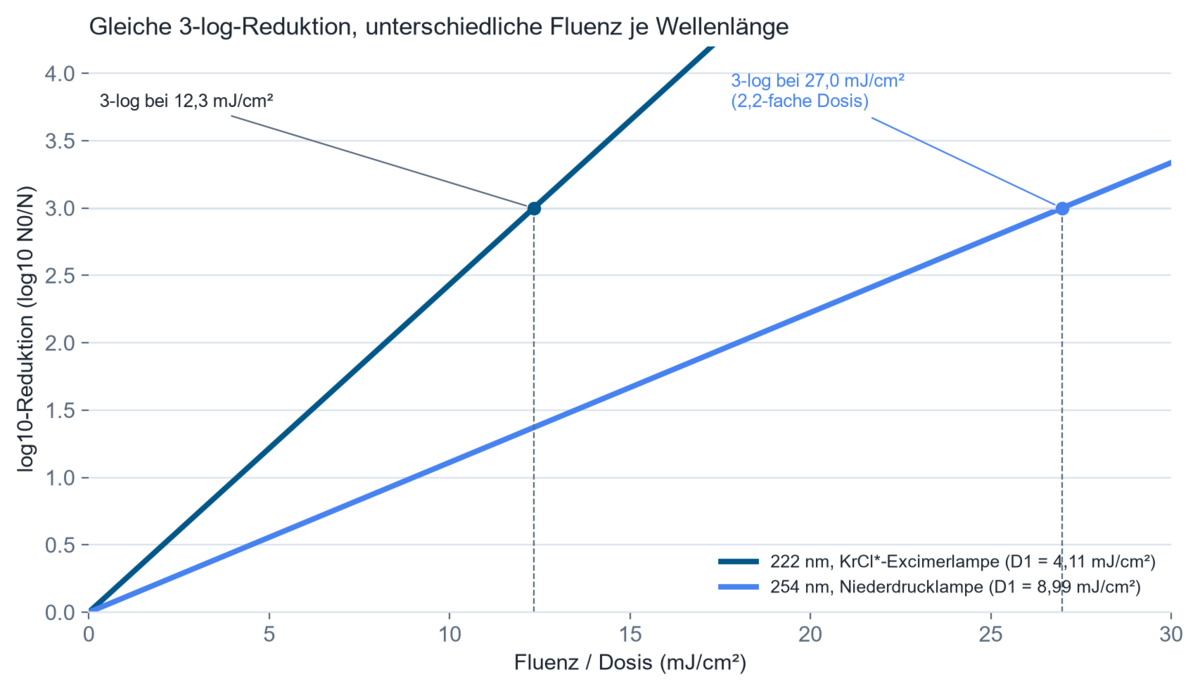
1. Assumptions. A study on the inactivation of antibiotic-resistant bacteria determined, for one test organism, a 1-log-reduction dose (D₁) of 4.11 mJ/cm² at 222 nm (KrCl* excimer lamp) and 8.99 mJ/cm² at 254 nm (low-pressure lamp) (RSC Environmental Science: Water Research & Technology, 2024). As a simplifying model assumption, this is extrapolated log-linearly.
2. Model. D(n-log) ≈ n · D₁ (valid only in the log-linear range, ignoring shoulder or tailing effects).
3. Calculation for an assumed 3-log reduction (99.9 %):
- 222 nm: D₃ ≈ 3 × 4.11 mJ/cm² = 12.3 mJ/cm²
- 254 nm: D₃ ≈ 3 × 8.99 mJ/cm² = 27.0 mJ/cm²
4. Result. In this particular experiment, the 254 nm source requires about 2.2 times the fluence of the 222 nm source for the same reduction.
5. Technical interpretation. The difference shows that the choice of radiation source directly affects the energetic and geometric design of a reactor. However, the values apply strictly to the organism and water matrix studied; carrying them over directly to other target organisms, real waters or technical plants without an own dose-response determination – for example via a collimated-beam test – is not technically justified.
Where is UV disinfection used?
Drinking water supply: UV disinfection is the only approved physical disinfection method for public water supply in Germany. The critical process quantity is the reduction equivalent fluence (REF) of the complete plant, which must be demonstrated by biodosimetry per DIN 19294 or DVGW W 294-1. The technology's relevance follows directly from the regulatory ban on chemical additives in this application.
Municipal and industrial wastewater and process-water treatment: here, UV disinfection and UV/H₂O₂ oxidation increasingly appear as a fourth treatment stage for trace-substance removal. The critical factor is the often lower and more variable UVT compared with drinking water, which calls for dynamic, UVT-dependent dose control.
Ultrapure water in semiconductor manufacturing and pharmaceuticals: process water with very high UVT places different demands on reactor design and material compatibility; here the photo-oxidative effect of UV on TOC reduction is often as relevant as disinfection itself.
Food and beverage industry: UVC is used for surface decontamination of packaging materials in aseptic filling and for treating clear liquids, an application area with points of contact to the Plants, Agriculture & Food Technology market page. The critical process quantity here is the actual irradiation of the relevant surface, taking geometry and conveyor speed into account, not lamp power.
HVAC and air disinfection: in-duct UVGI systems inactivate bioaerosols as air flows through the duct. What matters is residence time within the irradiation field as a function of air velocity and duct geometry; simple wall-sensor readings represent the actual fluence distribution along the flow only imperfectly (Luo & Zhong, 2022).
Medical technology and hospital hygiene: UVC robot systems and irradiation cabinets are used for terminal disinfection of rooms, instruments and surfaces – an application field closely related to the Medicine & Phototherapy market page. A critical factor is shadowing by furniture, equipment and complex object geometries, which does not occur in laboratory testing; studies show systematic deviations between controlled test conditions and real clinical operation (Casini et al., 2024).
Research, photobiology and biotechnology: bacteriophages are frequently used as surrogate organisms to characterise dose-response curves without having to work with pathogenic target organisms – see also the Photobiology & Biotechnology market page; the observed UVC sensitivity cannot be predicted from taxonomic relatedness of the phages alone (Schubert et al., 2023).
What helps with people present, turbid media and shadowed geometry?
For spaces with permanent human presence, far-UVC around 222 nm is being investigated, since penetration into human tissue is limited to a few micrometres by strong protein absorption and radiation is absorbed mostly in the outermost, already dead skin layer – personal protection and photobiological safety are covered in more depth under Safety of UV Disinfection. At the same time, far-UVC sources can generate ozone in air; current studies on individual lamps show no significant increase in ozone or particulate matter in the room, but also point to open questions about long-term effects at higher fluences (PLOS ONE, 2025). For strongly turbid or strongly absorbing media, where conventional UV reactors reach the limits of their design, UV processes are often combined with upstream filtration or membrane technology to ensure adequate UVT. For surfaces with complex three-dimensional geometry, where fixed lamp arrangements cause shadowing, mobile systems with several irradiation positions or robot systems are used, whose actual effectiveness in field use should be demonstrated separately – not only in laboratory testing.
Which quantities need to be measured or monitored?
Measurement requirements follow from the specific application, not the other way round. The quantities that must generally be captured are irradiance at the relevant process location, the UV transmittance of the medium (for water applications) and – for changing or polychromatic sources – the spectral distribution of the radiation.
A broadband measurement is sufficient when the source is known, spectrally stable and largely monochromatic, as with established low-pressure lamp installations with a defined ageing behaviour – a calibrated UVC sensor is suitable here. As soon as several source technologies are compared, a polychromatic source is involved, or spectral shift due to ageing needs to be documented, a spectral measurement with a spectroradiometer such as the SR900 becomes necessary, since a broadband sensor cannot resolve different wavelength components separately. For guidance on choosing the right sensor per source technology, see Selecting UV Sensors and How UV Sensors Work.
Spatially resolved measurements become necessary when the fluence distribution within a reactor, air duct or irradiation cabinet is itself the subject of investigation – for example when validating new reactor geometries. Time-resolved measurements (long-term monitoring) are relevant for detecting lamp ageing and fouling of protective sleeves early, before the target dose is undershot.
Permanently installed, digital sensors such as the PLC.D series handle this ongoing monitoring in technical plants and transmit not only the current reading, but also sensor type and calibration status to the control system. This information enables process control that goes beyond simple threshold monitoring: instead of a fixed exposure time, the controller can end exposure once a defined target dose is reached – a principle implemented, for example, by the UV-MAT dose control in irradiation chambers – so that lamp ageing does not directly affect the applied dose. Combined with flow and UVT measurement, dynamic dose control (dose pacing) can be realised, in which the plant adapts lamp power or the number of active modules to fluctuating water quality and flow rates instead of running a fixed, worst-case-oversized output. For documenting biological test series and regulatory evidence, reading, calibration status, sensor position, distance, sample geometry and exposure time must all be recorded together, since only this combination allows a traceable reconstruction of the applied dose.
Relevant measurement uncertainties concern traceability of calibration to national standards, the angular response of the sensor (cosine error at non-perpendicular incidence) and the temperature dependence of sensor responsivity. Qualified testing of drinking-water plants requires standard-compliant reference sensors whose requirements are set out in DIN 19294 and ÖNORM M 5873 respectively, and which must be designed differently depending on lamp type (low-pressure or medium-pressure). For the initial determination of a dose-response relationship for a target organism, a collimated-beam test with defined sample geometry and known irradiated area provides the controlled reference conditions that a pure system measurement cannot offer.
What do customer publications show?
Under the theme UV disinfection, the customer-publications overview currently lists 16 works examining UV and UVC radiation in a disinfection context. A recent study tested the effectiveness of UVC irradiation against the Mpox virus on contaminated surfaces and thereby provides pathogen-specific data for a virus for which few UV dose-response data existed so far.
UV-C Irradiation Effectiveness on Mpox-Virus-Contaminated Surfaces. Gidari, Anna, et al. Pathogens, 15(1), 2026, Art. 78. DOI
Another study compared the same UVC robot system under controlled laboratory conditions and in real hospital operation, illustrating how far laboratory figures and field conditions can diverge.
Antimicrobial efficacy of an experimental UV-C robot in controlled conditions and in real hospital scenario. Casini, Beatrice, et al. Journal of Hospital Infection, 2024. PubMed
A study testing germicidal treatment cabinets and carousels used a bacteriophage as a surrogate organism and visualised the spatial dose distribution inside the cabinet – relevant for assessing shadowing effects.
An Assessment of Germicidal Ultraviolet Treatment Cabinets and Carousels Using a Bacteriophage Surface Challenge. Brookes, Jodi, et al. Applied Biosafety, 28(4), 2023, pp. 242–255. PubMed
A study on the genetic diversity of lactococcal bacteriophages investigated whether their relatedness allows predictions about UVC susceptibility, providing direct evidence for the organism-specific nature of the dose-response curve.
Does the high biodiversity of lactococcal bacteriophages allow predictions about their different UV-C susceptibilities? Schubert, Christina, et al. International Journal of Food Microbiology, 401, 2023, Art. 110274. PubMed
A modelling study developed and validated an improved mathematical irradiance model for in-duct UVGI applications, illustrating how far fluence and surface readings can diverge in air ducts.
Development and experimental validation of an improved mathematical irradiance model for in-duct ultraviolet germicidal irradiation applications. Luo, Hao, and Lexuan Zhong. Building and Environment, 226, 2022, Art. 109699. ScienceDirect
A study on the decontamination performance of a dielectric-barrier discharge (DBD) with a UVC-emitting phosphor describes an alternative, low-mercury source technology alongside conventional lamps and LEDs.
Decontamination efficiency of a DBD lamp containing an UV-C emitting phosphor. Caillier, Bruno, et al. Photochemistry and Photobiology, 91(3), 2015, pp. 526–532. PubMed
Further use cases by topic are listed in the overview Customer Publications – by Topic.
Technical background and further reading
- DVGW worksheet W 294-1 (December 2023): Planning, operation and monitoring of UV disinfection plants in water supply. DVGW
- DIN 19294-1 to -4 (2020/2026): Devices for disinfecting water using ultraviolet radiation – requirements and testing. DVGW-Regelwerk
- US EPA: Ultraviolet Disinfection Guidance Manual (UVDGM) and UV Treatment Toolkit, 2006/2022. US EPA
- ISO 15858:2016, UV-C Devices – Safety information – Permissible human exposure. ISO
- IEC 62471-6:2022, Photobiological safety of lamps and lamp systems – Part 6: Ultraviolet lamp products. IEC
- IUVA: Far UVC Radiation for Disinfection of Air and Surfaces – scientific statement on 222 nm applications. IUVA
- A complete overview of the applicable UV standards by country and lamp type is maintained at Guidelines, Standards and Norms in UV.
FAQ on UV disinfection
How does UV disinfection work technically?
UVC radiation is absorbed by nucleic acids in micro-organisms and produces photochemical damage, in particular pyrimidine dimers in DNA or RNA. This damage prevents replication and reproduction without necessarily destroying the cell immediately. The effect is not a chemical reaction but a physical-photochemical process, with no additives in the treated medium.
Which wavelength is best suited to UV disinfection?
The range around 260–265 nm, the absorption maximum of the bases, is the most effective against nucleic acids. Conventional low-pressure lamps emit almost monochromatically at 253.7 nm, close to this optimum. UV LEDs and far-UVC sources at 222 nm show partly different, organism-specific action profiles and require their own, wavelength-specific dose-response evidence before practical use.
What dose is required for a given log reduction?
There is no universal dose. The required fluence depends on the target organism, the water matrix, the wavelength and the desired reduction. Reliable values come from collimated-beam tests with the specific target organism under defined sample geometry, not from generic tables for other applications or organisms.
What is the difference between irradiance, dose and fluence?
Irradiance is radiant power per area at a given moment. Dose (exposure) is its time integral over a fixed area geometry. Fluence additionally refers to an object that can receive radiation from all directions – relevant for organisms in three-dimensional radiation fields such as reactors or air ducts. The formal definitions of irradiance, radiant exposure and fluence are given under radiometric quantities.
Why does a UV plant not work reliably despite adequate lamp power?
Common causes are falling UV transmittance of the medium, fouling of protective sleeves, unfavourable flow distribution with short residence times on some paths, or a measurement position that does not reflect the actual fluence at the process location. Electrical power alone is no proof of adequate disinfection performance – it is merely an operating parameter of the source. The underlying definitions and units are listed in the overview of radiometric quantities.
How is the UV dose measured and monitored in a plant?
For known, stable sources, calibrated broadband sensors at defined measurement positions are sufficient. For polychromatic sources or when comparing several source technologies, a spectral measurement with a spectroradiometer is required, since a broadband sensor cannot separate wavelength components. Drinking-water plants require standard-compliant reference radiometers per DIN 19294 or ÖNORM M 5873.
Which technology suits which application?
Low-pressure and amalgam lamps dominate large-volume water disinfection with established standards. Medium-pressure lamps suit high throughputs and oxidation processes. UV LEDs are advantageous for small flow rates, point-of-use applications and wherever mercury-free operation is required. Far-UVC is still in the research and validation phase for applications in occupied spaces.
Why is electrical lamp power not a suitable indicator of disinfection performance?
Several loss mechanisms lie between electrical power draw and the fluence effective at the organism: electro-optical efficiency of the source, spectral composition, geometric distribution within the reactor and absorption in the medium. Only the actually measured or validated fluence at the target is a reliable process quantity – not the datasheet value of the lamp.
Related application fields
This application is closely related to adjacent fields of optical radiation metrology – for example Photobiology & Biotechnology (bacteriophages as surrogate organisms, general dose-response characterisation), Medicine & Phototherapy (UVC robot systems in hospital hygiene), and Plants, Agriculture & Food Technology (surface decontamination of packaging and food).
Author: Dr. Mark Paravia
Dr.-Ing. Mark Paravia is the managing director of Opsytec Dr. Gröbel GmbH in Ettlingen and heads the accredited calibration laboratory. Following his research on pulsed xenon excimer discharges at the Institute of Lighting Technology at KIT, his current focus is on optical radiation measurement technology. He is a recognized UV expert, vice-chair of the DIN Standards Committee FNL 7 “Optical Radiation,” and a member of the DVGW Project Group on UV Disinfection.
Does the fluence actually reaching the organism match your target dose?
Unsure whether the irradiance measured at the sensor actually corresponds to the fluence your target organisms receive in the reactor or air duct? A reliable answer requires a measurement and validation strategy matched to the application and source technology – from spectral characterisation with the SR900 to standard-compliant reference measurement with the RMD Pro. Talk to us about your plant or testing task.