

Radiometric quantities with symbols and units
Radiometric quantities describe electromagnetic radiation in energetic terms, independently of the sensitivity of the eye – in technical use above all UV and IR radiation. The four basic quantities are radiant flux Φ in watts, irradiance E in W/m² or mW/cm², radiance L and radiant intensity I. The field is called radiometry; the eye-weighted counterparts are the photometric quantities.
Radiometric quantities are measured quantities that refer to the total electromagnetic radiation. In technical applications, this is used as UV radiation or IR radiation. The field is called radiometry. Radiation is classified according to the wavelength of the radiation.
The following diagram shows the four radiometric quantities. The table contains a visual representation, mathematical definition, unit and brief explanation for each quantity.
- Radiant flux Φ
- Irradiance E
- Radiance L
- Radiant intensity I

Definition and explanation of radiometric measurands
Radiant flux
Radiant flux , also known as radiant power, is the total amount of energy emitted by a radiation source in all directions per unit of time. The unit of radiant flux is the watt (W).
- Formula symbol: Φ
- Unit: W
- Definition: The total emitted radiant power.
Example:
A standard incandescent lamp with a power consumption of 60 watts emits around 57 watts as radiant flux, with the rest being lost as heat. These 57 watts are distributed across the visible and infrared spectrum.
The radiation flux is measured in an integrating sphere.
Irradiance
Irradiance is a physical quantity that describes the power density of the radiation hitting a surface. It is defined as the radiant power per area incident on a surface element. The unit of irradiance is watts per square meter (W/m²) or milliwatts per square centimeter (mW/cm²). A UV meter is suitable for measuring the irradiance.
- Formula symbol: E
- Unit: W/m², mW/cm²
- Definition: The radiation hitting a surface element regardless of the direction.
The irradiance indicates how much energy in the form of radiation falls on a certain surface per unit of time. It does not matter from which direction the radiation comes.
Tip: Convert W/m² to mW/cm²
Example:
The average irradiance of the sun on the earth's surface on a clear day is around 1000 W/m². This means that every square meter of the earth's surface receives 1000 watts of radiation.
The irradiance is measured with a radiometer.
Radiance
Radiance is a physical quantity that describes the radiant power emitted by a radiation source per unit area and per unit solid angle. It is measured in watts per square meter per steradian (W/(m²-sr)).
- Formula symbol: L
- Unit: W/(sr m²)
- Definition: Quotient of radiated radiant flux and the product of surface element and solid angle.
The radiance takes into account both the area of the radiation source and the solid angle at which the radiation is emitted.
Example:
The sun has a high radiance because it emits a large amount of radiant energy into space over a relatively small area.
Radiant intensity
Radiant intensity is a physical quantity that describes the flow of radiation in a particular direction per unit solid angle. It is used to indicate the intensity of radiation in a specific direction. The unit of radiant intensity is watt per steradian (W/sr).
- Formula symbol: I
- Unit: W/sr
- Definition: Quotient of radiated radiant flux in a defined direction and the solid angle element.
The radiant intensity describes the amount of energy emitted by a radiation source in a specific direction within a solid angle. It is a measure of the directional dependence of the radiated power.
Example:
An LED with an output of 1 watt could have a radiant intensity of 10 W/sr if it emits the light at a solid angle of 0.1 sr. This means that the emitted energy is strongly concentrated on a small solid angle.
Convert radiometric quantities
Radiometry Calculator for UV and Light:
Easily convert irradiance, dose and exposure time. Try it now!
Convert radiometric quantities online
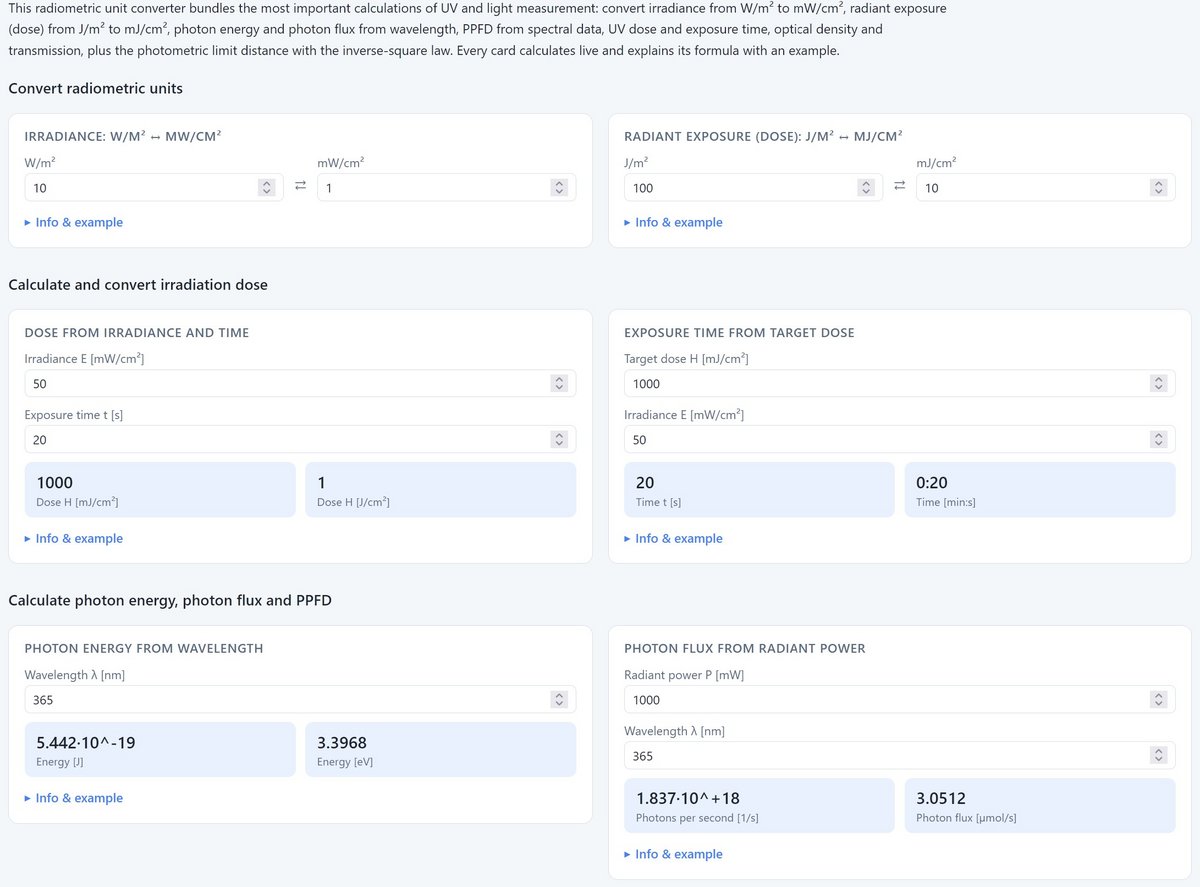
The quantities explained on this page can be converted directly with the Radiometry Calculator: irradiance between W/m² and mW/cm², radiant exposure (dose) between J/m² and mJ/cm², and dose and exposure time from one another. Free to use and without registration.
Frequently asked questions on radiometric quantities
What is the difference between irradiance and dose?
Irradiance E (W/m² or mW/cm²) is the instantaneous power per unit area; radiant exposure – colloquially the dose – is its integral over time, H (J/m² or mJ/cm²). At constant irradiance, H = E · t. Irradiance determines how quickly a dose is reached; whether the intended effect occurs is usually decided by the dose. Both quantities therefore belong in the documentation separately – a time alone is not evidence.
What distinguishes fluence from dose?
Radiant exposure refers to a fixed, flat receiving surface and weights obliquely incident radiation with the cosine of the angle of incidence. Fluence, by contrast, refers to an object that can receive radiation from all directions – a microorganism in a reactor or an air duct, for instance. In a directed radiation field the two agree; in a diffuse field the fluence can be considerably larger than the exposure measured on a plane. Where this difference decides the process is shown in UV disinfection.
Why is the electrical lamp power not a measurand?
Between the electrical power drawn and the effect at the process location lie the electro-optical efficiency, the spectral distribution of the source, distance and angle of incidence, the transmittance of windows and protective sleeves, and contamination and ageing. None of these is constant over the service life. The power rating therefore describes the operating state of the source, not the result at the workpiece, the organism or the sample. How this becomes a reliable process release in a plant is covered by automation and process integration.
What distinguishes irradiance from radiance?
Irradiance is a receiver quantity: it describes what arrives on a surface, regardless of direction. Radiance is a source quantity: it describes what a source emits per unit area and solid angle. Releasing a process depends on the irradiance at the point of action; assessing extended sources under IEC 62471, by contrast, depends on radiance – see occupational safety and photobiological safety.
When is a broadband measurement enough and when is a spectral measurement needed?
A broadband measurement is sufficient if the source is known and spectrally stable and the sensor was calibrated against that very source. A spectral measurement is required as soon as different source technologies are compared, the spectrum shifts through ageing or dimming, an action spectrum has to be applied, or several spectral bands have to be assessed separately. The underlying error is spectral mismatch.
Downloads
Author: Dr. Mark Paravia
Dr.-Ing. Mark Paravia is the managing director of Opsytec Dr. Gröbel GmbH in Ettlingen and heads the accredited calibration laboratory. Following his research on pulsed xenon excimer discharges at the Institute of Lighting Technology at KIT, his current focus is on optical radiation measurement technology. He is a recognized UV expert, vice-chair of the DIN Standards Committee FNL 7 “Optical Radiation,” and a member of the DVGW Project Group on UV Disinfection.