

UV irradiation in plant cultivation, agriculture and food technology
In plant cultivation and food technology, UV radiation is not a blanket tool but an intervention with a narrow effective window: too little has no effect, too much damages tissue or quality traits. More radiation does not automatically mean more effect – plants have response thresholds, acclimate to recurring exposure and actively repair damage. A treatment only becomes reproducible once wavelength, dose, dose rate, developmental stage and irradiation geometry are documented together. The central physical quantities are the spectral irradiance at the actual site of action, the resulting dose and – for microbiological and plant-physiological endpoints – the wavelength-dependent biological effectiveness of individual photons. Without traceable optical measurement, any observation remains only partially comparable.
How is the market for UV applications in agriculture and food technology developing?
No uniformly defined overall market exists for “UV in plant cultivation, agriculture and food technology,” since UV radiation is used here simultaneously as a growth stimulus, a physical crop-protection measure and a food hygiene process. More reliable figures come from closely related, clearly defined sub-markets that serve as indicators of the underlying technological momentum.
The vertical farming market, in which controlled light environments with a UV component are increasingly used, was estimated at around USD 9.6 billion in 2025 and is projected to grow to roughly USD 39.2 billion by 2033 – an annual growth rate of about 19.3 percent between 2026 and 2033 (Grand View Research, 2025). The broader horticultural lighting market, covering LED and other lighting technology for greenhouse and indoor cultivation, stood at around USD 6.26 billion in 2024 and is expected to reach roughly USD 29.1 billion by 2033, a CAGR of about 18.9 percent (Grand View Research, 2025). Within this lighting segment, the UV LED sub-market is developing on its own trajectory: valued at around USD 1.23 billion in 2025 and projected to reach roughly USD 2.16 billion by 2030 (CAGR about 11.9 percent) (MarketsandMarkets, 2025). For postharvest hygiene, the adjacent UV disinfection equipment market is also relevant, valued at around USD 5.63 billion in 2025 (Fortune Business Insights, 2025).
Technically, this growth means two things above all: first, the light source is shifting from broadband discharge lamps to narrowband, individually controllable UV LED arrays, which considerably simplifies the targeted study of individual wavelength bands in plant physiology and crop protection. Second, the growing number of controlled cultivation systems – greenhouses, vertical farms, growth chambers – increases the need for reproducible, documented dose control, because the UV environment there is fully determined by the facility and must therefore be metrologically traceable.
On the regulatory side, the European Union has repeatedly extended the marketability of UV-treated foods: after the first approval of UV-treated culinary mushrooms as a novel food (Commission Implementing Decision (EU) 2017/2355), an extension of the permitted application quantities followed (Commission Implementing Regulation (EU) 2018/1011), and most recently the approval of vitamin D2 mushroom powder from UV-treated mushrooms (Commission Implementing Regulation (EU) 2025/691). In the United States, 21 CFR 179.39 governs the use of UV radiation for processing and treating food, including pasteurization of fruit and vegetable juices. Both frameworks presuppose a documented, traceable irradiation – a plain time or lamp power rating is not sufficient.
The shift from mercury lamps to UV LEDs is changing not only cost and efficiency structures but also methodological possibilities: LED arrays provide several wavelengths simultaneously and independently controllable, so dose-response relationships can now be determined directly and experimentally by varying the excitation wavelength, rather than working with only a few fixed lamp lines. The establishment of excimer sources around 222 and 282 nm opens up new applications for selective effects, since their narrow spectral bandwidth allows a targeted separation of photodamage and photoreception. On the regulatory side, the European Union continues to expand the permitted applications of UV-treated foods – most recently with the 2025 approval of vitamin D2 mushroom powder (Commission Implementing Regulation (EU) 2025/691) – which structurally requires more documented, traceable dose measurement in food production. In physical crop protection, the focus is shifting from purely chemical-free alternatives to integrated concepts that combine UV-B irradiation with biological control, for example the simultaneous use of predatory mites and nightly UV-B application against spider mites.
How does UV radiation act on plant and microbial material?
UV radiation acts through two parallel mechanisms: photodamage and regulated photoreception. Photodamage occurs when UV-B or UV-C photons are absorbed directly by nucleic acids, aromatic amino acids or other chromophores and thereby alter covalent bonds, for example by forming cyclobutane pyrimidine dimers in DNA. Photoreception, by contrast, is a controlled signalling response: higher plants possess a specific UV-B photoreceptor, UVR8 (UV RESISTANCE LOCUS 8), whose chromophore is formed from several tryptophan residues – chiefly Trp285. Absorption of a UV-B photon triggers the near-instantaneous monomerisation of the UVR8 homodimer; the monomer binds COP1, the central regulator of light signalling, and thereby initiates a gene-expression cascade that upregulates, among other things, flavonoid synthesis and DNA-repair pathways (Rizzini et al., 2011, Science). In microbial inactivation during postharvest hygiene, by contrast, direct photochemical DNA damage to the target organism dominates, without a regulated repair pathway such as UVR8. Which mechanism prevails depends on wavelength, target organism and dose: UV-A acts mainly via oxidative stress as a secondary effect, UV-B via both mechanisms simultaneously, UV-C almost exclusively via direct photodamage.
Which technologies and light sources are used?
A range of source technologies is available for controlled UV irradiation of plants, mushrooms and food, differing in bandwidth, wavelength range, pulse operation and ageing behaviour.
Low-pressure mercury lamps emit near-monochromatically at 253.7 nm and are traditionally used for UV-C applications in postharvest disinfection. Medium- and high-pressure mercury lamps deliver a broadband line spectrum from UV-B into the visible range and are suited to large-area irradiation in research chambers and greenhouses. UV LEDs are narrowband, switch almost instantaneously, are mercury-free and can be combined into arrays covering several wavelengths, which greatly simplifies recording dose-response relationships and makes them the preferred source for UV priming trials and vertical-farming applications. Excimer lamps, for example based on krypton chloride (222 nm) or krypton bromide (282 nm), emit quasi-monochromatically with low scattering losses and are increasingly used for selective action-spectrum research. Xenon flash lamps (pulsed light) deliver a broadband, pulsed spectrum with a high UV-C share at very short exposure times and low thermal load on the sample; they are mainly used for surface decontamination of packaging and in beverage filling (Claranor; Fraunhofer IVV).
| Technology | Characteristics | Advantages | Limitations | Typical application |
|---|---|---|---|---|
| Low-pressure mercury lamp | Quasi-monochromatic, 253.7 nm | High UV-C efficiency, established, low cost | Mercury content, ageing, ignition delay | Postharvest disinfection, surface decontamination |
| Medium-/high-pressure mercury lamp | Broadband line spectrum, UV-B to Vis | High total output, large areas can be irradiated | Strong heat generation, difficult to filter | Greenhouse irradiation, research chambers |
| UV LED (UV-A/UV-B/UV-C) | Narrowband, multiple wavelengths combinable | Low thermal load, fast switching, dimmable, mercury-free | Lower single-unit output than discharge lamps, wavelength-dependent temperature drift | UV priming, action-spectrum studies, vertical farming |
| Excimer lamp (e.g. KrCl*, 222 nm; KrBr*, 282 nm) | Quasi-monochromatic, short wavelength | Defined single wavelength, low scattering losses | Limited power density, special optics/power supplies | Selective action-spectrum research, surface decontamination |
| Xenon flash lamp (pulsed light) | Broadband, pulsed, high UV-C share | High peak output at short exposure time | Pulse shape affects the outcome, calibration effort | Packaging and surface decontamination |
Which process parameters are decisive?
The effect of a UV treatment is not determined by a single quantity but by the interplay of several physical parameters that must be recorded separately.
Irradiance (in W/m² or mW/cm²) describes the radiant power incident on a surface and determines how quickly a dose is reached. Dose, or radiant exposure (in J/m² or mJ/cm²), is the time integral of irradiance and the quantity usually correlated with a biological effect such as a priming response, log-reduction of a microorganism or tissue damage. Spectral irradiance (W/(m²·nm)) is the starting quantity whenever several wavelengths are to be compared or combined, since every weighted quantity can be derived from it, but not the reverse. Dose rate matters independently of total dose because biological repair, stimulus-perception and transport processes run on their own time scales and can therefore respond differently to the same total value depending on whether it is delivered briefly and intensely or over a long period at low intensity. Photosynthetic photon flux density (PPFD, µmol·m⁻²·s⁻¹) describes the visible portion of the irradiation and matters because growth conditions such as temperature, nutrient supply and background lighting co-determine the observed UV response. Developmental stage and irradiation geometry – distance, angle of incidence, uniformity across the treated area – round out the list of quantities that must be recorded separately for reproducible documentation.
What limits the process or causes errors?
A common mistake is equating electrical lamp power with optical dose at the site of action. Between the lamp and the target structure lie distance, possibly a protective screen, the leaf or fruit surface and – in dense stands – neighbouring plant parts; each of these layers attenuates the radiation in a wavelength-dependent way. A measurement at the lamp position therefore describes the source, not the actual exposure of the target.
Equally common is the assumption that stating a time alone is sufficient documentation. Under the Bunsen–Roscoe reciprocity law, the product of irradiance and time is constant for purely photochemical processes; for biological systems, however, this reciprocity holds only within a limited intensity and time window whose boundaries differ by endpoint and organism. For UV-B-induced mortality of the spider mite Tetranychus urticae, reciprocity has been experimentally confirmed over a wide intensity range (Murata & Osakabe, 2013, Journal of Insect Physiology) – the law is therefore not fundamentally invalid for biological endpoints, but must be checked separately for each organism and wavelength. Independently of this, repair mechanisms, oxygen replenishment and mass transport can proceed on their own time scales, so the same dose delivered at high irradiance over a short time can produce a different outcome than the same dose at low irradiance over a long time. Anyone comparing trial series should therefore state irradiance, time and dose separately, rather than treating a shorter exposure at higher intensity as a neutral conversion.
A third, often underestimated point is photoreactivation: many organisms can enzymatically repair UV-induced DNA damage upon subsequent exposure to UV-A or blue light. This effect explains why threshold doses determined under laboratory conditions cannot be transferred without verification to the field or to a greenhouse with different background lighting – a point explored quantitatively in the worked example in this section. A fourth, systematically underestimated effect is product geometry: irregularly shaped produce receives the full dose only on exposed surfaces, while recesses, stem attachments and contact surfaces remain shaded; rotation, a defined distance and multi-sided irradiation are therefore necessary parts of process development. For liquids, transmission instead governs the outcome: clear products can be irradiated through, while turbid or strongly absorbing media often limit the usable layer thickness to a few millimetres.
What influence do leaf structure, pigments and irradiation geometry have?
The leaf epidermis is the most effective natural UV filter of higher plants. In a study of 25 plant species under natural sunlight, epidermal transmittance for UV radiation (280–400 nm) was below 5 percent for more than half of the species; UV-absorbing flavonoids and related pigments in the epidermis accounted for 20 to 57 percent of the attenuation in 16 of the species studied (Robberecht & Caldwell, 1978, Oecologia). This filtering effect is not constant but is itself UV-induced: via the UVR8 pathway, a preceding UV-B exposure increases flavonoid synthesis and thereby lowers epidermal transmittance for subsequent irradiation – a plant stand therefore does not respond linearly to repeated UV doses, but with a self-reinforcing shielding effect. For trial design and practical application, this means a dose calibrated on one leaf or stand tends to lose effectiveness under continued treatment unless it is readjusted.
At the canopy level, canopy architecture adds a further factor: leaf angle, leaf density and growth direction determine what proportion of the leaf area receives direct irradiation and what proportion remains shaded – in dense stands, this effect can be larger than the underlying spectral action function itself. In postharvest treatment and food, a structurally related but technically different issue applies to product geometry and transmission through packaging or liquid, as described in the previous section. In both cases the consequence is the same: an irradiance specified at the source says little about the dose actually effective at the biologically relevant site without knowledge of the attenuation caused by tissue, pigments or geometry.
The reciprocity law and its limits in plant and pest biology
The Bunsen–Roscoe reciprocity law describes the simplest relationship between irradiance and exposure time for photochemical processes:
H = E · t
Here H is the dose (J/m²), E the irradiance (W/m²) and t the exposure duration (s). The law assumes that the photochemical reaction depends only on the cumulative photon count and is disturbed neither by repair processes nor by saturation effects within the intensity and time window under consideration. For UV-B-induced mortality of the spider mite Tetranychus urticae, this reciprocity has been confirmed over an irradiance range of 0.19 to 0.58 W/m² – and for eggs down to as low as 0.014 W/m² – with mortality probability correlating linearly with cumulative UV-B irradiance, independent of the intensity applied (Murata & Osakabe, 2013, Journal of Insect Physiology). The practical consequence: within the tested range, a target dose can be reached through different combinations of irradiance and time without changing the effect.
The model does, however, have an important limitation that must not be confused with a violation of reciprocity: it describes only the relationship between irradiance and time within a given exposure situation, not the transferability of a threshold dose determined in the laboratory to other light conditions.
Worked example: why does the effective UV-B dose against spider mite eggs differ between laboratory and field?
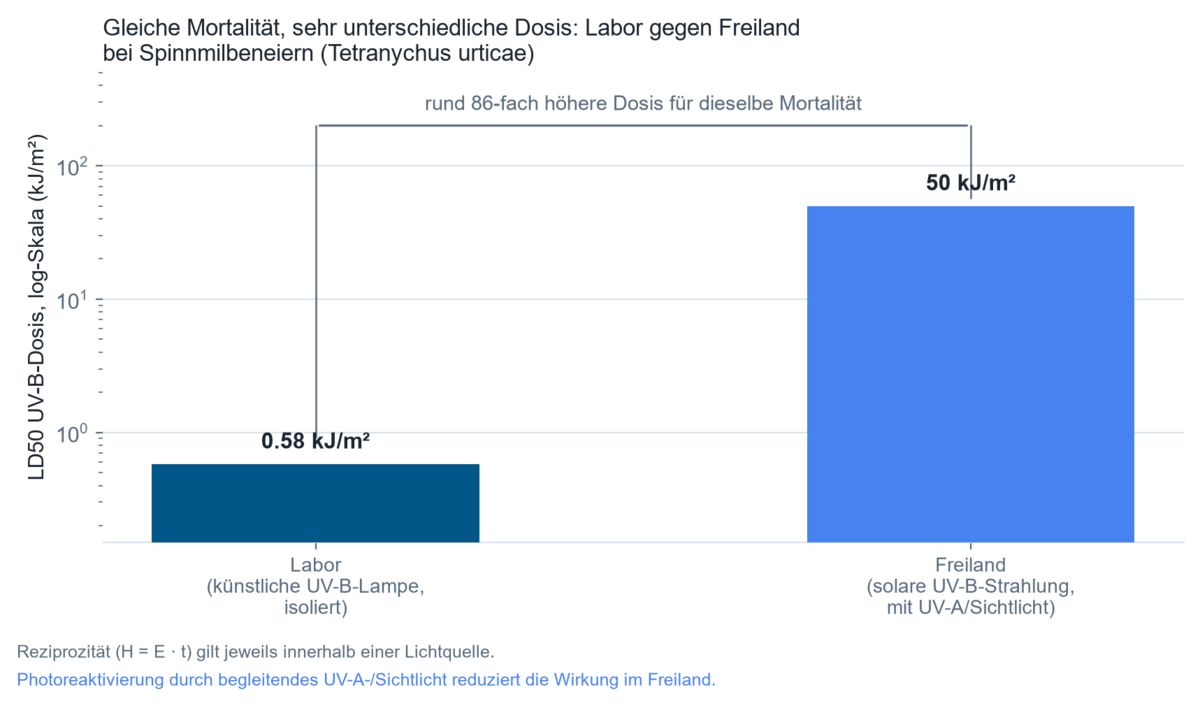
Question. In the same study, an LD50 of 0.58 kJ/m² was determined for spider mite eggs under an artificial UV-B lamp. An earlier field trial with solar UV-B radiation had produced an LD50 of about 50 kJ/m² for the same endpoint. How large is the difference, and why does it occur despite valid reciprocity?
1. Assumptions. LD50(laboratory, artificial UV-B lamp) = 0.58 kJ/m²; LD50(field, solar UV-B radiation) ≈ 50 kJ/m² (Murata & Osakabe, 2013).
2. Model. Ratio of the two doses; no reciprocity formula is needed since both values are already integrated doses.
3. Calculation. 50 kJ/m² ÷ 0.58 kJ/m² ≈ 86.
4. Result. Under solar radiation, a roughly 86-fold higher cumulative dose was required to produce the same mortality as under the artificial UV-B lamp in the laboratory.
5. Technical interpretation. The authors attribute this difference to photoreactivation – a repair mechanism activated by accompanying UV-A and visible light that is active in the field but not in isolated laboratory irradiation. The example shows that reciprocity within one light source says nothing about the transferability of a dose-response relationship to a spectrum with different accompanying radiation. For practically relevant applications – such as UV-B crop protection in a greenhouse – threshold doses must therefore be determined under the actual irradiation environment, including background light.
Where is UV irradiation used in plant cultivation, agriculture and food technology?
Plant physiology and basic research: UV-B and UV-A trigger, via UVR8, signalling pathways that control pigment formation, antioxidant systems and the synthesis of secondary metabolites. The critical process parameter here is the separate documentation of wavelength, irradiance and developmental stage, since the same dose acts differently at different growth stages. For ornamental and crop species where quality is driven by secondary metabolites – cannabis flowers, for example – comparisons of several UV spectra and intensities on the same stand show that the effects of wavelength and intensity can be separated (Huebner et al., 2024, Frontiers in Plant Science).
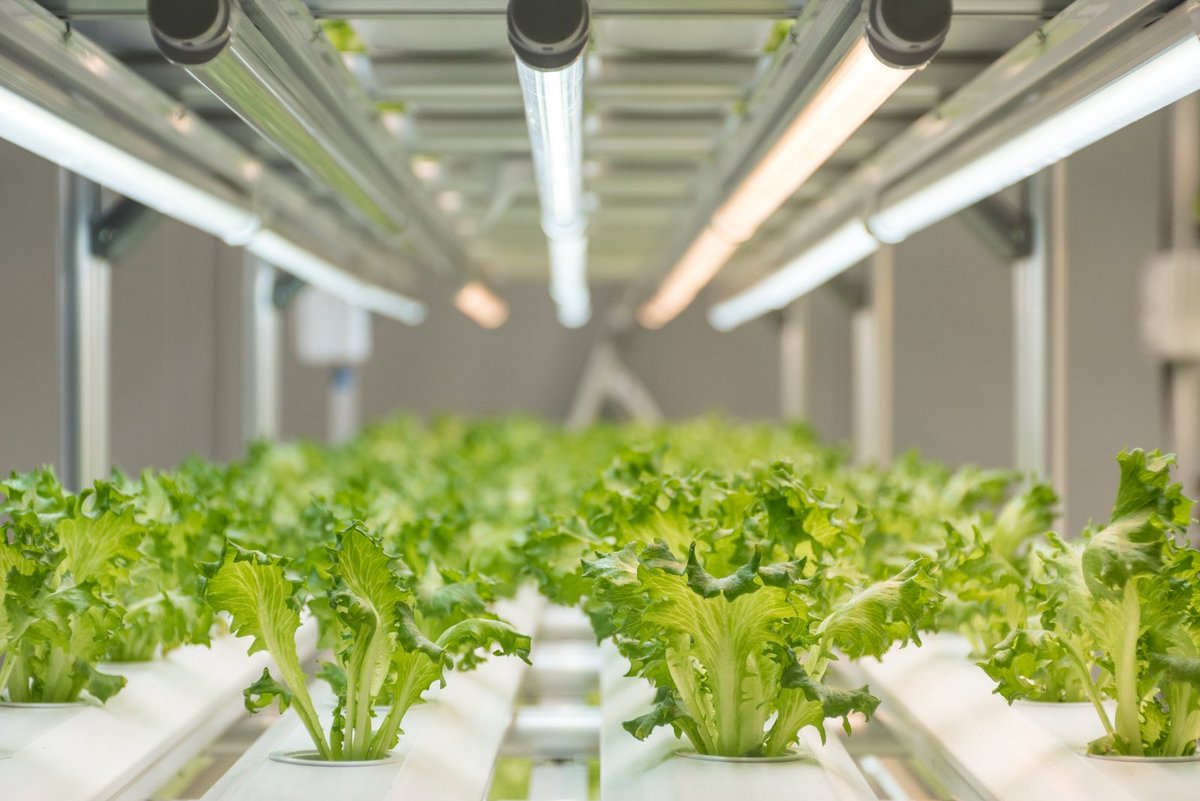
Controlled cultivation systems (vertical farming, growth chambers, greenhouses): in fully controlled light environments, UV is increasingly used as a plannable growth and quality factor rather than merely a by-product of natural sunlight. The critical requirement is jointly capturing UV content and visible, photosynthetically active radiation, since both jointly determine the observed plant response.
UV priming: a controlled UV-B or UV-C pretreatment can increase later stress tolerance to drought or pathogens, for example in stress-sensitive rice seedlings. What is critical is reproducibility over weeks, seasons or years, since ageing lamps without dose-controlled irradiation or regular radiometric checks systematically deliver different doses than at the start of a trial.
Physical pest management (integrated pest management): UV-B is used specifically to suppress pests and fungal diseases without chemical agents. Applying UV-B at night suppresses powdery mildew on cucumber, strawberry and other crops more effectively than daytime application, because fungal photoreactivation by daylight does not occur during the dark phase (Suthaparan et al., 2016, Plant Disease). In parallel, UV-B combined with light-reflecting sheets can physically control the two-spotted spider mite in greenhouse strawberry crops (Tanaka et al., 2016, Journal of Economic Entomology). In both cases, timing of application – not dose alone – is critical, because photoreactivation effects are time-of-day- and wavelength-dependent.
Postharvest treatment and food safety: UV-C reduces surface microorganisms and pathogenic fungi on fruit, vegetables and raw materials such as cacao and coffee. A probabilistic dose specification instead of a fixed treatment time allows targeted inactivation of Colletotrichum while protecting product quality (Ahn et al., 2026, Food Control). The critical process parameter is product geometry, since irregularly shaped produce receives the full dose only on exposed surfaces.
Beverage and juice pasteurisation: in the United States, UV irradiation is approved under 21 CFR 179.39 for, among other things, reducing human pathogenic microorganisms in fruit and vegetable juices. Critical here is the transmission of the liquid: clear juices can be irradiated in thin films, while turbid products limit the usable layer thickness.
Culinary mushroom production: UV irradiation specifically raises the vitamin D2 content of culinary mushrooms such as Agaricus bisporus; in the EU this is approved as a novel food with defined application quantities (Commission Implementing Regulation (EU) 2018/1011; Commission Implementing Regulation (EU) 2025/691). Comparing artificial and natural irradiation is critical, since both can produce different ratios of vitamin D2 to undesirable co-products such as agaritine (Urbain, Valverde & Jakobsen, 2016, Plant Foods for Human Nutrition).
Packaging and filling: pulsed xenon flash-light systems decontaminate packaging surfaces and containers without chemicals or water, particularly for chilled or acidic products (Fraunhofer IVV). Critical here is uniform illumination of three-dimensional packaging geometries, since shadowed areas can remain untreated.
How are irregular produce, turbid juices and dense plant canopies irradiated?
For irregularly shaped postharvest produce – root vegetables, mushrooms with a stem base, fruit with recesses – the full dose is reached only on exposed surfaces; rotation, a defined distance and multi-sided irradiation are necessary parts of the process. For liquids such as juices or liquid extracts, transmission governs the usable layer thickness: clear media can be irradiated in films several centimetres thick, while turbid or pigmented liquids often limit this to a few millimetres, which requires flow-based reactor geometries with a thin liquid film. For physical pest control in the greenhouse, light-reflecting sheets are used to increase irradiation of the leaf underside, where many pests preferentially reside. For dense plant stands in vertical farms, where individual leaf layers shade one another, multi-sided or surrounding irradiation systems are necessary, since single-sided illumination from above representatively captures only the uppermost leaf layer.
Which quantities must be measured or monitored?
The starting point for any measurement plan is which quantity is actually relevant for the given biological or microbiological endpoint – choosing the right UV sensor follows from wavelength range and application, not the other way round. If a single, well-characterised wavelength is used, a broadband radiometer with a matching sensor can be sufficient for routine monitoring. Once several wavelengths are to be compared or combined – for example when comparing UV content and visible lighting in growth chambers and greenhouses, the standard case in plant research – a spectral measurement of UV content and visible lighting with a spectroradiometer is required, since spectral information cannot be recovered from an integral reading.
Measurements should generally be taken at the actual target site – the leaf surface, fruit surface or product surface – not at the lamp position, since absorption by tissue, packaging or liquid would otherwise be systematically underestimated. Relevant measurement uncertainties arise from spectral mismatch between sensor response and source spectrum, from the angular dependence of sensor response under non-parallel incident light, and from calibration uncertainties of the reference standard. For large or spatially complex samples, a single measurement position is not enough; a grid across the treated area, from which maximum, minimum and mean values can be read, is the only way to show whether all samples in a batch were treated comparably. Time-resolved measurements become necessary once lamps age over weeks or months or their spectrum drifts – an effect more pronounced in gas discharge lamps than in UV LEDs, where it is instead replaced by irradiance- and temperature-dependence of the wavelength.
In automated postharvest and packaging lines, a one-time setting of lamp power and exposure time is not sufficient, because the actual irradiance changes continuously through lamp ageing, reflector fouling and temperature drift. Dose-controlled operation continuously measures irradiance with a calibrated sensor and automatically ends exposure once the target dose is reached, rather than switching off after a fixed time. For probabilistic dose specification in postharvest disinfection – for instance inactivating Colletotrichum in cacao and coffee processing – the target dose is defined not as a fixed value but as a statistically secured lower bound that guarantees a defined inactivation probability despite variable product geometry (Ahn et al., 2026).
For physical crop protection in the greenhouse, research on mildew suppression explicitly shows that application frequency, timing and automation of UV-B application jointly determine effectiveness (Suthaparan et al., 2016, Plant Disease): automated, time-controlled night-time applications require reliable sensor feedback, since an identical dose applied during the day can show reduced effect due to competing photoreactivation. In regulated environments – for example when producing UV-treated foods under the EU and FDA rules mentioned above – traceable, documented logging of each individual dose is additionally relevant, to make batch comparisons verifiable after the fact.
In practice, UV metrology for defined dose control in irradiation chambers with a selectable spectral range is well suited to creating defined exposures for plant, fungal and food trials; dose-controlled irradiation decouples the trial outcome from lamp ageing and makes trial series comparable over long periods. For routine measurements, a radiometer for routine UV monitoring with a matching sensor is suitable; where UV content and visible lighting need to be captured together, a spectroradiometer is the appropriate tool.
What does the published research show?
Three foundational studies provide the physical and biological basis for the statements on this page, independent of specific Opsytec customer applications:
Rizzini, L., et al. (2011). Perception of UV-B by the Arabidopsis UVR8 protein. Science 332(6025): 103–106. The basis for the molecular mechanism of the UVR8 photoreceptor described on this page.
Robberecht, R., Caldwell, M. M. (1978). Leaf epidermal transmittance of ultraviolet radiation and its implications for plant sensitivity to ultraviolet-radiation induced injury. Oecologia 32: 277–287. The basis for the figures on epidermal UV transmittance in the section on leaf structure and pigments.
Murata, Y., Osakabe, M. (2013). The Bunsen–Roscoe reciprocity law in ultraviolet-B-induced mortality of the two-spotted spider mite Tetranychus urticae. Journal of Insect Physiology 59: 241–247. Confirms the reciprocity law for a biological endpoint over a wide intensity range and supplies the lab-versus-field dose difference underlying the worked example on this page.
What does published research from customers show?
Beyond the general scientific literature, customers use Opsytec instruments directly in plant science, agriculture and food technology:
Huebner, D. S., et al. (2024). Influence of different UV spectra and intensities on yield and quality of cannabis inflorescences. Frontiers in Plant Science 15: 1480876. DOI: 10.3389/fpls.2024.1480876. Compares several UV spectra and intensities on the same stand using the UVpad spectroradiometer.
Jazayeri, S. M., et al. (2024). Comparison of the Effects of UV-C Light in the Form of Flash or Continuous Exposure: A Transcriptomic Analysis on Arabidopsis thaliana L. International Journal of Molecular Sciences 25(24): 13718. DOI: 10.3390/ijms252413718. Also recorded with the UVpad, comparing pulsed and continuous UV-C exposure at the transcriptome level.
Ahn, E., et al. (2026). From minutes to bounds: A probabilistic UV-C control and a shape-only morphological fingerprint for postharvest Colletotrichum inactivation in cacao and coffee processing. Food Control 183: 111956. DOI: 10.1016/j.foodcont.2025.111956. Uses the RMD Pro for dose-controlled postharvest disinfection.
Thomas, T. T. D., Dinakar, C., Puthur, J. T. (2020). Effect of UV-B priming on the abiotic stress tolerance of stress-sensitive rice seedlings: Priming imprints and cross-tolerance. Plant Physiology and Biochemistry 147: 21–30. DOI: 10.1016/j.plaphy.2019.12.001. Investigates UV-B priming in stress-sensitive rice seedlings.
Urbain, P., Valverde, J., Jakobsen, J. (2016). Impact on vitamin D2, vitamin D4 and agaritine in Agaricus bisporus mushrooms after artificial and natural solar UV light exposure. Plant Foods for Human Nutrition 71(3): 314–321. DOI: 10.1007/s11130-016-0552-8. Compares artificial and natural solar irradiation for vitamin D formation in culinary mushrooms.
Further work from plant science, agriculture and food technology – 18 customer publications in total across these two topic areas – is listed in the overview Publications by customers on plant science, agriculture and food technology.
Technical background and further reading
- Rizzini, L., et al. (2011): Perception of UV-B by the Arabidopsis UVR8 protein. Science 332(6025): 103–106. DOI 10.1126/science.1200660.
- Robberecht, R., Caldwell, M. M. (1978): Leaf epidermal transmittance of ultraviolet radiation and its implications for plant sensitivity to ultraviolet-radiation induced injury. Oecologia 32: 277–287. DOI 10.1007/BF00345107.
- Murata, Y., Osakabe, M. (2013): The Bunsen–Roscoe reciprocity law in ultraviolet-B-induced mortality of the two-spotted spider mite Tetranychus urticae. Journal of Insect Physiology 59: 241–247. DOI 10.1016/j.jinsphys.2012.11.008.
- Commission Implementing Decision (EU) 2017/2355 on the authorisation of UV-treated culinary mushrooms as a novel food. eur-lex.europa.eu
- Commission Implementing Regulation (EU) 2018/1011 extending the permitted use levels for UV-light-treated mushrooms. eur-lex.europa.eu
- Commission Implementing Regulation (EU) 2025/691 authorising vitamin D2 mushroom powder from UV-treated mushrooms. eur-lex.europa.eu
- 21 CFR 179.39 – Ultraviolet radiation for the processing and treatment of food (FDA/eCFR). ecfr.gov
- ISO 21348:2007 – Definitions of Solar Irradiance Spectral Categories (UV-A/-B/-C boundaries). iso.org
FAQ on UV irradiation in plant cultivation, agriculture and food technology
How does UV priming work in plants?
In priming, a plant is exposed to a controlled UV-B or UV-C dose that activates signalling pathways via the UVR8 photoreceptor and upregulates repair and protective mechanisms. A later stress from drought or pathogens can then be reduced. The effect depends on dose and developmental stage and cannot be generalised to other species.
Which wavelength is effective for vitamin D formation in culinary mushrooms?
UV-B radiation (280–315 nm) is effective for converting ergosterol to vitamin D2. Both artificial UV-B sources and natural sunlight increase vitamin D2 content, but differ in the ratio to undesirable co-products such as agaritine. The specific permitted quantity is regulated in the EU as a novel food.
What dose is required for postharvest disinfection?
The required dose depends on the organism and product and is increasingly specified probabilistically rather than as a fixed value, to ensure a defined inactivation probability despite variable product geometry. Literature values apply to the specific measurement geometry used and cannot be transferred directly without renewed verification.
What is the difference between irradiance and dose?
Irradiance (W/m²) describes the instantaneous power per unit area, dose (J/m²) its integral over time. In plant cultivation this distinction matters particularly: the same daily dose acts differently when applied as a short, intense pulse or spread over hours, because the plant's repair and protection mechanisms need time. Irradiance, exposure time and dose therefore belong in the test record separately. Symbols, units and the distinction from fluence are given under radiometric quantities.
Why does a UV treatment fail despite sufficient lamp power?
Often the electrically rated lamp power does not reach the biologically relevant target unattenuated: distance, tissue, packaging or liquid absorb radiation in a wavelength-dependent way, often by orders of magnitude. In addition, photoreactivation from accompanying light or an unfavourable application time can reduce the expected effect. Why a power rating is not a measurand in principle is derived under radiometric quantities.
How is the actual UV dose measured in a plant culture?
Ideally directly at the leaf or fruit surface, not at the lamp position, since tissue and geometry attenuate the radiation in a wavelength-dependent way. For large or non-uniform stands, a grid measurement with maximum, minimum and mean values is necessary to ensure comparability across a batch.
Which technology is suited to physical pest control with UV-B?
Broadband UV-B sources combined with light-reflecting sheets are used to control spider mites, while timed night-time applications suppress powdery mildew more effectively than daytime applications. Effectiveness depends strongly on application timing, since photoreactivation from daylight reduces the effect of doses applied during the day.
What factors affect the reproducibility of UV trials on plants?
Besides wavelength, dose and dose rate, developmental stage, temperature, water supply, nutrients and background visible lighting are all influencing factors. Ageing lamps also change irradiance and sometimes the spectrum, so a constant device setting over longer trial series does not guarantee a constant dose.
Related application fields
These applications are closely related, technically, to adjacent fields of optical radiation metrology – photobiology and biotechnology: controlled optical irradiation (a shared basis in photoreceptors and dose-response relationships), UV disinfection: operating principle and measured quantities (comparable requirements for dose-controlled postharvest hygiene), and occupational safety and photobiological safety of optical radiation (relevant to personnel protection at automated UV-B crop-protection installations).
Author: Dr. Mark Paravia
Dr.-Ing. Mark Paravia is the managing director of Opsytec Dr. Gröbel GmbH in Ettlingen and heads the accredited calibration laboratory. Following his research on pulsed xenon excimer discharges at the Institute of Lighting Technology at KIT, his current focus is on optical radiation measurement technology. He is a recognized UV expert, vice-chair of the DIN Standards Committee FNL 7 “Optical Radiation,” and a member of the DVGW Project Group on UV Disinfection.
Is the actual UV dose reaching the leaf, the fruit or the product?
Unsure what UV dose is actually reaching the leaf surface, the fruit tissue or the cell layer – rather than just being measured at the lamp? A reliable assessment begins with a measurement at the real site of action and a documented, dose-controlled irradiation that remains reproducible independent of lamp ageing. For trial series on plants and mushrooms, the UV-MAT is well suited, for routine control the RMD Pro, and for separating UV content from visible lighting spectrally, the SR900. Get in touch about your measurement or process task.