

Collimated Beam Device BSH-03 CBD
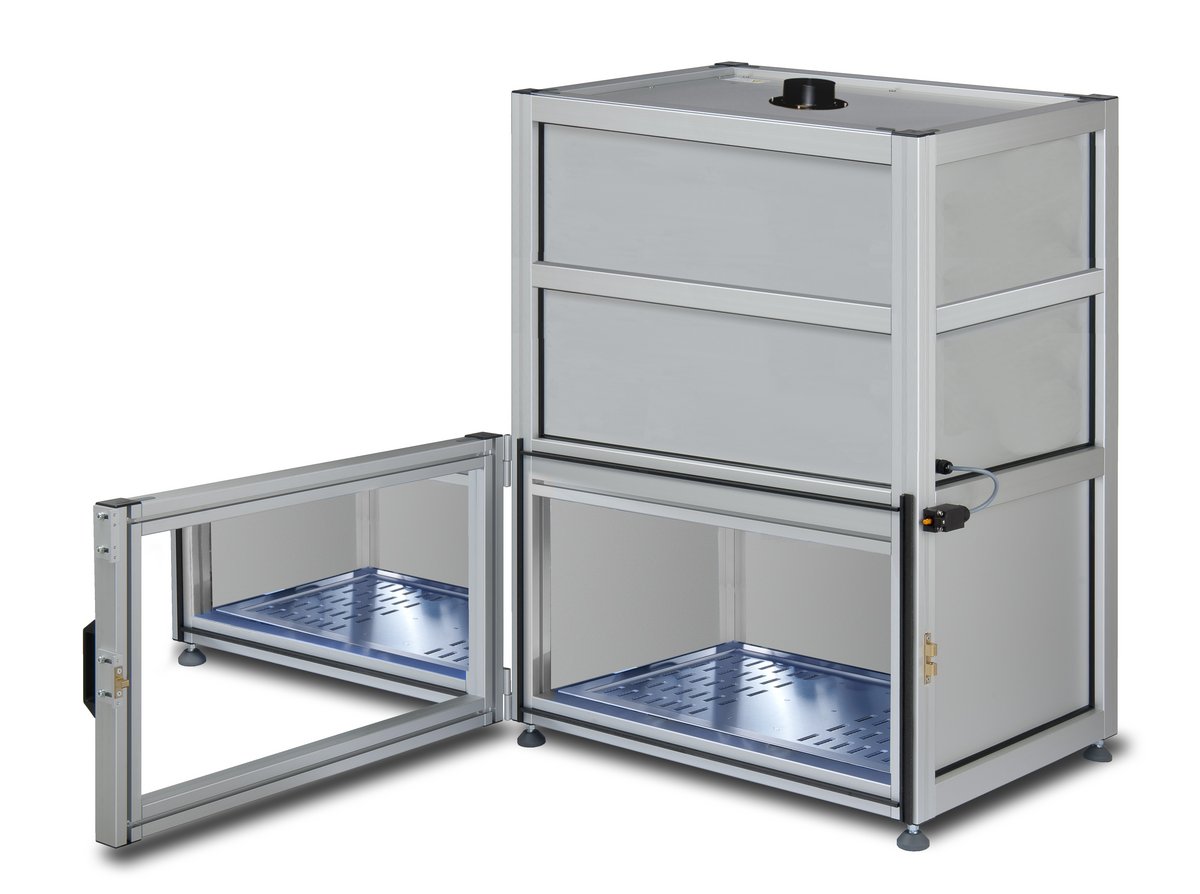
The BSH-03CBD is a precisely engineered collimated beam irradiation chamber for reproducible and dose-accurate UV irradiation of liquid samples. With three 150 W UVC amalgam lamps, it ensures a homogeneous, high-intensity 254 nm radiation source. The system was developed based on the standard methods for fluence and dose determination described in the technical literature according to Bolton & Linden, Standardization of Methods for Fluence “UV Dose Determination in Bench-Scale UV Experiments” (2003) – the methodology that is considered the reference in scientific UV disinfection research.
The procedure was adopted in DIN 19294-1:2020-08, so that the BSH-03CBD can be used to determine the average fluence rate in the spore suspension.
The inactivation must be carried out in a BSH-03CBD in accordance with Annex D of DIN 19294-1:2020-08.
The amalgam lamps stay at operating temperature throughout the experiment; the exposure time is defined by the internal shutter alone, which the UV-MAT regulates to the target dose. The chamber can therefore be opened during operation to load and unload samples without letting the lamps cool down – safety monitoring rules out any UV emission in the process.
The BSH-03CBD irradiation chamber is therefore a reliable and precise solution for scientific research and industrial applications of UV disinfection. Its robust construction, safety, and user-friendly operation make it an indispensable tool in water treatment and chemical analysis.
Key features of the UVC collimated beam device:
- The BSH-03CBD is equipped with three ozone-free 150 W UVC amalgam lamps. These lamps ensure uniform and high UV irradiation.
- The closed protective housing fully shields the UVC radiation of the three amalgam lamps.
- The 60 × 40 cm irradiation area takes customer-supplied Petri dishes together with magnetic stirrers for spore suspensions to DIN 19294-1.
- A UV reference sensor for dose-controlled operation is built in.
- A second UVC sensor allows for easy setup of the system.
- The UV-MAT Touch regulates the irradiation via the UVC reference sensor and switches off once the target dose is reached.
- Monitored & interlocking door: Safety mechanisms prevent the emission of UV radiation when the door is open.
- The base plate with screw threads allows the irradiation field to be measured and the Petri factor to Bolton/Linden to be determined.
- Pneumatic plate shutter: the amalgam lamps stay at operating temperature, the exposure time is defined by the shutter alone.
- Operating hours counter – the amalgam lamps reach a typical service life of 3,000 to 5,000 h.
- Raw data and short reports (PDF) are stored by the supplied PC software, password protected with an administrator and an operator account.
BSH-03 CBD or BSM-03 CBD?
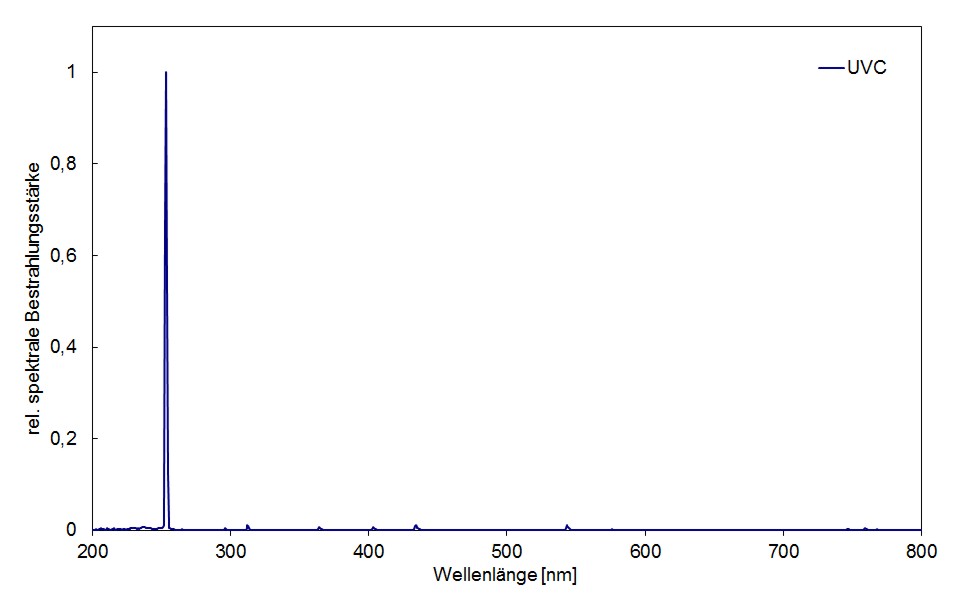
With three 150 W UVC amalgam lamps the BSH-03 CBD emits practically monochromatically at 254 nm. This removes the spectral weighting from the fluence calculation according to Bolton and Linden and makes the chamber suitable for determining the average fluence rate to DIN 19294-1 as well as for inactivation experiments at a defined UV dose. At 550 W on 230 V and a lamp life of 3,000 to 5,000 h it is also the more economical chamber. Wherever the polychromatic radiation of a medium-pressure lamp is required – photolysis, AOP experiments, spectral action functions – the BSM-03 CBD with its 1 kW medium-pressure mercury lamp is the matching variant.
Background & Information
The paper “Standardization of Methods for Fluence (UV Dose) Determination in Bench-Scale UV Experiments” by James R. Bolton and Karl G. Linden (2003) presents a basic standard procedure for determining UV fluence (UV dose) in laboratory experiments. The aim of the paper is to standardize experimental methods for UV disinfection and to ensure the comparability of scientific results in water treatment.
Ultraviolet light has established itself as an efficient method for inactivating pathogenic microorganisms in drinking water and wastewater.
The mechanism is based on the absorption of UV radiation by nucleic acids, which leads to dimerization of pyrimidine bases and thus prevents the replication of DNA or RNA. Wavelengths around 254 nm, as emitted by low-pressure mercury lamps, are particularly effective.
There are major differences in the literature regarding the design, calibration, and implementation of UV experiments. Among other things, the type of lamp, distance to the sample, homogeneity of the radiation, and calculation of the dose varied. This variability made it difficult to compare dose-response curves and led to uncertainties in regulatory applications and the technical implementation of UV disinfection systems.
Bolton and Linden developed a uniform methodology for determining fluence that is applicable to both monochromatic (low-pressure) and polychromatic (medium-pressure) UV light sources (BSM-03CBD) and proposes an irradiation chamber. The aim of the irradiation chamber is to achieve homogeneous, quasi-parallel irradiation of the water surface in order to ensure uniform fluence distribution.
The protocol includes:
- the mechanical construction of the irradiation chamber,
- the calibration of the measuring instruments,
- the mathematical correction of the radiation parameters,
- as well as guidelines for microbiological and safety aspects
Description of the standard protocol:
The fluence is defined as the product of the fluence rate (E) and the irradiation time (t):
The measurement is performed with a radiometer whose sensor is positioned at the height of the water surface. To increase the measurement accuracy, several correction factors are taken into account:
- Reflection factor: loss due to reflection at the water surface (~2.5%)
- Petri factor: correction for inhomogeneity across the sample area (should be > 0.9)
- Water factor: consideration of UV absorption in water according to Beer–Lambert‘s law
- Divergence factor: Correction for the non-completely parallel beam path
For medium-pressure lamps, the sensor factor (spectral sensitivity of the detector) and the germicidal factor (weighting of the wavelengths) are also taken into account.
Microbiological test procedure
- Stirring: Homogeneous mixing of the suspension without vortex formation.
- Irradiation with different dose values
- Replicates: At least three repetitions per dose value; perform dose-response curves at least twice.
- Randomization: Random order of irradiation to minimize systematic errors.
- Evaluation: Calculation of the log10 reduction of microorganisms as a function of dose and linear regression to determine UV sensitivity.
The paper defines a complete, internationally recognized protocol for standardizing UV disinfection tests on a laboratory scale.
Through precise correction methods, defined design requirements, and microbiological guidelines, it provides the basis for reproducible and comparable results in determining UV fluence-effect relationships.
The Bolton & Linden (2003) method remains the reference standard for laboratory testing with collimated beam systems and is central to regulatory applications such as DIN 19294, validation testing, and the development of industrial UV disinfection technologies.
Technical data UVC collimated beam device
| Interior chamber | 60 x 40 x 25 cm |
| Dimensions | 130 x 62 x 76 cm |
| Weight | ca. 65 kg |
| Power consumption | 550 W |
| Mains | 230 VAC, 6 A |
| 3 x110/208 VAC, 8 A, optional | |
| Operation temperature | 15 to 30 °C |
| Humidity | < 80% non-condensing |
| Lamp lifetime | 3.000 h to 5.000 h, typical |
| Number of lamps | 3 |
| Lamp type | 150 W UVC amalgam lamps |
| ozone free | yes |
| Sample temperature | Room temperature + ~ 1-2°C |
| Shutter control | Pneumatic, 4-6 bar |
| Cooling | 1 x DN 100 |
Downloads
Accessories
Publications at a glance
Our irradiation chambers are used in research, development, and production.
A selection of scientific publications is available here.