

Photocatalytic hydrogen production and water splitting
Photocatalytic hydrogen production is the direct generation of hydrogen from water and light using a semiconducting photocatalyst – without the detour through external electricity generation as in classical electrolysis. The goal of the process is photocatalytic water splitting: light absorption creates electron-hole pairs in the semiconductor that drive the reduction of protons to hydrogen and the oxidation of water to oxygen at the catalyst surface. The central technical challenge lies not only in materials development but in the reliable assessment of light utilisation: efficiency, apparent quantum yield and solar-to-hydrogen efficiency (STH) are only meaningful if photon flux, spectral irradiance, irradiated area and reactor geometry are precisely known. Without these optical quantities, any efficiency value remains incompletely defined.
How is photocatalytic hydrogen production developing?
Photocatalytic hydrogen generation is not yet an economic market of its own; reliable market figures do not exist for it. For context, the hydrogen sector as a whole serves as a market indicator: global hydrogen demand rose to just under 100 million tonnes in 2024, an increase of about 2 percent over 2023, driven mainly by established applications in oil refining and industry (IEA, Global Hydrogen Review 2025). Low-emission hydrogen – covering both electrolysis from renewable electricity and, potentially, photocatalytic processes – grew by 10 percent in 2024, but still accounts for less than 1 percent of global production. The production potential of low-emission processes announced for 2030 was even revised downward in the current edition of the report compared with the previous year, from 49 to 37 million tonnes per year, mainly due to delayed electrolysis projects.
Even the technically more mature pathways such as alkaline and PEM electrolysis are thus only at the beginning of scale-up; photocatalytic water splitting sits clearly earlier on this maturity curve and remains predominantly at laboratory and pilot scale. A first reliable indication of the economic outlook comes from a 2025 cost and CO2 assessment of a scalable photocatalytic Z-scheme raceway reactor, which rates the approach as potentially competitive with conventional electrolysis but explicitly calls for further experimental validation and field trials (Collins et al., Energy & Environmental Science 2025). Research currently focuses on semiconductors such as TiO2, g-C3N4, sulfides, oxynitrides, bismuth vanadate and complex heterostructures, complemented by co-catalysts made of platinum, nickel, cobalt or alloys – background on material choice and band gap is covered by the photocatalysis market page. A particular focus lies on visible-light-active systems, because the UV fraction of the solar spectrum provides only a small share of the available photons. This shift toward broader absorption ranges creates a measurement requirement: UV and visible spectral ranges must be captured jointly and with spectral resolution – a requirement that grows in importance as material diversity increases.
Five developments set the pace and direction of this field:
Replacement of mercury vapour lamps by xenon solar simulators and UV-LEDs: this trend improves the spectral controllability of laboratory experiments and makes measurement results between different setups more comparable, but in turn requires more careful spectral characterisation of the new, often narrower-band sources.
Standardisation initiatives for test protocols: proposals for uniform accreditation of STH and AQY values for particulate photocatalysts aim to improve the comparability of published efficiencies between laboratories; the concrete consequence is a growing expectation of fully documented irradiation conditions in publications (Wang et al., Joule 2021).
Scale-up from laboratory to pilot scale: concepts such as the Z-scheme raceway reactor shift the focus from pure materials optimisation toward cost and CO2 assessment at field scale; this brings the transferability of laboratory measurements under a solar simulator to real outdoor conditions with a fluctuating solar spectrum more strongly into focus.
Moving away from purely sacrificial-reagent systems: the focus is increasingly shifting toward genuine water splitting with a stoichiometric hydrogen-to-oxygen ratio rather than half reactions; this raises the analytical demands on the accompanying gas analysis.
Compatibility with sea and raw water: advances in corrosion-resistant materials such as InGaN alloys reduce dependence on high-purity water as a feedstock and bring location-independent applications closer to technical feasibility (Zhou et al., Nature 2023).
How does photocatalytic hydrogen production work?
When a photon with energy above the semiconductor's band gap strikes the photocatalyst, an electron is raised from the valence band into the conduction band, leaving behind a positively charged “hole” in the valence band. These charge carriers must first reach the particle surface without recombining before they can drive chemical reactions there: electrons reduce protons to hydrogen, holes oxidise water to oxygen. Complete water splitting thermodynamically requires a band gap of at least 1.23 electronvolts, as this corresponds to the free reaction enthalpy of the reaction (U.S. DOE/OSTI, Metal-Free Photocatalysts for Hydrogen Evolution). In practice, usable band gaps lie well above this value, because additional overpotentials for the hydrogen and oxygen evolution reactions and losses from charge-carrier recombination must be overcome. Co-catalysts made of noble or transition metals address exactly this point: they lower the activation energy at the surface and accelerate charge-carrier extraction, leaving recombination less time to annihilate the photogenerated electron-hole pairs.
Which technologies are used for photocatalytic hydrogen production?
Material choice determines which part of the solar spectrum can be used, while reactor type and light source determine under which optical boundary conditions a catalyst is actually tested.
| Photocatalyst | Band gap (approx.) | Usable spectral range | Advantages | Limitations |
|---|---|---|---|---|
| TiO2 (anatase) | approx. 3.2 eV | UV, < 390 nm | Chemically stable, low-cost, well studied | Uses only the small UV fraction of the solar spectrum (Nature Scientific Reports 2017) |
| g-C3N4 (carbon nitride) | approx. 2.7 eV | UV–Vis, up to approx. 460 nm | Metal-free, simple synthesis, visible-light-active | Moderate charge-carrier separation, usually needs a co-catalyst (Nature Scientific Reports 2017) |
| BiVO4 | approx. 2.4 eV | Visible, up to approx. 515 nm | Good visible-light absorption, common in PEC half-cells | Better suited to oxygen evolution, electron transport limiting |
| CdS and sulfides | approx. 2.4 eV | Visible | High absorption in the visible range | Photocorrosion under illumination, usually stable only with a sacrificial reagent |
| InGaN (indium gallium nitride) | tunable via indium content | UV–Vis, tunable | Corrosion-resistant, band gap deliberately tunable | More demanding fabrication, currently the support structure for record STH values (Zhou et al., Nature 2023) |
| Halide perovskites | material-dependent | Visible | High activity, tunable band gap | Sensitive to moisture and oxygen, low long-term stability |
Co-catalysts made of platinum, nickel, cobalt or alloys such as PtPdAg are deposited on the support materials to kinetically facilitate the hydrogen evolution reaction; their loading, distribution and contact quality often influence quantum yield more strongly than the choice of support semiconductor alone.
Different light sources are used for laboratory characterisation. Xenon solar simulators reproduce the AM1.5G solar spectrum broadband and are a prerequisite for comparable STH measurements; their suitability is assessed via criteria such as spectral match, spatial uniformity and temporal stability, as originally defined for photovoltaic testing in the IEC 60904-9 standard and transferable by analogy to STH characterisation (IEC 60904-9:2020). Mercury vapour lamps provide a UV-rich but discontinuous line spectrum and are increasingly being replaced by UV-LEDs for both spectral and regulatory reasons. UV-LEDs emit narrowband at a defined wavelength and are therefore particularly suited to determining apparent quantum yield in a wavelength-resolved manner. Natural sunlight is used for outdoor and pilot trials, but requires accompanying spectral measurement there, since cloud cover, time of day and season directly affect intensity and spectrum.
On the reactor side, a distinction is made between batch or suspension reactors, flow and microreactors, immobilised film reactors, and large-area panel or raceway reactors as discussed for Z-scheme concepts at pilot scale. Each geometry changes optical path length, irradiated area and residence time of photons in the medium, and is thus itself part of the optical boundary conditions of the experiment.
Which process parameters are decisive for photocatalytic hydrogen production?
Several process parameters act on the hydrogen evolution rate, often simultaneously and not independently of one another:
- Spectral photon flux: only photons with energy above the band gap contribute to excitation; the total irradiance of a broadband source is therefore not a direct measure of the usable photon quantity.
- Wavelength or photon energy: it determines whether a photon can be absorbed at all and, for multi-absorber systems, which sub-process (hydrogen or oxygen evolution) is addressed.
- Catalyst mass and active surface area: as mass increases, light absorption first rises but then saturates once the suspension becomes optically dense; beyond this point, mass-specific activity falls because deeper-lying particles no longer receive light.
- Reactor volume and optical path length: they determine how many photons are actually absorbed rather than transmitted or scattered on their way through the medium.
- Sacrificial reagent concentration: sacrificial reagents such as methanol or triethanolamine consume the photogenerated holes and thereby prevent the back reaction, but turn the process from genuine water splitting into a half reaction.
- Temperature: it affects reaction kinetics and gas solubility, and – as a recent study shows – a deliberately elevated operating temperature of around 70 °C can suppress the back reaction of hydrogen and oxygen, significantly increasing net yield (Zhou et al., Nature 2023).
- Source type and spectrum: it determines which fraction of the catalyst's spectrum is excited at all and whether a measurement is comparable to an STH measurement under a reference spectrum.
What limits the process or causes errors in photocatalytic hydrogen production?
A common misconception is assuming that electrical lamp power is a usable measure of optical excitation. Losses occur through reflection, filters, reactor glass, geometry and absorption in the medium; for solar-like sources, the power is additionally spread over a broad spectrum, of which only a part lies above the band gap and is thus usable at all. A wattage figure from the lamp power supply therefore says nothing about the photon flux actually reaching the catalyst.
A second, less frequently considered point concerns the limits of the photochemical reciprocity law (Bunsen-Roscoe law), according to which a photochemical effect should depend solely on the product of irradiance and time – the dose. This assumption holds only as long as quantum yield is intensity-independent. In photocatalytic systems this is often not the case: as irradiance increases, the steady-state concentration of photogenerated charge carriers rises, so that bimolecular recombination processes become disproportionately more important. Apparent quantum yield then falls with increasing intensity, and a short, intense exposure does not yield the same result as a long, weak exposure with an identical dose. A time or dose figure alone, without knowledge of the actual irradiance, is therefore not sufficient for comparing two experimental series.
Further typical sources of error:
- Back reaction instead of genuine net yield: the same co-catalyst that accelerates hydrogen evolution can also catalyse the recombination of hydrogen and oxygen back to water. Without checking the stoichiometric ratio of about 2:1 between hydrogen and oxygen, it remains unclear whether genuine complete water splitting or only a half reaction with a sacrificial reagent is taking place (Wang et al., Joule 2021).
- Photocorrosion: sulfidic materials such as CdS decompose under illumination and can then produce hydrogen even without functioning water splitting; evidence over time is needed to distinguish self-decomposition from catalytic activity.
- Measurement position outside the reactor: a measurement taken directly at the lamp describes neither scattering losses nor absorption in the reactor glass or the medium, and systematically overestimates the irradiance actually reaching the catalyst.
- Shared irradiance for different band gaps: if a UV-active and a visible-light-active material are tested under the same broadband lamp, total irradiance is not a common basis for comparison, because both materials draw on different parts of the same spectrum. Only a spectrally resolved measurement allows the photon flux each material can actually use to be assigned correctly.
What influence do spectrum and reactor geometry have on the measurement?
Photocatalysts are mostly present as powders in suspension. Unlike clear, weakly scattering solutions, the simple Beer-Lambert law, which describes absorption purely in terms of concentration and path length, applies here only to a limited extent: a substantial part of the incident light is scattered at the particles, sometimes reflected multiple times, and can be reabsorbed elsewhere in the suspension. For strongly scattering, diffusely reflecting powder layers, the Kubelka-Munk theory is therefore often used, treating scattering and absorption coefficients separately instead of combining them into a single extinction coefficient as Beer-Lambert does. For practical measurement this means: an irradiance calibrated on a clear reference solution cannot simply be transferred to a turbid catalyst suspension; higher catalyst concentrations initially increase light utilisation but increasingly shift light absorption into a thin boundary layer near the illuminated surface, while deeper regions of the suspension become optically shaded. Reactor geometry and catalyst loading are therefore not independent variables but jointly responsible for the actual spatial distribution of photon absorption. The sensor's own measurement error additionally depends on its spectral match to the source – see spectral mismatch in UV sensors.
Efficiency metrics: formulas, prerequisites and limits
Three metrics dominate the assessment of photocatalytic systems in the literature.
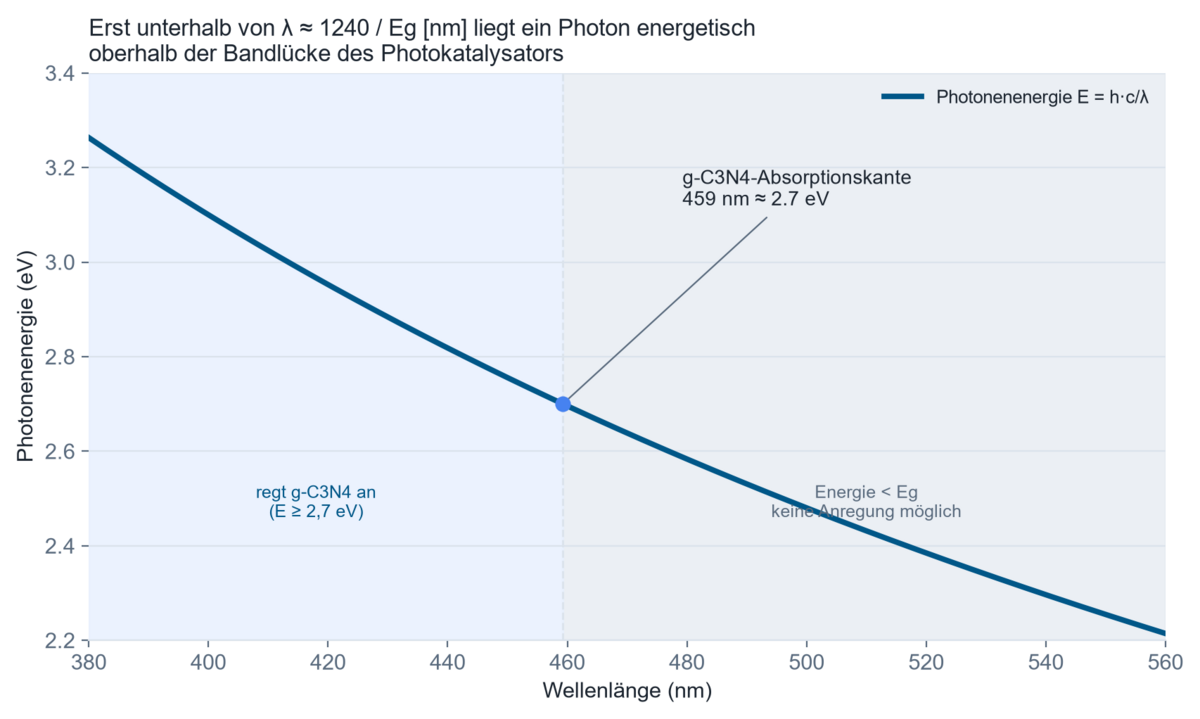
Photon energy: according to the Planck-Einstein relation, E = h·c/λ, with h the Planck constant, c the speed of light and λ the wavelength. In practice the relation can be written as λ [nm] ≈ 1240 / E [eV]. It determines which wavelengths a photocatalyst with a given band gap can excite at all.
Apparent quantum yield (AQY): it relates the number of electrons converted to the number of incident photons at a defined wavelength. For hydrogen evolution, a two-electron process, AQY(λ) = 2 × N(H2) / N(photons, λ) applies (PMC, A multimodal flow reactor for photocatalysis 2023). The quantity requires both the wavelength and the photon flux measured there; “quantum yield” without these figures is not a complete metric.
Solar-to-hydrogen efficiency (STH): it relates the chemical energy stored in the hydrogen produced to the incident solar energy: STH = [H2 formation rate (mol/s) × ΔG (237,000 J/mol)] / [irradiance (W/m²) × irradiated area (m²)] (Sayago-Carro et al., RSC Applied Interfaces 2024). ΔG denotes the free reaction enthalpy of water splitting. For the value to be comparable, the measurement must be carried out under a standardised reference spectrum, typically the AM1.5G spectrum at 1000 W/m² “one sun” irradiance, and without external bias or a sacrificial reagent. STH values from experiments with a sacrificial reagent or under non-referenced irradiance are not directly comparable to genuine one-sun STH values.
The practical consequence of all three quantities is identical: without a spectrally resolved, traceably calibrated measurement of the photon flux at the reaction site, neither AQY nor STH can be determined reproducibly.
Worked example: band gap and usable wavelength of a photocatalyst
1. Assumptions. A g-C3N4 photocatalyst has a band gap of Eg ≈ 2.7 eV (Nature Scientific Reports 2017).
2. Formula. λ [nm] = 1240 / Eg [eV] (from E = h·c/λ).
3. Calculation. λ = 1240 / 2.7 ≈ 459 nm.
4. Result. The absorption edge lies at around 459 nm.
5. Technical interpretation. Photons with a wavelength longer than about 459 nm carry less energy than the band gap and cannot excite g-C3N4. An AQY measurement on this material must therefore not be based on the total irradiance of a xenon lamp, but exclusively on the spectral photon flux in the range of roughly 300 to 459 nm. If the same catalyst is inadvertently evaluated against the photon flux of the entire visible and infrared spectrum, the result is a systematically too-low, non-comparable quantum yield.
Where is photocatalytic hydrogen production used or researched?
Energy and materials research: universities and research institutes develop new semiconductors, heterostructures and co-catalysts aiming for higher STH values. The critical process parameter here is the spectrally resolved characterisation of new thin-film and powder samples, since only this allows reliable conclusions on band-gap position and actual photon utilisation.
Green hydrogen economy and energy storage: photocatalytic processes are discussed as a potentially less capital-intensive alternative to electrolysis, since they require no separate electricity generation. The critical issue here is the transfer from laboratory to outdoor conditions, since natural sunlight varies in intensity and spectrum with time of day and weather.
Water and environmental technology: in photocatalytic treatment, pollutants in wastewater are often used simultaneously as the sacrificial reagent, coupling pollutant degradation with hydrogen generation. The critical process parameter is pollutant concentration, since it affects both light absorption in the medium and the availability of oxidisable species; a broader view of UV processes in this sector is offered by the Water and environmental technology market page.
Semiconductor research and photovoltaics-adjacent processes: photoelectrochemical tandem cells, which combine photocatalytic and electrochemical principles, share with pure photocatalysis the need for standardised solar simulator characterisation according to the criteria of spectral match, uniformity and temporal stability.
Testing and calibration laboratories: as the number of publications on new photocatalysts grows, so does the need for traceably calibrated, wavelength-resolved irradiance measurement technology, to make published AQY and STH values comparable at all between different laboratories.
Which reactor concepts work for Z-schemes, seawater and concentrated sunlight?
For systems without external bias that still aim for complete water splitting, Z-scheme concepts with two separate photoabsorbers are increasingly being investigated: one absorber is tuned to hydrogen evolution, the other to oxygen evolution, coupled via a reversible redox pair in solution. Such systems can be realised in large-area raceway reactors, in which the photoactive particles are suspended in two stacked volumes (Collins et al., Energy & Environmental Science 2025).
For saline or contaminated water sources, corrosion-resistant materials such as InGaN alloys are of interest; using sea water or tap water, STH values of around 7 percent were achieved with them, compared with 9.2 percent for high-purity water under otherwise identical conditions (Zhou et al., Nature 2023). For applications with strongly concentrated sunlight, operating temperature gains additional importance, since a deliberate temperature increase can suppress the back reaction, while at the same time placing its own demands on reactor materials and seals.
Which quantities must be measured or monitored in photocatalytic hydrogen production?
The basis of any reliable efficiency determination is the spectral irradiance at the reaction site, from which the spectral photon flux can be derived – the quantity on which both AQY and STH are built. In addition, chemical actinometry, for example with potassium ferrioxalate as the IUPAC-recommended standard actinometer, provides an independent, integrating reference measurement of photon flux directly within the reaction volume, independent of reactor geometry (HAL, Accurate Measurement of the Photon Flux 2015).
Whether a broadband measurement suffices or a spectral measurement is required depends on the question at hand: for long-term monitoring of an already characterised, stable system – for example to detect lamp ageing during a multi-week experimental series – a calibrated broadband radiometer with a matching sensor is often sufficient. For comparing different catalyst materials, especially when UV- and visible-light-active systems are set against each other, a spectrally resolving measurement with a spectroradiometer covering the UV, visible and solar-like range in a single measurement is required instead. Spatial measurements at several positions become necessary for large-area panel or raceway reactors, to capture inhomogeneities of irradiance across the surface; time-series measurements are indicated when catalyst degradation must be distinguished from a declining light source. Relevant measurement uncertainties arise, among other things, from the spectral mismatch of the sensor relative to the actual source, as well as from the calibration traceability of the measuring instrument itself.
In automated photoreactor setups, for example for screening runs with changing catalyst samples, continuous radiometric monitoring serves not only documentation but acts as a feedback quantity: if the measured irradiance deviates from a stored tolerance band, this points to lamp ageing, contamination of optical windows, or sample misalignment, before erroneous efficiency values are calculated from it. Coupling the optical readings with online gas analysis allows hydrogen evolution rate and irradiance to be logged in time synchrony, which also reveals intensity-dependent effects such as a declining quantum yield at high irradiance. For reproducibility between different laboratories – for example in round-robin trials to validate new photocatalysts – the complete digital recording of the optical boundary conditions is just as important as the yield data itself, since AQY and STH values can only be reconstructed with fully documented irradiation conditions.
In addition to the optical measurement, determining AQY and STH requires quantitative gas analysis, usually by gas chromatography, to separately capture hydrogen, oxygen and, where relevant, nitrogen and to check the stoichiometric ratio (Wang et al., Joule 2021). For continuous monitoring of a defined wavelength range over a long experimental series, a radiometer such as the RMD Pro with a matching sensor can be sufficient; the selection is outlined under Selecting UV sensors. For full spectral characterisation – for example when first characterising a new reactor or directly comparing several light sources – a spectroradiometer such as the SR900 covering roughly 200 to 1100 nanometres is needed, to capture UV, visible and solar-like sources in a single measurement. Photon energy and dose for your own worked examples can be worked through with the UV Tools.
What do scientific publications and technical sources show on photocatalytic hydrogen production?
The following six references cover market context, efficiency records, test methodology, efficiency definitions, reactor technology and measurement standardisation.
Puts global hydrogen demand and the share of low-emission processes into context and serves in this text as a market indicator, since no dedicated market size exists for photocatalytic processes in the narrower sense.
IEA (2025): Global Hydrogen Review 2025. International Energy Agency, Paris.
Achieves a solar-to-hydrogen efficiency of more than 9 percent with an indium gallium nitride photocatalyst, among other things through deliberate temperature control to suppress the back reaction.
Zhou, Peng, et al. (2023): Solar-to-hydrogen efficiency of more than 9% in photocatalytic water splitting. Nature 613, 66–70.
Summarises standardisation proposals for accrediting the efficiency of particulate photocatalysts and argues why test protocols for irradiation and gas analysis are necessary for the comparability of results.
Wang, Zhiliang, et al. (2021): Efficiency Accreditation and Testing Protocols for Particulate Photocatalysts toward Solar Fuel Production. Joule 5.
Systematically classifies the efficiency definitions used in the literature for photocatalytic hydrogen production, including quantum yield and STH.
Sayago-Carro, Rocío, et al. (2024): Efficiency in photocatalytic production of hydrogen. RSC Applied Interfaces.
Provides an initial quantitative cost and CO2 assessment for a scalable Z-scheme raceway reactor concept and discusses its competitiveness against electrolysis.
Collins, Stephanie, et al. (2025): Levelized cost and carbon intensity of solar hydrogen production via water splitting using a scalable and intrinsically safe photocatalytic Z-scheme raceway system. Energy & Environmental Science.
Defines criteria for spectral match, spatial uniformity and temporal stability of solar simulators, which are also applied by analogy to the STH characterisation of photocatalytic systems.
IEC (2020): IEC 60904-9:2020 – Photovoltaic devices – Part 9: Classification of solar simulator characteristics. International Electrotechnical Commission, Geneva.
What does published research by customers show?
Under the topic Hydrogen production, the topic overview of customer publications currently lists eight works; the following six deal with photocatalytic hydrogen generation in the narrower sense and repeatedly show explicitly that the light source itself is an experimental variable.
Compares the same process under different lamp types in a batch and a micro-photoreactor – direct evidence that the source is an experimental variable.
Meinhardová, Vendula, et al. “Role of lamp type in conventional batch and micro-photoreactor for photocatalytic hydrogen production.” Frontiers in Chemistry 11 (2023): 1271410.
Traces the hydrogen yield back to the structure of nitrogen-doped nanowires under solar-like illumination.
Attalario, Evan, et al. “Structure-Dependent Performance of N-Doped TiO2 Nanowires toward Efficient Solar-Driven Hydrogen Production.” Bulletin of Chemical Reaction Engineering & Catalysis 21.2 (2026): 490–499.
Examines how multiple junctions and surface hydroxyl groups in a copper-titanium heterostructure interact.
Subagyo, Riki, et al. “Synergetic effects of multiple junction and surface hydroxyl in Cu/CuO/Cu2O/TiO2 heterostructures towards highly efficient photocatalysts for hydrogen generation.” Materials Science for Energy Technologies 8 (2025): 131–142.
Uses a dendritic silica-titania structure to increase the accessible surface area per irradiated volume.
Subagyo, Riki, et al. “Dendritic Fibrous Nano Silica–Titania for High-Performance Photocatalytic Hydrogen Evolution.” ACS Applied Energy Materials (2025).
Shows on porous alloy particles on nanotubes how strongly the co-catalyst determines hydrogen formation.
Nguyen, Nhat Truong, et al. “Providing significantly enhanced photocatalytic H2 generation using porous PtPdAg alloy nanoparticles on spaced TiO2 nanotubes.” International Journal of Hydrogen Energy 44.41 (2019): 22962–22971.
Reviews strategies for improving photocatalytic water splitting.
Fajrina, Nur, and Muhammad Tahir. “A critical review in strategies to improve photocatalytic water splitting towards hydrogen production.” International Journal of Hydrogen Energy 44.2 (2019): 540–577.
The remaining two works in this topic area concern a related but different process (microbial electrochemical generation of hydrogen peroxide rather than photocatalytic water splitting) and are deliberately not listed here; the complete list is available under Publications by customers – thematic sorting.
FAQ on photocatalytic hydrogen production
How does photocatalytic hydrogen production work?
A semiconductor absorbs photons with energy above its band gap, forming electron-hole pairs. If these charge carriers reach the catalyst surface without recombining, electrons reduce protons to hydrogen while holes oxidise water to oxygen. Co-catalysts accelerate these surface reactions and thereby reduce recombination losses.
Which wavelength is suitable for a given photocatalyst?
Only photons with energy above the material's band gap can generate charge carriers. For TiO2 (approx. 3.2 eV) these are wavelengths below about 390 nm, for g-C3N4 (approx. 2.7 eV) wavelengths below about 460 nm. The threshold wavelength can be estimated via λ [nm] ≈ 1240 / Eg [eV].
What photon flux is required for an experiment?
There is no universal target value; what matters is that the spectral photon flux actually reaching the catalyst is known and documented. For STH comparisons a reference value of 1000 W/m² under the AM1.5G spectrum is commonly used, for AQY measurements the photon flux at the wavelength under study.
What is the difference between photocatalytic and photoelectrochemical water splitting?
In photocatalytic water splitting, reduction and oxidation take place on the same or on suspended particles without any external circuit. In the photoelectrochemical variant, photoanode and cathode are spatially separated and usually connected via a small external bias voltage, which theoretically allows higher efficiencies but requires a more complex setup.
Why does a photocatalyst produce no hydrogen despite sufficient irradiance?
Possible causes include insufficient photon energy relative to the band gap, dominant charge-carrier recombination, a missing or unsuitable co-catalyst, unfavourable reactor geometry with strong optical shading, or a parallel back reaction of hydrogen and oxygen.
How is apparent quantum yield measured?
AQY is obtained from the ratio of the number of electrons converted to the number of incident photons at a defined wavelength: AQY(λ) = 2 × N(H2) / N(photons, λ). Photon flux is usually determined with a spectroradiometer or by chemical actinometry using potassium ferrioxalate.
Which measurement technology is suitable for comparing UV- and visible-light-active catalysts?
A spectroradiometer that captures the UV, visible and solar-like range in a single measurement is required, because a pure broadband measurement does not distinguish between the spectral components each of the two materials can actually use.
Which factors limit the scale-up from laboratory to pilot scale?
Besides material stability and reactor costs, the transferability of light characterisation is decisive: outdoor conditions with a fluctuating solar spectrum cannot be compared directly with laboratory results under a stabilised solar simulator without capturing the actual spectral irradiance on site.
Related application fields
This application is closely related, technically, to neighbouring fields of optical radiation measurement – for example photocatalysis (shared semiconductor physics and band-gap systematics, different target reaction) and water and environmental technology (shared reactor principles, sometimes coupled pollutant degradation and hydrogen generation).
Author: Dr. Mark Paravia
Dr.-Ing. Mark Paravia is the managing director of Opsytec Dr. Gröbel GmbH in Ettlingen and heads the accredited calibration laboratory. Following his research on pulsed xenon excimer discharges at the Institute of Lighting Technology at KIT, his current focus is on optical radiation measurement technology. He is a recognized UV expert, vice-chair of the DIN Standards Committee FNL 7 “Optical Radiation,” and a member of the DVGW Project Group on UV Disinfection.
Unsure what photon flux is actually reaching your photocatalyst?
Wavelength, photon flux and irradiated area determine whether a reported quantum yield or STH value is traceable and comparable with other work. Anyone who wants to spectrally characterise their own photoreactors, select light sources for an experimental setup, or check an existing measurement series for plausibility can turn to the calibration laboratory of Opsytec Dr. Gröbel GmbH for an expert assessment of the optical boundary conditions. Contact us about your measurement or testing task.