
UV curing and photopolymerization
Whether a UV cure succeeds is not decided by the lamp's power rating, but by three conditions that must be met simultaneously: the source's emission spectrum must actually excite the photoinitiator, the radiation must reach the reaction depth at sufficient irradiance, and the reaction must be able to proceed there without being stopped prematurely by oxygen, heat dissipation, or rising viscosity. UV curing refers to the photochemically induced polymerization or crosslinking of monomers, oligomers and reactive resins by irradiation with ultraviolet or near-visible radiation. The technical goal is a defined, reproducible degree of crosslinking within an economically viable process time. The central challenge is that the photochemically effective quantity is a spectrally weighted irradiance at the reaction site – not the lamp's electrical power draw or a blanket exposure time.
How is the market for UV curing and photopolymers developing?
Market size and growth. The market for UV curing systems (lamps, LED modules, controllers, equipment) was estimated at around USD 6.71 billion in 2025 and is expected to grow to about USD 17.48 billion by 2031, corresponding to an annual growth rate of roughly 17 percent (Mordor Intelligence, 2026). A second market view puts the market for photopolymers – the reactive materials themselves, primarily for additive manufacturing – at around USD 3.14 billion in 2024, with an expected CAGR of 11.3 percent through 2033 (Grand View Research, 2025). The two figures describe different market scopes – equipment on one hand, material class on the other – and should not be added together, but independently point to double-digit growth in a technology field that is changing structurally.
Technology shift. Within the equipment market, mercury vapor lamps still held a revenue share of around 52 percent in 2025, while UV LED systems are growing considerably faster, with a projected CAGR of nearly 18 percent through 2031 (Mordor Intelligence, 2026). This shift is not merely a procurement question; it changes how a process is photochemically designed: a formulation tuned to a broadband mercury spectrum is not automatically reactive under a narrowband LED source, because the photoinitiator's absorption band may only just clip the edge of the new source's emission, or miss it entirely – more on individual LED wavelengths and their limits is covered on the technology page on UV LEDs for UVA, UVB and UVC.
Regulatory driver. By incorporating the Minamata Convention on Mercury into European law (delegated regulation of July 2023, revised Mercury Regulation in force since 30 July 2024), the EU has restricted the manufacture and export of further mercury-containing lamp types in stages, effective 31 December 2025 and 31 December 2026 respectively (European Commission, 2026). For operators of existing mercury-lamp installations, this means a foreseeable need for replacement that is accelerating the switch to UV LED or excimer systems – and with it, new requirements for spectral measurement, process qualification and formulation adjustment.
Growth drivers at a glance. Besides regulation, cited drivers include: tighter limits on volatile organic compounds (VOCs), which put solvent-based systems at a disadvantage relative to photochemically curing formulations; growing electronics and semiconductor manufacturing, where UV bonding and protective coatings are replacing thermally demanding soldering steps; electromobility, where UV adhesives fix battery modules; and increasing AI-supported inline process control aimed at reducing scrap (Mordor Intelligence, 2026). Each of these drivers structurally raises the demands on measurement, quality assurance and automation – a fast, but narrowband and locally acting process can no longer be qualified by a blanket exposure time alone.
Three developments are noticeably changing the technology of UV curing:
Transition from mercury lamps to UV LED. Driven by regulation and economically favoured by today's higher efficiency, the equipment base is shifting from broadband to narrowband sources. Technical consequence: formulations increasingly need to be tuned specifically to individual LED peaks rather than to a broad continuum spectrum, raising the importance of spectral compatibility checks.
Higher electrical efficiency and new wavelengths. As the wall-plug efficiency of LED chips rises, the parasitic heat load on the part decreases, making UV curing accessible for increasingly temperature-sensitive substrates such as thin electronic assemblies. In parallel, additional peak wavelengths between 385 and 460 nm are becoming established, closing the spectral gap between the classic UV-A range and visible light – details on individual bands are covered on the technology page on UV LEDs for UVA, UVB and UVC.
Material-side developments. Bio-based and photobleaching photoinitiator systems, along with pigmentable yet deep-curing formulations, are extending the range of UV curing into applications traditionally reserved for thermal or solvent-based processes.
How does UV curing (photopolymerization) work?
In UV curing, a photoinitiator or a photoreactive group in the resin absorbs a photon of suitable energy and decomposes into reactive intermediates that trigger a chain reaction, converting monomers and oligomers into a crosslinked polymer network. Two main mechanisms are distinguished: in free-radical photopolymerization – mostly with acrylates – free radicals form that react very quickly but are sensitive to oxygen. In cationic photopolymerization – mostly with epoxides or vinyl ethers – the initiator generates a photoacid that is insensitive to oxygen, but continues to crosslink after irradiation has stopped (a dark reaction, or post-cure). For both mechanisms the same principle holds: it is not the irradiated power as such, but the number of photons actually absorbed per unit time in the photoactive spectral range that determines the formation rate of reactive species. Without spectral overlap between the source and the initiator's absorption band, little or no efficient excitation occurs – regardless of irradiance.
Which technologies are used for UV curing?
Several radiation sources with fundamentally different emission characteristics are available for photochemical crosslinking. They differ in bandwidth, power density, switching behaviour and lifetime, and are therefore not freely interchangeable but must be matched to the formulation and process geometry.
| Technology | Characteristics | Advantages | Limitations | Typical application |
|---|---|---|---|---|
| Mercury vapor lamp (medium/high pressure, sometimes doped) | Broadband line-and-continuum spectrum (including 254, 313, 365, 405, 436 nm); irradiances of roughly 80–240 W/cm for medium-pressure lamps | High power density, broad spectral coverage for many photoinitiators, established equipment base | Short lifetime (roughly 1,000–2,000 operating hours), significant IR/heat load, warm-up time, regulatory restrictions under the EU Mercury Regulation | Web-fed lines for coatings, printing inks and thicker or pigmented layers with broad absorption requirements |
| UV LED array | Narrowband emission at discrete peaks (often 365, 385, 395 or 405 nm) | Instant switching with no warm-up, low added IR load, long lifetime (on the order of 35,000 operating hours), high electrical efficiency | Formulation must be matched to the narrow emission band; wavelength-dependent, limited penetration depth in heavily filled or very thick layers | Electronics manufacturing, bonding processes, digital printing, production lines with high demands on process consistency |
| Excimer lamp (dielectric barrier discharge) | Quasi-monochromatic UV/VUV emission (e.g. 172 nm Xe₂*, 222 nm KrCl*, 308 nm XeCl*) from an electrodeless gas discharge | Highly surface-selective effect, no mercury content, fast switching | Short range in air, usually requires operation under inert gas, limited area output, ozone formation in air | Surface activation, ultrathin coatings, selective de-coating |
| Laser (diode, solid-state or pulsed femtosecond lasers, among others) | Coherent, monochromatic, focusable radiation with spot sizes in the micrometre range | Highest spatial resolution, precisely targeted energy delivery, the basis for nonlinear techniques such as two-photon polymerization | Serial rather than area-wide processing, higher equipment and alignment effort | Stereolithography, microfabrication, photonic and micro-optical structures |
This classification is idealized: real medium-pressure lamps with metal-halide doping (iron, gallium) shift their spectrum deliberately toward longer wavelengths, and modern LED modules increasingly combine several peak wavelengths in a single module to partly close the spectral gap left by individual mercury lines.
Which process variables are critical for UV curing?
A curing process is governed by several variables acting at the same time – none of them alone is sufficient to predict the outcome.
- Irradiance (W/cm²): It determines the rate at which initiator radicals or photoacid form. Because termination reactions, oxygen diffusion and rising viscosity each proceed on their own timescale, a higher irradiance changes not only the speed but also the achievable final degree of crosslinking.
- Radiant exposure, or dose (mJ/cm² or J/cm²): It is the time integral of irradiance and a necessary, but – see the reciprocity law further below – not a sufficient descriptor of the degree of crosslinking.
- Spectral overlap with the initiator's absorption: An initiator absorbs only within a limited wavelength band. If the source's emission falls outside this band, the reaction remains inefficient regardless of the irradiated power, because the extinction coefficient at that wavelength approaches zero.
- Oxygen concentration at the interface: In radical systems, molecular oxygen competes with chain growth and preferentially terminates radicals at the surface facing the process gas, resulting in a lower degree of crosslinking there than in the bulk.
- Layer thickness and penetration depth: As depth increases, the available irradiance decreases through absorption and scattering; whether the minimum dose required by the formulation still reaches the bottom of the layer depends jointly on the extinction coefficient, pigmentation and layer thickness.
- Temperature: It affects diffusion rates, viscosity and – particularly for cationic systems – the rate of post-cure; the temperature dependence of many sub-steps follows an approximately Arrhenius behaviour.
What limits the UV curing process or causes errors in practice?
Electrical lamp power is not an optical dose. Between a lamp's electrical power draw and the irradiance actually reaching the workpiece lie several loss paths: the electrical-to-optical efficiency of the source itself (often only a fraction in the usable UV band for mercury vapor lamps, considerably higher for UV LEDs but still below 50 percent), reflector losses, distance and divergence, and transmission losses at protective glass or at the part being irradiated itself. A nominally more powerful lamp therefore does not automatically deliver a higher irradiance at the process location.
A time value alone is not a transferable process parameter. Exposure times are only valid as long as the source, distance, line speed and part geometry remain unchanged. Because a source's radiant output ages over its operating life – for mercury lamps through electrode erosion and bulb clouding, for LEDs through junction temperature and degradation of the semiconductor structure – both the level and, in part, the spectral position of the emission shift, without the set exposure time changing at all. Details on this effect are covered in the article on the aging of UV lamps and UV LEDs.
A measurement taken away from the actual process location is often not meaningful. Calibrating at the lamp housing or while the line is stationary does not capture the real profile a workpiece experiences on a conveyor – there it passes through a zone with a rise, a maximum and a fall in irradiance, whose time integral can differ from a static measurement.
The same dose does not necessarily produce the same result. From the definition of dose as a time integral, it is often inferred that short-and-bright is equivalent to long-and-dim. For many photopolymerizations this holds only within a limited irradiance range (see the reciprocity law and its limits further below).
Material and geometry effects are frequently underestimated. Pigments, fillers, dyes and the part geometry itself change how much radiation reaches the initiator at all – a surface can already appear dry while deeper or shadowed regions remain incompletely crosslinked.
Oxygen-dependent assumptions hold only under the conditions under which they were determined. A process limit established in air is not valid under a nitrogen atmosphere, and vice versa; anyone transferring a process window established in an irradiation chamber to a production line must keep spectrum, dose rate, oxygen concentration and geometry jointly comparable – not just the dose.
What effect do layer thickness, pigmentation and scattering have?
The penetration depth of UV radiation into a formulation follows approximately the Beer–Lambert law: irradiance decreases exponentially with depth, modulated by the wavelength-dependent extinction coefficient and the concentration of absorbing species. In clear, unfilled systems, the surface dose required for a given layer thickness can be estimated fairly directly from this. Once pigments or fillers in the micrometre range are present, scattering also occurs: titanium dioxide, for example, absorbs UV radiation only to a limited extent but scatters it strongly, so that it both reduces the photochemically usable radiation and – through multiple scattering – partly redirects it back into deeper layers. White or highly opaque systems therefore often require photobleaching or longer-wavelength-absorbing photoinitiators that reduce their own absorption during the reaction, clearing the path for incoming photons. In such systems, pure absorption models systematically underestimate the achievable cure depth because they do not account for scattering contributions.
The reciprocity law and its limits in photopolymerization
The Bunsen–Roscoe reciprocity law states that a photochemical effect depends only on the product of irradiance and time: D = Ee × t, where D is the radiant exposure or dose, Ee is the irradiance and t is the exposure duration. The law implies that any combination of high irradiance and short time produces the same effect as a low irradiance over a proportionally longer time. This assumption demonstrably holds only within a limited range of irradiance and time (IEC 60050, International Electrotechnical Vocabulary). Reciprocity failure has been documented for many free-radical photopolymerizations: at the same dose but higher irradiance and correspondingly shorter time, studies on methacrylate-based systems measured a lower final conversion than at lower irradiance over a longer time – the total dose needed for full conversion increased with irradiance (PMC – The reciprocity law concerning light dose-relationships, 2014). Contributing causes include the limited diffusion rate of oxygen and reactive species, recombination effects at very high radical densities, and the diffusion resistance that rises with the reaction itself as viscosity increases. Practical consequence: a dose qualified under a given irradiance cannot be transferred without verification to a source with a markedly different irradiance, even if the product of irradiance and time is numerically identical.
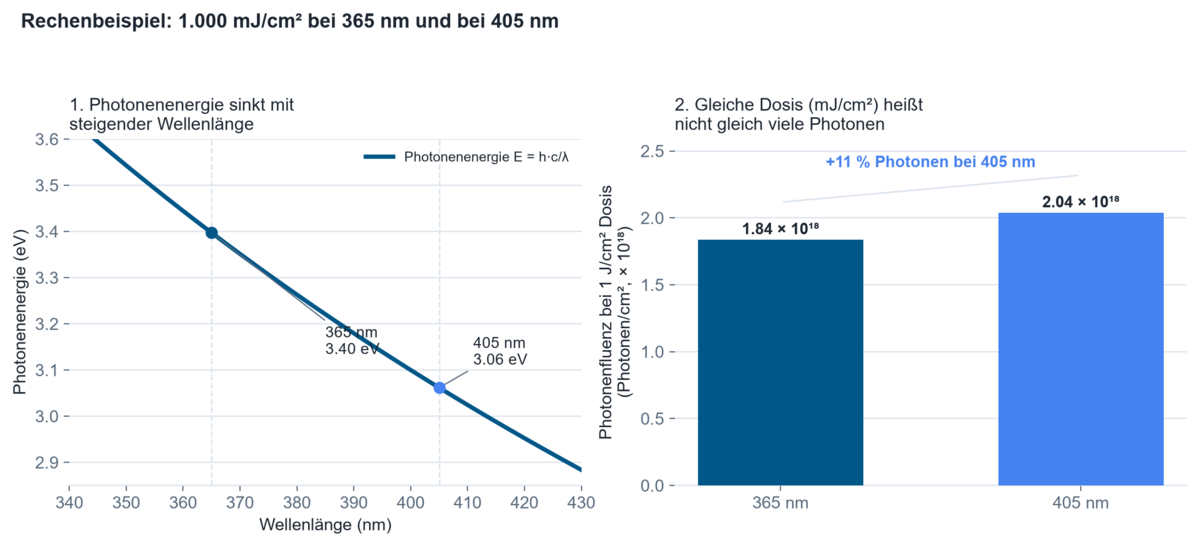
Worked example: Does the same dose at 365 nm and 405 nm mean the same number of photons?
1. Assumptions. Two UV LED sources deliver the same radiometric dose of 1,000 mJ/cm² (1 J/cm²) at the workpiece – once at 365 nm, once at 405 nm.
2. Model. The energy of a single photon follows from Ephoton = h·c/λ, with Planck's constant h, the speed of light in vacuum c, and the wavelength λ. The photon fluence per unit area follows from Φ = D / Ephoton.
3. Calculation. With h·c ≈ 1239.8 eV·nm, the photon energy at 365 nm is roughly 3.40 eV (5.44 × 10⁻¹⁹ J), and at 405 nm roughly 3.06 eV (4.90 × 10⁻¹⁹ J). At an identical dose of 1 J/cm², this gives a photon fluence of roughly 1.84 × 10¹⁸ photons/cm² at 365 nm versus roughly 2.04 × 10¹⁸ photons/cm² at 405 nm.
4. Result. At a numerically identical dose, the 405 nm source delivers roughly 11 percent more photons than the 365 nm source.
5. Technical interpretation. Photopolymerization is fundamentally a quantum process: each absorbed photon can trigger, at most – moderated by the initiator's quantum yield – one primary photochemical event. Dose in mJ/cm² is an energy-based, not a photon-based, quantity. Two processes with identical dose at different wavelengths are therefore not fundamentally equivalent photochemically, even before differences in extinction coefficient and penetration depth are considered. For transferring a process between different wavelengths, the dose figure alone is not sufficient.
Where is UV curing used?
Coatings for furniture, flooring and building components. High throughput on web-fed lines and the demand for scratch and chemical resistance make UV coatings economically attractive over solvent-based systems; the main challenge here is uniform curing across the full web width at variable line speeds.
Packaging and digital printing. UV-curable inks and coatings allow immediate further processing without a drying section; besides irradiance, the key requirement is compliance with migration-relevant residual monomer levels for food-contact materials.
Electronics and semiconductor manufacturing. UV-curable adhesives and conformal coatings are increasingly replacing thermally demanding soldering steps; the critical variable is component temperature during cure, since many electronic components allow only a limited thermal budget. In-depth aspects of bonding and encapsulation processes are covered in the article on UV bonding, potting and encapsulation.
Automotive industry and electromobility. UV adhesives fix components in seconds rather than minutes and are increasingly used to assemble battery modules; the critical issue here is accessibility of all bond lines, since housings and densely packed assemblies often create shadowing.
Additive manufacturing and 3D printing. Vat photopolymerization processes such as stereolithography, DLP and LCD printing create parts through spatially controlled exposure and often only reach their final state in a separate post-cure step; the central requirement is a dose that is homogeneous across the entire part. Details are covered in the article on additive manufacturing and 3D printing.
Dental technology and medical devices. Composite fillings, aligners and custom-made hearing aid shells are applied light-curing; here, penetration depth into an often several-millimetre-thick, filled mass is the critical process variable, since an incompletely cured bottom zone compromises the mechanical and biocompatible properties of the product.
Optics and precision components. For bonding optical components, cationically curing systems with low shrinkage are preferred, to minimize dimensional change and optical distortion.
How are microstructures, thick parts and pigmented formulations cured?
Two-photon polymerization. With focused, pulsed femtosecond laser radiation, photoinitiation occurs only in the region of highest intensity at the focal point, because the absorption probability depends quadratically on irradiance. This nonlinear effect enables feature resolutions below the classical diffraction limit and is used for photonic and micro-optical components, but requires a serially scanning, comparatively slow exposure strategy.
Frontal photopolymerization. In strongly exothermic systems, a locally initiated reaction can generate a self-sustaining, thermally driven reaction front that propagates through the material without further irradiation. This allows curing of optically thick, heavily filled or pigmented parts that would be too thick for straightforward through-cure – but only for formulations with sufficient reaction enthalpy and a controllable front velocity.
Pigmented and opaque systems. As described above, white or highly opaque formulations require photobleaching or longer-wavelength-absorbing initiator systems, sometimes combined with a second, UV-independent crosslinking reaction (dual cure), to reach regions that scattering and absorption by the pigment make optically inaccessible.
Which quantities must be measured or monitored for UV curing?
In series production, spot-check monitoring is not enough, because a source's irradiance and spectrum can shift over its operating life without any outward sign. Continuous inline monitoring, with sensors permanently installed in the beam path – for example with the UV Curing Sensors XT – makes this aging visible before parts are produced outside the qualified process window. The technical significance lies less in the digital interface itself than in the fact that readings are compared against a physically grounded tolerance band in real time, so deviations are recognized immediately as a process deviation – not only later as scrap at the part. Combined with dose-controlled rather than time-controlled endpoints, as implemented by the UV-MAT, exposure can be kept constant even as the source's output declines over time.
For designing and qualifying a curing process, the spectrally resolved irradiance at the actual reaction site is the primary measurand, from which dose is obtained by integrating over time. A pure broadband measurement is sufficient when the source and process window are already known and stable and only recurring checks against a qualified limit are required – a broadband radiometer such as the RMD Pro with a matching sensor head is suited to this. A spectral measurement becomes necessary as soon as sources are compared, a switch is made to a different technology, or photoinitiators with a narrow absorption band are used – a broadband sensor can produce substantially deviating readings under narrowband LED spectra due to spectral mismatch between sensor responsivity and initiator absorption; a flat spectroradiometer such as the UVpad is suitable for this. Spatially resolved measurements are indicated where uniformity across an area or a complex part must be ensured, for example when post-curing additively manufactured parts; time-resolved measurements are necessary when a workpiece passes through an irradiation zone and experiences a characteristic profile of rise, maximum and fall, whose time integral can differ from a static measurement – a high-resolution dose profile on fast-running lines is provided by curelog. Because UV radiometers do not detect infrared radiation, the thermal side of the process is usually tracked separately as part temperature via a non-contact pyrometer. A general introduction to UV measurement technology is offered by the UV FAQ, and an overview of suitable sensors is available under selecting UV sensors.
What does published research from customers show?
Under the topics Photochemistry and Polymer Research and Stereolithography, Crosslinking, Coatings, the topic overview of customer publications lists around 20 works in total; the following six illustrate the range of photopolymerization – from interfacial chemistry to controlled reaction management to bio-based formulation.
Examines the oxygen-affected zone in multilayered photopolymers – the effect that leaves the surface tacky while the bulk is fully crosslinked.
Pierrel, J., et al. “Effect of the oxygen affected layer in multilayered photopolymers.” Polymer Chemistry 8.31 (2017): 4596–4602. DOI: 10.1039/C7PY00974G.
Describes a light-activated, controlled-radical polymerization – an example of light serving as a control variable rather than merely an energy source.
Bonda, Lorand, et al. “TIRP – Thiol-Induced, Light-Activated Controlled Radical Polymerization.” Macromolecules 56.14 (2023): 5512–5523. DOI: 10.1021/acs.macromol.3c00789.
Runs a photoRAFT polymerization continuously in microflow, where layer thickness and penetration depth are deliberately kept small.
Wenn, Benjamin, and Tanja Junkers. “Continuous microflow photoRAFT polymerization.” Macromolecules 49.18 (2016): 6888–6895. DOI: 10.1021/acs.macromol.6b01534.
Shows, for ultrafast-curing acrylates, how comonomer choice and amount shift the thermomechanical properties.
Böhm, Michael, et al. “Influence of co-monomer-type and amount on thermomechanical properties of ultrafast-curing acrylic resins using a triacrylic crosslinker.” Journal of Applied Polymer Science 136.13 (2019): 47294. DOI: 10.1002/app.47294.
Tunes the cure kinetics of a bio-based photopolymer via the degree of methacrylation.
Mhirsi, Oumaima, Mehmet-Talha Yapa, and Marie-Pierre G. Laborie. “Photocurable Lignin Materials: Tuning Lignin Methacrylation to Tailor Photocuring Kinetics.” Macromolecular Materials and Engineering 311.1 (2026). DOI: 10.1002/mame.202500372.
Uses a light-induced reaction for targeted surface modification rather than bulk curing.
Siegmann, Konstantin, et al. “Photografting of perfluoroalkanes onto polyethylene surfaces via azide/nitrene chemistry.” Applied Surface Science 396 (2017): 672–680.
Technical background and further reading
- European Commission: Mercury – implementation of the Minamata Convention in EU law, revised Mercury Regulation (in force since 30 July 2024), 2026.
- IEC 60050 – International Electrotechnical Vocabulary, definitions of the Bunsen–Roscoe reciprocity law and reciprocity failure.
- DIN 5031 – Optical radiation physics and illuminating engineering, quantities, symbols and units.
- Mordor Intelligence: UV Curing System Market – Size, Share, 2026–2031, market data as of 2026.
- Grand View Research: Photopolymers Market Size & Share Report, 2025–2033, market data as of 2025.
- Pierrel, J., et al.: “Effect of the oxygen affected layer in multilayered photopolymers.” Polymer Chemistry 8.31 (2017): 4596–4602 – peer-reviewed primary source on oxygen inhibition.
FAQ on UV curing and photopolymerization
How does UV curing work chemically?
A photoinitiator absorbs radiation of a suitable wavelength and decomposes into reactive species – free radicals for acrylates, a photoacid for epoxides – which trigger a chain reaction that converts monomers and oligomers into a crosslinked polymer.
Which wavelength suits which process?
That depends on the absorption band of the photoinitiator used; 365, 385, 395 and 405 nm are among those common in industry. What matters is the spectral overlap between source and initiator, not the source's irradiance alone.
What UV dose is required for a complete cure?
That depends on the formulation and layer thickness and cannot be generalized. Because of possible reciprocity failure, a dose qualified at a given irradiance also cannot be transferred without verification to a source with markedly different irradiance.
What is the difference between a mercury vapor lamp and a UV LED?
Mercury lamps emit broadband at high power density but age faster and contain mercury. UV LEDs emit narrowband at discrete peak wavelengths, switch instantly, age more slowly and operate more efficiently electrically, but require a formulation matched to the narrow band.
Why does a UV coating fail to cure through despite sufficient lamp power?
Common causes include a lack of spectral overlap between source and initiator, loss paths between electrical power and the actual irradiance at the workpiece, insufficient penetration depth due to pigmentation or layer thickness, and oxygen inhibition at the surface. The underlying definitions and units are listed in the overview of radiometric quantities.
How is UV dose measured in practice?
Using a radiometer or spectroradiometer at the actual process position, which captures irradiance and integrates it over time to obtain dose. For narrowband sources, a spectral measurement is preferable to a pure broadband measurement, to avoid spectral mismatch.
What role does oxygen play in UV curing?
In radical systems, oxygen competes with chain growth and creates an incompletely crosslinked boundary layer at the surface. Cationic systems are largely insensitive to oxygen but continue to post-cure after irradiation ends.
Related application fields
This application is closely related, technically, to neighbouring fields of optical radiation measurement – for example UV bonding, potting and encapsulation (electronics and battery assembly with UV adhesives) and additive manufacturing and 3D printing (vat photopolymerization as a specialized UV curing technique).
Author: Dr. Mark Paravia
Dr.-Ing. Mark Paravia is the managing director of Opsytec Dr. Gröbel GmbH in Ettlingen and heads the accredited calibration laboratory. Following his research on pulsed xenon excimer discharges at the Institute of Lighting Technology at KIT, his current focus is on optical radiation measurement technology. He is a recognized UV expert, vice-chair of the DIN Standards Committee FNL 7 “Optical Radiation,” and a member of the DVGW Project Group on UV Disinfection.
Not sure whether your formulation still cures within its qualified window under the source actually in use?
A dose figure on a data sheet does not answer whether spectrum, irradiance and oxygen conditions on your line match the qualification conditions. A spectrally resolved measurement at the real process location shows whether source and photoinitiator actually match – the basis for a defensible process qualification instead of an estimate based on lamp power. Talk to us about your measurement or testing task.