

UV Radiation in Water and Environmental Technology: Disinfection, Photolysis and Advanced Oxidation
UV radiation serves three technically distinct tasks in water and environmental technology: inactivating micro-organisms (disinfection), directly breaking down dissolved substances through photochemistry (photolysis), and generating reactive radicals in combination with oxidants (Advanced Oxidation Processes, AOP). All three rely on the same physical quantity: fluence, i.e. the radiant energy per area actually absorbed in the medium, not the irradiance measured at the lamp or the reactor wall. The central technical challenge is inferring the dose acting throughout the flowing volume from an irradiance measured at a single point. Wavelength, optical path length, transmittance of the medium and residence time distribution are jointly decisive for this – a single parameter is not enough.
How is the market for UV water technology developing?
The global market for UV disinfection equipment was estimated at roughly 5.63 billion US dollars in 2025 and is expected to reach about 6.25 billion US dollars in 2026; by 2034 it is forecast to grow to 15.59 billion US dollars at an annual growth rate of 12.1 percent (Fortune Business Insights, 2026). Water and wastewater treatment is the largest application segment. An independent survey arrives at a comparable growth rate of around 12 percent for 2024–2029 and identifies Asia-Pacific as the fastest-growing region (Mordor Intelligence, 2025).
Within this market, the technology base is shifting noticeably toward semiconductor sources: the global UV-LED market is valued at roughly 1.6 billion US dollars for 2025 and is expected to grow to 12.4 billion US dollars by 2035, at an annual growth rate of 23.5 percent between 2026 and 2035; the UV-C segment (200–280 nm) grows even faster, at around 25.3 percent per year (Global Market Insights, 2026). This analysis names the revised EU Mercury Regulation as an explicit regulatory driver: it prohibits the manufacture, import and export of mercury-containing lamps from the end of 2026, favouring mercury-free alternatives – background on these sources is covered in UV-LEDs for UVA, UVB and UVC applications.
A second regulatory driver lies in the wastewater sector: the EU Urban Wastewater Treatment Directive (Directive (EU) 2024/3019) obliges treatment plants serving 150,000 population equivalents or more to introduce a fourth treatment stage for removing micropollutants, phased at 20 percent of plants by 2033, 60 percent by 2039 and all affected plants by 2045, with a required average elimination performance of at least 80 percent against defined indicator substances. Recognised processes for this stage include the combinations ozone plus UV, hydrogen peroxide plus UV, and titanium dioxide plus UV. This requirement acts directly on the process side: where a plain reduction in germ count used to suffice, a documented removal performance referenced to indicator substances is now additionally required – with correspondingly higher demands on dose control, matrix characterisation and evidence.
For market definition it matters that “UV disinfection equipment” and “UV-LED market” use different boundaries and include applications outside water and environmental technology (surface, air and food disinfection); the figures quoted should therefore be read as indicators of technological direction, not as an exact figure for the water-treatment sub-market alone.
The shift from mercury lamps to UV-LEDs is the most significant technical trend in this field. Technically, the electrical efficiency of UV-C LEDs around 265 nm remains clearly at a disadvantage, historically 1 to 6 percent against roughly 35 percent for low-pressure lamps; however, newer devices validated under laboratory conditions by the German national metrology institute (PTB) already achieve more than 10 percent efficiency at 265 nm, or 7.5 percent at a comparable wavelength – an improvement that is shifting the practical application range of UV-LEDs from small point-of-use systems increasingly toward larger municipal applications.
With the growing spread of UV-LEDs with freely selectable, manufacturer-dependent peak wavelengths, the traditional validation practice referenced exclusively to 254 nm is losing general applicability. An international professional body (International Ultraviolet Association) therefore published a peer-reviewed framework developed by a task force in 2023, recommending that disinfection benchmarks no longer be referenced exclusively to 254 nm, that germicidally weighted sensors be used, and that under intermittent operation it be specifically checked whether unirradiated water can bypass the reactor during the switch-on delay (IUVA Task Force, 2023).
How does UV radiation act in water?
UV radiation in the roughly 200 to 300 nm range is strongly absorbed by nucleic acids, with an absorption maximum near 260 nm. This absorption produces photoproducts in DNA and RNA, chiefly cyclobutane pyrimidine dimers, which disrupt replication and transcription and thereby reproductively inactivate the micro-organisms. Unlike chemical disinfectants, no reaction with the surrounding water occurs in the classical sense; UV acts photophysically on the target organism itself. In direct photolysis, the dissolved substance to be treated instead absorbs the radiation and is altered or cleaved in its molecular structure. In Advanced Oxidation Processes, an additional oxidant – usually hydrogen peroxide, less often chlorine, persulfate or ozone – is cleaved by UV photolysis; the resulting hydroxyl radicals react almost unselectively with organic molecules in the water. Which mechanism dominates depends on the spectrum applied and the absorption behaviour of the water matrix.
Which technologies are used?
Different radiation sources serve the three mechanisms described above, and they differ markedly in spectrum, electrical efficiency and operating behaviour.
| Technology | Characteristics | Advantages | Limitations | Typical application |
|---|---|---|---|---|
| Low-pressure mercury lamp | Near-monochromatic at 254 nm | High electrical efficiency, roughly 35 percent of electrical power converted to UV radiation; long track record; basis of most approval standards | Fixed wavelength; sometimes lower effectiveness against particularly resistant organisms such as adenoviruses, depending on their short-wavelength absorption behaviour | Drinking-water disinfection, municipal wastewater disinfection |
| Amalgam lamp | Low-pressure principle with mercury amalgam for vapour pressure stabilisation | Higher UV output per lamp length than a classic low-pressure lamp, more compact design | More sensitive to water temperature at the lamp sleeve; higher cooling effort | Large-volume drinking-water and wastewater plants |
| Medium-pressure mercury lamp | Polychromatic spectrum across UV-C, UV-B and UV-A | Effective even against UV-resistant organisms (e.g. adenoviruses); compact design at high power density | Lower electrical efficiency; broader spectrum complicates dosimetric assessment; more photoproduct formation possible in AOP | Wastewater disinfection, industrial process water treatment, AOP |
| UV-LED (AlGaN semiconductor) | Selectable peak wavelength from UV-A to UV-C, instantly available with no warm-up time | No mercury, compact, suited to intermittent operation, long lifetime in the range of several 10,000 hours | Electrical efficiency historically well below mercury lamps (often 1 to 6 percent); newer UV-C devices reach over 10 percent under laboratory conditions at 265 nm | Point-of-use systems, small flows, plants with frequent on/off cycling |
| Excimer source (e.g. KrCl, 222 nm) | Pulsed or continuous discharge in a noble-gas/halogen mixture, narrow-band emission in the far-UVC range | Shallower penetration depth into organic material, potentially reducing by-product formation on surfaces and thin films | Mostly unsuitable for bulk-volume applications in turbid or optically dense media because of limited penetration depth; market availability for water applications still limited | Near-surface and thin-film applications, research |
For Advanced Oxidation Processes and photocatalytic processes, the wavelength must additionally be matched to the absorption range of the oxidant or semiconductor: hydrogen peroxide absorbs in the UV-C and UV-B range, while photocatalytically active semiconductors such as titanium dioxide are mainly excited in the UV-A range around 365 nm – background on this is covered in Photocatalysis: Mechanism, Materials and Metrology.
Which process parameters are decisive?
- Fluence or UV dose (mJ/cm² or J/m²): The product of fluence rate and residence time determines the inactivation or degradation achieved. It is the actual effective quantity, not the electrical lamp power.
- Fluence rate or irradiance (mW/cm²): This describes the photon power per area at a given location and varies strongly across the reactor depending on distance from the source and local absorption.
- UV transmittance (UVT, usually at 254 nm, referenced to 1 cm or 10 mm path length): This determines how quickly the radiation is attenuated with increasing path length and must therefore feed directly into the calculation of the mean fluence in the reactor volume.
- Hydraulic residence time distribution: In flow-through reactors, not every water parcel receives the same residence time; short-circuit flow leads to under-dosed sub-flows even when the mean residence time appears sufficient.
- Turbidity and particle content: Particles can enclose or attach to micro-organisms and thereby shield them from radiation, independent of the UVT measured for the water as a whole.
- Dissolved organic carbon, alkalinity, nitrate, halides: In AOP processes these parameters act as radical scavengers or competing absorbers and change the usable radical yield independent of the photon dose delivered.
- Temperature and pH: Both influence the reaction kinetics of photolysis and oxidation as well as the physiological repair mechanisms of micro-organisms after irradiation.
What limits the process or causes errors?
The electrical power of a lamp is not an optical dose. Several conversion steps lie between electrical input power and the effective radiation actually arriving in the medium: the electro-optical efficiency of the source, the spectral weighting onto the relevant effect range, the geometric coupling into the reactor volume, and absorption in the medium itself. Doubling the lamp power therefore does not necessarily double the inactivation performance.
A time value alone is likewise insufficient if the fluence rate is not constant over the course of the process. Ageing lamps, fouled quartz sleeves and changing water turbidity shift the fluence rate actually present, so the same exposure time in operation delivers a different dose than at commissioning.
Turbidity and particle association are frequently underestimated. Studies on goethite-bound bacterial cells show that turbidity values between 1 and 50 NTU can already produce a measurable protective effect against UV inactivation, because particles shield the micro-organisms without the UVT measured in the clear-water fraction changing accordingly. A representative UVT measurement therefore does not necessarily describe the dose actually effective in a particle-laden matrix.
Not every target organism responds to the same fluence with equal sensitivity. Adenoviruses are considered comparatively resistant to monochromatic 254 nm radiation because their double-stranded DNA can be repaired via host-cell reactivation; polychromatic medium-pressure radiation often achieves higher inactivation at the same 254 nm-equivalent dose, because additional wavelengths trigger other damage mechanisms. A dose validated for Escherichia coli therefore cannot be transferred to other target organisms without verification.
Inactivation is not necessarily permanent after irradiation. Some bacteria carry photolyase enzymes that can repair UV-induced DNA damage upon subsequent exposure to visible or UV-A light (photoreactivation); light-independent dark-repair mechanisms also exist. Medium-pressure radiation reduces photolyase activity more strongly than monochromatic low-pressure radiation, presumably through oxidation of the enzyme's flavin cofactor – an effect relevant when selecting a light source for applications with subsequent light exposure.
Finally, the reciprocity law (Bunsen-Roscoe law), under which the same photochemical effect is determined by the product of irradiance and time, holds only in a limited way in biological systems. At very low dose rates, physiological counter-regulation can partially compensate for the effect; deviations from the simple time-intensity equivalence have also been observed at very high or very low irradiances. For many technical UV water applications within the usual operating range, reciprocity holds approximately, which is supported by studies on solar water disinfection showing comparable inactivation rates over a certain intensity range (MDPI Water, 2024); however, it must not be applied unchecked to extreme operating conditions or to all organisms.
What influence do spectrum, material and geometry have?
Attenuation of the radiation in water follows the Lambert-Beer law and is wavelength-dependent: short-wave components are generally absorbed more strongly than longer-wave ones. An irradiance measured broadband at the reactor wall therefore does not describe the spectrum arriving at greater depth in the medium – a polychromatic source effectively becomes a different, spectrally shifted source inside an absorbing medium. For processes whose mechanism is wavelength-dependent (such as the photolysis of hydrogen peroxide in the UV-C range versus the excitation of titanium dioxide in the UV-A range), the actually usable effect therefore changes across the reactor depth.
Reactor geometry additionally determines what fraction of the volume is reached with sufficient fluence rate at all. Annular-gap reactors, channel reactors with multiple lamp rows, and reactors with reflective inner surfaces produce different fluence-rate distributions at the same installed lamp power. Quartz sleeves around the lamps reduce direct water contact but, through fouling (scale, iron or biofilm deposits), lead to an operationally increasing, wavelength-dependent loss of transmittance that can go unnoticed without continuous monitoring.
Photon energy, actinometry and the limits of reciprocity
The energy of a single photon follows from E = h · c / λ, with Planck's constant h, the speed of light c and the wavelength λ. At 254 nm this is roughly 4.88 eV, or about 471 kJ/mol referenced to one mole of photons. This energy clearly exceeds the O–O bond dissociation energy of hydrogen peroxide (most commonly quoted at around 210 kJ/mol in the literature), so that a single absorbed 254 nm photon is enough to homolytically split H₂O₂ into two hydroxyl radicals – the basis of the UV/H₂O₂ Advanced Oxidation process.
For calibrating UV sources in the germicidal range, the chemical actinometer based on potassium iodide and potassium iodate has become established (Rahn, Photochemistry and Photobiology, 1997). The quantum yield of this reaction is around 0.75 ± 0.03 at 254 nm and can be corrected for iodide concentration and temperature; the solution absorbs virtually all wavelengths below 290 nm and is optically transparent above 330 nm, making it well suited to determining the incident fluence of a low-pressure mercury source whose emission lies more than 85 percent at 254 nm. Actinometric measurements serve in practice as an independent check on physical radiometer readings, because they capture the photochemically effective fluence through a known reaction rather than a calibrated sensor response.
In regulatory practice, the actual effectiveness of a UV reactor is not determined purely by calculation from irradiance and residence time, but validated through the Reduction Equivalent Dose (RED): a surrogate organism with a known dose-response relationship, calibrated in a laboratory reactor, is passed through the reactor under test; the fluence effective in the reactor is back-calculated from the measured inactivation. This method implicitly accounts for the real fluence-rate distribution, short-circuit flow and geometric effects that a purely computational estimate cannot capture. The dose-response calibration of the surrogate organism required for this takes place under defined sample geometry in irradiation chambers, with dose-based rather than time-based termination of exposure, for example via UV-MAT.
Worked example: how does absorption in the medium change the required exposure time?
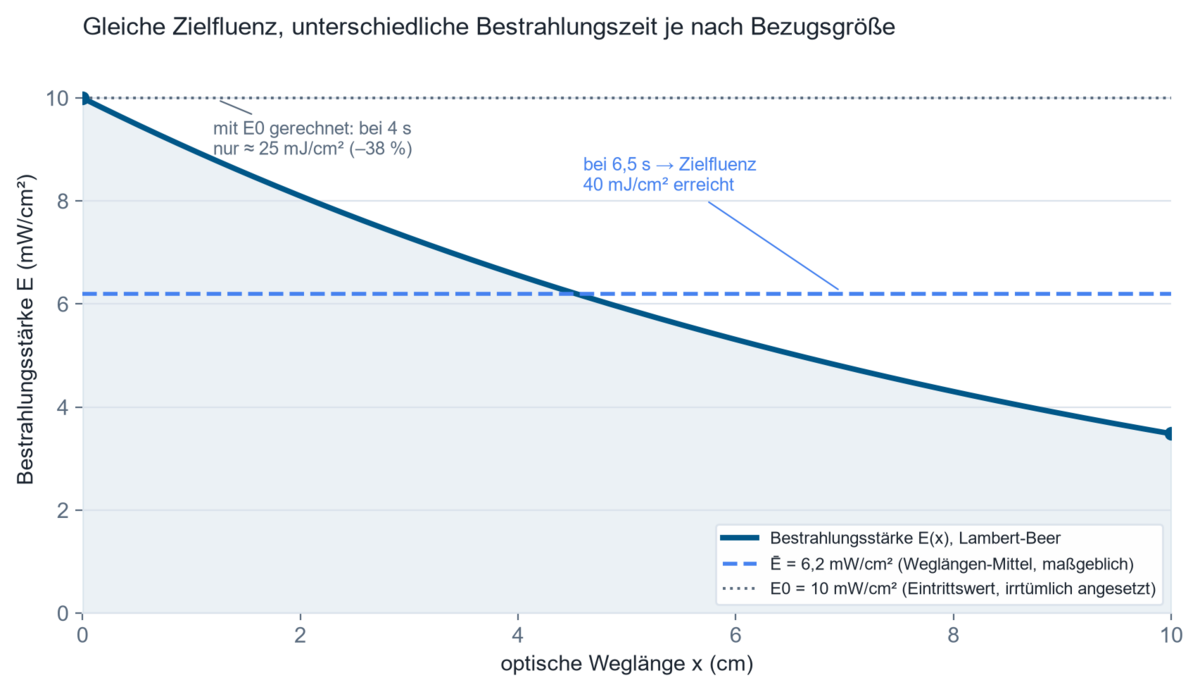
1. Assumptions. A reactor cross-section with an optical path length of 10 cm is flowed through by water with a UV transmittance of 90 percent per centimetre (UVT₁cm = 0.90 at 254 nm). An irradiance of 10 mW/cm² is present at the water inlet side. A fluence of 40 mJ/cm² is required (equivalent to 400 J/m², the minimum value required in Germany for approved UV plants for drinking-water disinfection, referenced to Bacillus subtilis at 254 nm).
2. Model. The decadic absorption coefficient follows from a = −lg(T) / 1 cm = 0.0458 cm⁻¹. The irradiance averaged over the path length L follows from integrating the Lambert-Beer law: Ē = E₀ · (1 − 10^(−a·L)) / (a · L · ln 10).
3. Calculation. With a·L = 0.458, 10^(−a·L) = 0.348; so Ē = 10 mW/cm² · (1 − 0.348) / (0.458 · 2.303) ≈ 6.2 mW/cm². The required exposure time for the target fluence is t = 40 mJ/cm² / 6.2 mW/cm² ≈ 6.5 s.
4. Result. If instead the calculation used the inlet value of 10 mW/cm² without accounting for absorption, this would give a (too short) exposure time of just 4 s. At that time, the fluence actually achieved on average across the cross-section would be only about 25 mJ/cm² – roughly 38 percent below the required value.
5. Technical interpretation. The example shows why an irradiance measured at the inlet side, without knowledge of UVT and optical path length, leads to a systematic overestimate of the effective dose. In practice, this risk is limited by UVT-guided dose-pacing control and by RED-based validation, not by a one-off computational design.
Where is UV technology used in water and environmental technology?
Public drinking-water supply: UV disinfection complements or, combined with a residual disinfectant, replaces chemical processes because it acts without adding chemicals and is effective against chlorine-resistant protozoa such as Cryptosporidium and Giardia. The critical factor here is continuously meeting the minimum dose required by national regulations throughout operation, including lamp ageing and fouling.
Municipal wastewater treatment and the fourth treatment stage: Besides classic effluent disinfection, UV combined with hydrogen peroxide or ozone is gaining importance as a building block of the micropollutant removal required by the EU Urban Wastewater Treatment Directive. Here the critical process parameter is less the pure inactivation dose than the AOP fluence referenced to a measured concentration reduction of defined indicator substances, under a real, organically loaded matrix.
Water reuse: When treating purified wastewater into irrigation or process water, UV is often combined with chlorine or peroxide (UV/Cl₂, UV/H₂O₂) to meet microbiological and chemical requirements at the same time. The more strongly fluctuating and generally lower UVT of these matrices makes continuous transmittance monitoring particularly important.
Industrial process water (semiconductor manufacturing, pharma, food and beverages): In ultrapure-water treatment, UV at 185 nm additionally serves the photochemical breakdown of Total Organic Carbon, while at 254 nm microbiological control is the priority. Here the critical factor is the tight specification of permissible residual germ counts and organic trace substances, requiring a considerably tighter process regime than in municipal water supply.
Swimming pools and recreational waters: UV reduces the formation of chlorinated by-products by lowering the required chlorine excess; the relevant process parameter is the combination of UV dose and residual disinfectant concentration, not UV dose alone.
Aquaculture and ballast-water treatment: Both applications require high flow rates under strongly fluctuating, often low UVT due to organic load and salinity; international regulations such as the IMO Ballast Water Management Convention require demonstrating defined organism reduction rates across different size classes, making application-specific biological validation necessary rather than a purely physical dose calculation.
What helps with turbid raw water, fluctuating flow and high throughput?
For strongly turbid or coloured media with UVT values well below 80 percent, classic design calculations reach their limits, because the effective optical path length is greatly shortened and even small turbidity fluctuations change the effective dose disproportionately; shorter reactor cross-sections, higher installed power densities and close-mesh UVT monitoring are common here. For plants with strongly intermittent or very low flow, UV-LED systems offer an advantage over mercury lamps, which typically need a warm-up phase and age faster with frequent switching, thanks to their instant availability without warm-up time; however, it must be ensured that no unirradiated water can bypass the reactor during operating pauses. At very high flow rates, such as in ballast-water treatment, multiple parallel or series-connected reactor units with medium-pressure lamps are often used to achieve the required fluence despite short residence time. For surface- and thin-film-related special applications, far-UVC excimer sources around 222 nm are increasingly being investigated; their shallow penetration depth is mostly unfavourable for bulk-volume applications in water but can be specifically exploited for thin films or surface treatment.
Which quantities must be measured or monitored?
The starting point for any measurement task is which physical quantity is actually needed for the process assessment. For designing and commissioning a reactor, the fluence rate weighted to the germicidal or photolytic effect range is relevant at several representative positions across the flow cross-section, not at a single measurement point at the reactor wall. For ongoing operation, the UV transmittance of the flowing medium must additionally be continuously recorded, since it changes with raw-water quality and pre-treatment.
A broadband measurement is sufficient when the source is spectrally known and stable, as with monochromatic low-pressure lamps, and when no spectral shift is expected over the operating period. A spectral measurement becomes necessary once polychromatic sources (medium-pressure lamps), UV-LEDs with manufacturer-dependent scattering peak wavelengths, or processes with a wavelength-specific mechanism (AOP, photocatalysis) are used, and whenever spectral changes over lamp lifetime must be documented. The requirements for online sensors for water quality, including response time, linearity and repeatability, are fundamentally described in ISO 15839 and also serve as a framework for UV-specific sensor testing (ISO 15839). An overview of selecting UV sensors by spectral range and measurement geometry, and of how UV sensors work internally, supports this decision.
In larger plants, irradiance is no longer checked only spot-wise but integrated continuously into the plant control system. Dose-pacing control adjusts lamp power or flow rate in real time to the measured UV transmittance and irradiance, so that when water transmittance falls, installed power is automatically increased or flow is throttled to maintain the required minimum dose. This approach replaces the previously common static design for a worst-case operating condition with dynamic control oriented to the actual state, reducing both the risk of under-dosing and the average energy input.
Safety-relevant is the linkage of sensor values to alarm and shutdown logic: if the measured irradiance falls below a defined threshold, the plant must automatically block the affected water stream or switch to a safe operating mode, following the principle described in standards such as DVGW code of practice W 294-1 (DVGW code of practice W 294-1). Digital sensor interfaces additionally allow calibration status and sensor type to be transmitted to the control system, so that unnoticed sensor drift or expired calibration intervals are recognised as a distinct fault cause instead of being misinterpreted as a process deviation. This feedback is a prerequisite for predictive maintenance concepts, in which lamp replacement and quartz-sleeve cleaning are planned according to measured performance decline rather than a fixed interval.
Radiometers with a sensor matched to the respective process are suited to these tasks in laboratory and process applications, such as the RMD Pro. Where polychromatic sources need characterising, or spectral changes over lamp lifetime need tracking, a spectroradiometer such as the SR900, covering 200 to 1100 nm, is appropriate. In technical plants, permanently installed digital sensors such as PLC.D take over ongoing monitoring and additionally report sensor type and calibration status to the plant control system alongside the measured value.
What does published research from customers show?
Under the topic Environmental Technology, the topic overview of customer publications currently lists over 20 papers. The following six illustrate what matters in practice for photolysis and Advanced Oxidation Processes: matrix effects, reactor design, and assessing what remains in the water after treatment.
A study on a TiO₂-coated microfiltration membrane shows, using steroid hormones as an example, how strongly organic background load slows down photocatalytic degradation.
Influence of organic matter on the photocatalytic degradation of steroid hormones by TiO2-coated polyethersulfone microfiltration membrane. Liu, Siqi, Pattabhiramayya C. Edara, and Andrea I. Schäfer. Water Research 245 (2023): 120438. ScienceDirect
A comparative study sets adsorption, photolysis and advanced oxidation side by side for the same active compound and classifies kinetics and reaction pathways.
The fate of aqueous betrixaban during adsorption, photolysis, and advanced oxidation: Removal, kinetics, and reaction mechanisms. Jasemizad, Tahereh, Lev Bromberg, and Lokesh P. Padhye. Journal of Water Process Engineering 44 (2021): 102430. ScienceDirect
Two papers on tricyclic antidepressants specifically examine photo-transformation products and their dependence on pH, concentration and temperature, as well as their biodegradability and toxicity.
Initial fate assessment of teratogenic drug trimipramine and its photo-transformation products – Role of pH, concentration and temperature. Khaleel, Nareman DH, et al. Water Research 108 (2017): 197–211. ScienceDirect
UV-photodegradation of desipramine: impact of concentration, pH and temperature on formation of products including their biodegradability and toxicity. Khaleel, Nareman DH, et al. Science of The Total Environment 566 (2016): 826–840. ScienceDirect
A paper on a continuously flowed, structured reactor describes a reactor type for the photochemical breakdown of dissolved pollutants under flow conditions.
A new continuous flow-through structured reactor for the photodegradation of aqueous contaminants. Fernandez-Perez, Amparo, et al. Journal of Environmental Chemical Engineering 6.4 (2018): 4070–4077. ScienceDirect
A study on removing a cytostatic drug combines advanced oxidation with subsequent aerobic biodegradability and toxicity testing, showing that the decline of the starting concentration alone is not a sufficient assessment criterion.
Removal of the anti-cancer drug methotrexate from water by advanced oxidation processes: Aerobic biodegradation and toxicity studies after treatment. Lutterbeck, Carlos Alexandre, et al. Chemosphere 141 (2015): 290–296. ScienceDirect
Further use cases by topic area are listed in the overview Publications from customers – by topic.
Technical background and further sources
- DVGW German Technical and Scientific Association for Gas and Water, code of practice W 294-1 (December 2023): Planning, operation and monitoring of UV disinfection plants in water supply. DVGW
- DIN EN 14897 / DIN 19294-1: standards for UV devices for drinking-water disinfection inside buildings and in centralised water treatment, respectively. DIN Media
- United States Environmental Protection Agency, Ultraviolet Disinfection Guidance Manual for the Final Long Term 2 Enhanced Surface Water Treatment Rule (2006). US EPA
- International Organization for Standardization, ISO 15839:2003 (EN ISO 15839:2006): Water quality – On-line sensors/analysing equipment for water – Specifications and performance tests. ISO
- International Ultraviolet Association (IUVA) Task Force, “Considerations for determining the performance of ultraviolet light emitting diode (UV-LED) water disinfection systems”, Water Environment Research 95 (2023). PubMed
- European Parliament and Council of the European Union, Directive (EU) 2024/3019 concerning urban wastewater treatment (recast), in particular Article 8 on the fourth treatment stage. EUR-Lex
- A complete overview of applicable UV regulations by country and lamp type is provided in Guidelines, Standards and Norms in UV.
FAQ on UV applications in water and environmental technology
How does UV disinfection of water work physically?
UV radiation around 254 nm is absorbed by nucleic acids in micro-organisms and generates photoproducts there, mainly pyrimidine dimers, which prevent replication and transcription. Micro-organisms are thereby reproductively inactivated, not chemically decomposed. What matters is the total fluence absorbed, not exposure time alone.
What UV dose is required for drinking-water disinfection?
In Germany, approved UV plants must achieve a minimum disinfection performance of 400 J/m² (40 mJ/cm²), referenced to Bacillus subtilis at 254 nm. Internationally, requirements often follow the Reduction Equivalent Dose for Cryptosporidium, Giardia and viruses, which varies depending on target organism and required log reduction.
What distinguishes UV disinfection from Advanced Oxidation Processes?
In disinfection, radiation acts directly on the nucleic acids of target organisms. In Advanced Oxidation Processes, an additional oxidant such as hydrogen peroxide is photolytically cleaved, producing hydroxyl radicals that oxidise dissolved organic substances unselectively. Both processes use the same radiation source but different mechanisms and target quantities.
Why is electrical lamp power not sufficient as a measure of disinfection performance?
Between electrical power and effective fluence lie the electro-optical efficiency of the source, the spectral usability for the target mechanism, and absorption in the medium. These conversion steps are not constant and change with lamp age, fouling and water quality, so the same electrical power can yield different actual doses. Why a power rating is not a measurand in principle is derived under radiometric quantities.
How is the UV dose validated in a flow-through reactor?
The Reduction Equivalent Dose (RED) is determined through biodosimetry: a surrogate organism with a known dose-response curve is passed through the real reactor, and the fluence effective in the reactor is back-calculated from the measured inactivation. This method accounts for real flow effects that a purely computational design cannot capture.
What role does turbidity play in UV disinfection?
Particles can enclose or attach to micro-organisms and thereby shield them from radiation. This effect can already be significant at turbidity values in the low double-digit NTU range and is not fully captured by the UVT measured on a clear water sample.
Are UV-LEDs already an equivalent alternative to mercury-vapour lamps?
For small, intermittently operated systems, UV-LEDs offer advantages through instant availability and freedom from mercury. In electrical efficiency they still lag behind classic low-pressure lamps at roughly 35 percent, historically at 1 to 6 percent, though newer, independently validated devices already exceed 10 percent. For large-volume municipal plants, mercury lamps therefore remain the more economical choice for now in most cases.
How is UV intensity continuously monitored in a plant?
Permanently installed sensors continuously record irradiance and, where relevant, the UV transmittance of the water. If defined thresholds are undershot, automated alarm and shutdown logic triggers a safe operating mode. Digital sensor interfaces additionally transmit calibration status and sensor type to the control system to distinguish sensor drift from genuine process deviations.
How is UVC measured in a water disinfection system?
With a device radiometer built into the reactor, measuring the irradiance at a defined point of the reactor wall; together with the flow rate and the UV transmittance of the water, the fluence is calculated from it. The sensor must be pressure-resistant and solar-blind and calibrated against the lamp type in use. The requirements for device and reference radiometers are set out in DIN 19294-1 and -3 for low pressure and DIN 19294-2 and -4 for medium pressure; DVGW W 294-1:2023-12 now only covers planning, operation and monitoring and no longer contains device requirements. In Austria, ÖNORM M 5873-1 and -2 apply. The operating radiometer is checked regularly against a reference radiometer; in addition the UV transmittance at 254 nm is measured, because it enters the fluence calculation directly.
Related application fields
This application is closely related, technically, to neighbouring fields of optical radiation metrology – for example UV Disinfection (identical mechanisms outside the water matrix, such as for air and surfaces), Photocatalysis (shared reactor principles, semiconductor physics and radical chemistry), and photocatalytic hydrogen production (the same interfacial chemistry, a different target reaction).
Author: Dr. Mark Paravia
Dr.-Ing. Mark Paravia is the managing director of Opsytec Dr. Gröbel GmbH in Ettlingen and heads the accredited calibration laboratory. Following his research on pulsed xenon excimer discharges at the Institute of Lighting Technology at KIT, his current focus is on optical radiation measurement technology. He is a recognized UV expert, vice-chair of the DIN Standards Committee FNL 7 “Optical Radiation,” and a member of the DVGW Project Group on UV Disinfection.
Unsure what fluence actually reaches the reactor cross-section in turbid raw water?
Between the irradiance measured at the reactor wall and the dose actually effective throughout the flowing volume lie UV transmittance, residence time distribution and the spectral composition of the source. Anyone wanting a reliable assessment of these relationships for a specific application, matrix or reactor geometry – from spectral characterisation with the SR900 to standard-compliant reference measurement with the RMD Pro – can turn to Opsytec's calibration laboratory and application engineering. Contact us about your plant or testing task.