

Surface LED series SFL-UV
The UV LED floodlight SFL-UV is a water-cooled high-power source for large-area, uniform UV irradiation. Three light-emitting areas from 100 × 100 mm to 200 × 200 mm are available in the wavelengths 365, 385, 395, 405 and 450 nm; the HO version reaches up to 6000 mW/cm², the ECO version up to 2200 mW/cm², each measured at a distance of 10 mm from the emitting window.
For acceptance testing and routine checks of the irradiance we offer matching UV meters and radiometers.
The SFL-UV modules use an intelligent LED driver. The absence of ineffective infrared radiation reduces the heat compared to conventional UV lamps.
Customized sizes are available on request.
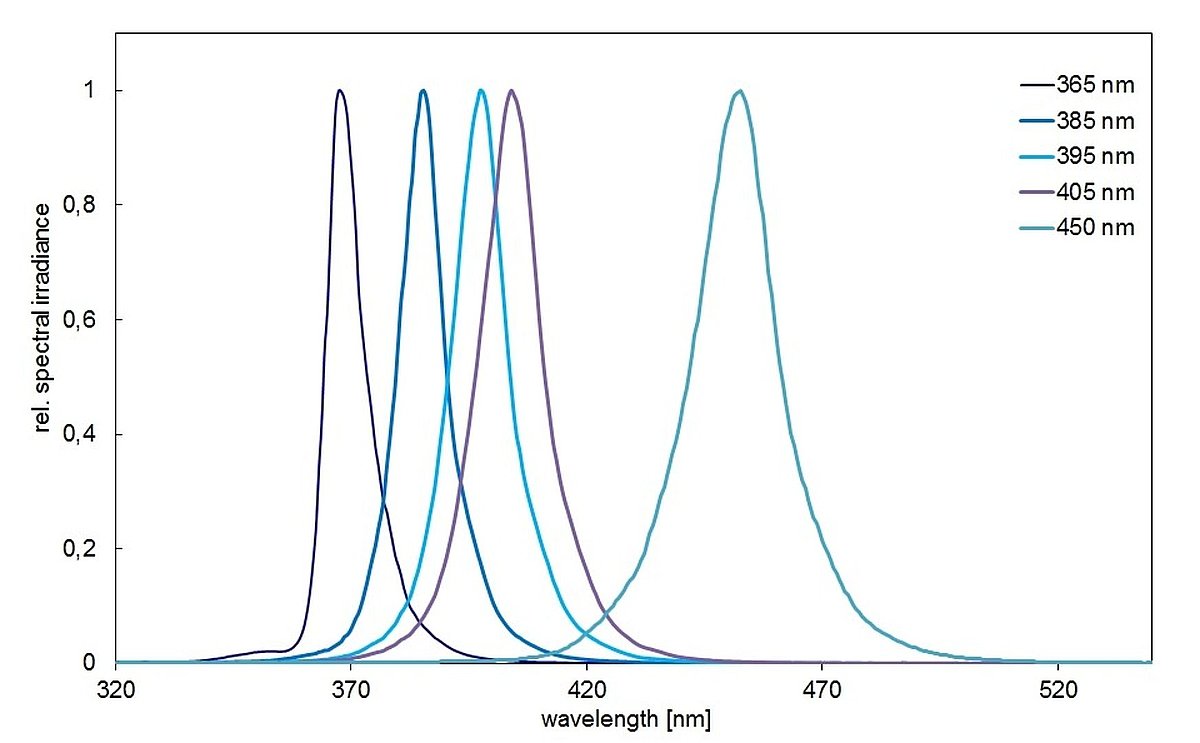
The high irradiance allows extremely short processing times. Wavelengths of 365, 385, 395, 405, and 450 nm are available for many different applications.
We offer the LedControl S as a desktop device and the LedControl DC for top-hat rail mounting to control the UV LED floodlights. The UV floodlights are supplied with the appropriate interfaces.
The LEDControl S can be configured as a master or slave and can be cascaded as required. With the multi-channel LEDControl 5S, up to 5 UV LEDs can be controlled individually. It is controlled via RS485, USB or RS232, which makes it easy to use in industrial production. Digital and analog PLC inputs are also available as an option.
The LEDControl DC is ideal for integration into a PLC and achieves a high performance level.
A timer for the irradiation times between 0.01 s and 9999 s is already integrated. Optionally you can choose between continuous or triggered operation.
The large-area UV LED light source operates reliably with optional internal and external control. The optical feedback option allows for connecting an external sensor to the SF-UV-LED driver. The irradiance can be measured with our long-term stable UV sensors at the desired position. To monitor and control irradiance, the internal feedback diode can be calibrated to the external sensor. The internal feedback keeps the irradiance constant to minimize LED temperature drift and aging.
Applications of surface LED series SFL-UV
- Industrial UV curing and bonding
- IC Encapsulation
- UV sealing
- Hairline / leak detection using fluorescence markers
- Fluorescence Spectroscopy
- Surface Inspection


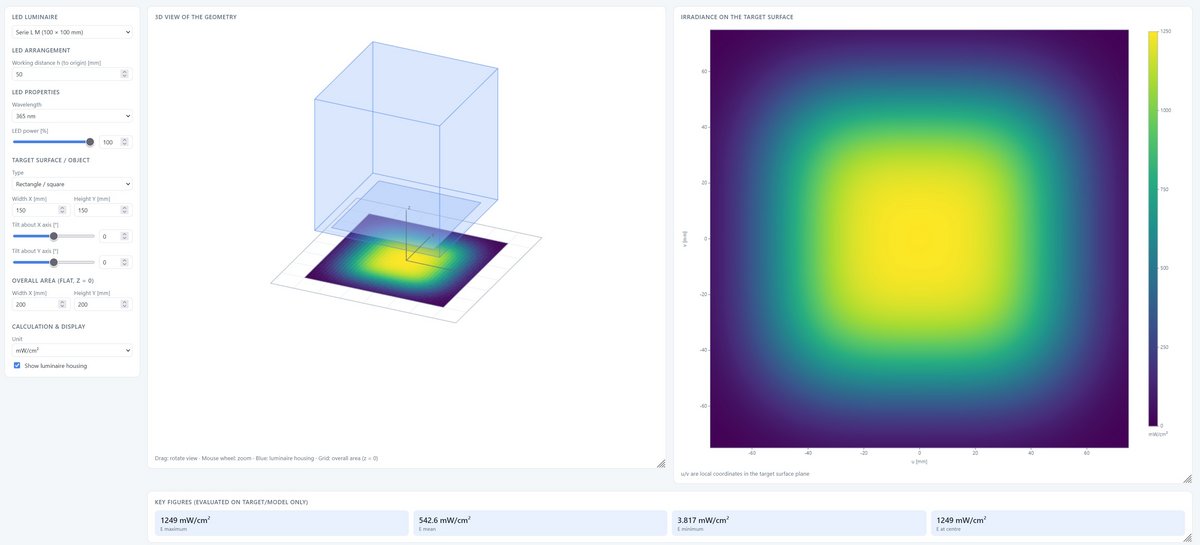
3D Calculation Tool for Custom Designs
Try it out for free!
It also works with step data!
Design the irradiance of the SFL-UV in the 3D calculator
For the SFL-UV, the UV-LED 3D Irradiance Calculator shows how the irradiance develops beyond the nominal distance of 10 mm: emitting area, wavelength, power and working distance can be set, several emitters combined into an array, and the result evaluated on flat, inclined or STEP-imported components.
Common technical data UV-LED flood lamp SFL
| Wavelength | 365, 385, 395, 405 or 450 nm |
| Irradiance 365 nm | 4500 / 1250 mW/cm² |
| Irradiance 385 nm | 6000 / 1600 mW/cm² |
| Irradiance 395 nm | 5800 / 1600 mW/cm² |
| Irradiance 405 nm | 5800 / 1600 mW/cm² |
| Irradiance 450 nm | 6000 / 2200 mW/cm² |
| Emission, peak tolerance | +/- 5 nm |
| Emission, FWHM | 10 - 20 nm |
| Uniformity | >90%, typical in a distance of |
| 10 mm with 5% std. deviation | |
| Cooling water temperature | min 18 °C, non-condensing |
| max 40°C | |
| Connections | Trigger in, dimming in (0-10V), |
| Interlock in, failure out | |
| Programming, optional | RS485, RS232 or USB |
| Internal security circuit | Over-temperature, LED N.C. |
| Optical feedback, opt. | internal and external sensor |
Publications at a glance
Our UV LED area illuminators are used in research, development, and production.
A selection of scientific publications is available here.