
The current RoHS Directive vs. UV lamps and UV LEDs - regulation and development
The RoHS Directive 2011/65/EU restricts hazardous substances in electrical and electronic equipment, mercury among them. Annex III of the Directive grants time-limited exemptions for mercury-containing lamps. Renewal requests have been filed for all UV-relevant exemptions; under Article 5(5) of the Directive they remain valid until the European Commission has taken a decision. For users this means: mercury-containing UV lamps remain available, and it is worth examining whether a process can be converted to UV LEDs.
Status August 2026: The UV-relevant exemptions are currently being assessed under the procedure known as "Pack 29". The stakeholder consultation ran from 6 June to 1 August 2026 and was reported closed by the Oeko-Institut on 2 August 2026. No decision by the European Commission has been published yet. The date of 24 February 2027 given in Annex III is therefore not an automatic ban date for these exemptions.
For general lighting the EU has moved considerably further: numerous exemptions for fluorescent and compact fluorescent lamps have already expired. Developments for UV sources follow a separate track and are described below.
Directive 2011/65/EU ("RoHS 2") replaced its predecessor Directive 2002/95/EC ("RoHS 1") on 3 January 2013 and, as amended from time to time, remains the governing legal basis. "RoHS 3", by contrast, is not the official name of a separate directive. In practice the term is used for Delegated Directive (EU) 2015/863, which added the four phthalates DEHP, BBP, DBP and DIBP to Annex II.
The exemptions in Annexes III and IV of Directive 2011/65/EU are limited in time and are reviewed regularly in the light of scientific and technical progress.
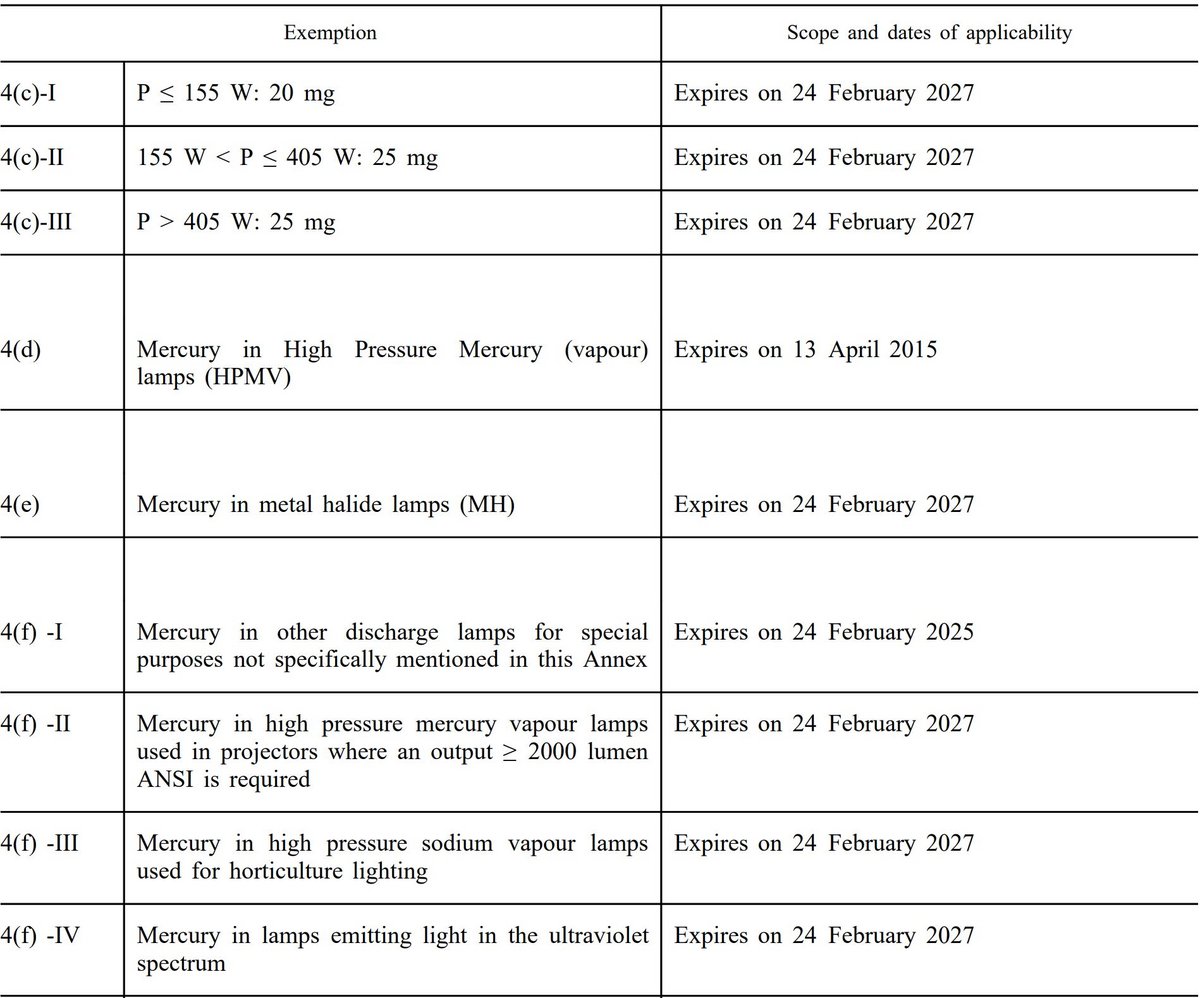
Several exemptions in Annex III of Directive 2011/65/EU are relevant to UV lamps. The published legal status and the ongoing renewal procedure have to be considered separately. The following exemptions carry the expiry date of 24 February 2027 in Annex III and are at the same time subject to the Pack 29 procedure:
- 1(f)-I – single-capped (compact) fluorescent lamps emitting mainly light in the ultraviolet spectrum: up to 5 mg mercury per burner
- 2(b)(4)-II – other fluorescent lamps emitting mainly light in the ultraviolet spectrum: up to 15 mg mercury per lamp
- 4(a)-I – low pressure discharge lamps without phosphor coating, where the application requires the main range of the spectral lamp output to be in the ultraviolet spectrum: up to 15 mg mercury per lamp (UV-C low pressure and amalgam lamps)
- 4(f)-IV – mercury in lamps emitting light in the ultraviolet spectrum (medium and high pressure lamps)
Annex III contains further lamp-related exemptions, for example 4(f)-II for high-pressure mercury (vapour) lamps used in projectors requiring an output of ≥ 2000 ANSI lumens. That exemption is also part of Pack 29.
Special case metal halide lamps: For exemption 4(e) ("mercury in metal halide lamps") the consolidated Annex III likewise states 24 February 2027. It is, however, not included in the published Pack 29 list. Continued validity under Article 5(5) requires a renewal request filed in time, and no such request is documented for 4(e) in the procedural status published so far. Anyone using metal halide lamps – in solar simulation or weathering testing, for instance – should therefore track this point separately rather than infer it from the continued validity of the UV exemptions.
The decisive point: the date of 24 February 2027 given in Annex III does not automatically end an exemption where a renewal was applied for in time. Under Article 5(5) of Directive 2011/65/EU the existing exemption remains valid until the Commission has decided on the request. If a renewal is refused or an exemption is revoked, it expires no earlier than twelve and no later than 18 months after that decision, under Article 5(6).
Where an exemption does in fact expire, the RoHS Directive prohibits the placing on the market of new mercury-containing UV lamps under that exemption. For the UV-relevant exemptions with an ongoing renewal procedure, however, no stop of the placing on the market as of 24 February 2027 has been decided as at August 2026; they continue to apply until the European Commission has taken a decision.
For stock, a distinction has to be drawn between the first placing on the Union market and the subsequent making available on the market. Lamps placed on the market before an exemption expired may continue to be traded and used. This does not apply to stock not yet placed on the market – the blanket statement that all remaining stock may be sold on regardless of its market status is therefore not accurate.
Article 4(4)(f) of the RoHS Directive does not tie the spare parts rule to the installation date of a system. The substance restriction under Article 4(1) does not apply to cables or spare parts for the repair, reuse, updating of functionalities or upgrading of capacity of electrical and electronic equipment which benefited from an exemption and was placed on the market before that exemption expired – in relation to that specific exemption. For UV systems this means: what matters is when the system was placed on the market, not when it was installed at the operator's site. Replacement lamps for systems placed on the market in time therefore remain permissible even after an exemption has expired.
When deciding on RoHS exemptions, the European Commission examines, among other things, whether elimination or substitution is scientifically or technically practicable, whether the reliability of substitutes is ensured, and whether the total environmental, health and consumer safety impacts of substitution are likely to outweigh its total benefits. The availability of substitutes, the socio-economic impact of substitution and any potential adverse impacts on innovation are also taken into account.
In this context, we see the current development of UV LEDs and UV lamps as follows:
The regulations aim to reduce the use of toxic mercury in lamps and switch to mercury-free alternatives such as LED technology in the long term.
For many UVA applications, UVA LEDs (emission at 365 nm and longer wavelengths) are now technically established mercury-free alternatives. Their advantages lie in fast switching, targeted spectral selection, compact designs and the absence of mercury. For new developments and the introduction of new processes we therefore recommend evaluating UVA LEDs. Whether full substitution makes sense depends on the individual process – in particular on wavelength, irradiance or dose, irradiated area, system geometry, efficiency, thermal management, service life and process qualification.
For UV-B and UV-C applications, as well as for high radiant fluxes, large irradiated areas or special spectra, substituting mercury-containing radiation sources is technically more demanding. UV-B and UV-C LEDs have made considerable progress in recent years and are already used in various applications. Technical and economic equivalence cannot, however, be assumed across the board for all UV processes. The availability, practicability and reliability of substitute technologies are therefore a key subject of the ongoing RoHS exemption assessment.
In 2015 and 2020, well-founded renewal requests for the exemptions in Annex III were submitted and decided with the involvement of market participants. For the current round, requests had to be filed under Article 5(5) no later than 18 months before expiry, that is by 24 August 2025. They are being assessed in 2026 under the Pack 29 procedure; the stakeholder consultation ran from 6 June to 1 August 2026 and has been closed since 2 August 2026. A decision by the European Commission has not yet been published. According to the Commission, a decision on a RoHS exemption currently takes 18 to 24 months from the application date; this does not amount to a binding decision date.
Historical development of mercury regulation
The regulation of mercury has a long and complex history that is closely linked to environmental and health disasters. The Minamata disaster in Japan, which began in the 1950s, is particularly noteworthy. The discharge of mercury-containing wastewater into Minamata Bay caused massive environmental damage and serious health effects on the local population. This catastrophe drew global attention to the dangers of mercury and led to increased efforts to regulate the pollutant.
The Minamata Convention aims to protect human health and the environment globally from mercury emissions. It regulates the entire life cycle of mercury, from mining to disposal.
In the European Union (EU), numerous legal measures have been taken in recent decades to minimize the use of mercury. An important milestone was the introduction of the RoHS Directive (Restriction of Hazardous Substances) in 2003, which aimed to restrict the use of certain hazardous substances such as lead, mercury, cadmium, hexavalent chromium and polybrominated biphenyls in electrical and electronic equipment.
The RoHS Directive in force today (2011/65/EU) was adopted in 2011 and is amended continuously; it was this directive that made the exemptions for UV lamps time-limited. Delegated Directive (EU) 2015/863, often referred to as "RoHS 3", added four phthalates to Annex II. This additional substance restriction has applied to most electrical and electronic equipment since 22 July 2019, and to medical devices including in vitro diagnostics as well as monitoring and control instruments since 22 July 2021. The maximum concentration value for mercury remained unchanged; the rules decisive for UV lamps are set out in Annex III and are adapted by delegated acts.
Alongside RoHS there are further EU rules on mercury and chemicals. The REACH Regulation (EC) No 1907/2006 dates back to 2006 and is therefore not a legal act newly introduced since 2022.
For mercury-added products, Regulation (EU) 2017/852 on mercury is also relevant. It was extended by Regulation (EU) 2024/1849 – this is where the dates 31 December 2025 and 31 December 2026 discussed in the industry come from. The entries added there to Part A of Annex II target lamps for general lighting purposes as well as non-linear tri-band and halophosphate lamps. For sources emitting mainly in the ultraviolet spectrum, the exemption system of Annex III of the RoHS Directive remains the decisive benchmark. The scopes of the two sets of rules have to be assessed separately.
Legal requirements in connection with mercury in UV lamps
Directive 2011/65/EU restricts mercury in electrical and electronic equipment in principle to the maximum concentration value laid down in Annex II of 0.1 % by weight in homogeneous materials. UV lamps are used in a variety of applications, including water and air disinfection, in the printing industry and in medical devices. Despite their useful properties, the mercury contained in these lamps poses an environmental and health risk.
For UV lamps, therefore, what matters is not only the general mercury limit but above all the applicable exemption in Annex III, with its precise scope and its own quantity limit – 5 mg per burner under 1(f)-I, up to 15 mg per lamp under 2(b)(4)-II and 4(a)-I. Manufacturers and importers must ensure and demonstrate compliance with the substance restrictions: through the technical documentation, the conformity assessment procedure, the EU declaration of conformity and the CE marking of the product. The RoHS Directive does not impose a general, self-standing obligation to label each UV lamp separately with its mercury content; additional labelling obligations may, however, arise from other rules.
Phasing out mercury in lamps: technical alternatives and challenges
The phasing out of mercury in lamps poses both technical and economic challenges. Mercury is an essential component in many UV lamps, as it is a very effective and stable source when irradiated with UV light. The development of mercury-free alternatives therefore requires considerable research and development efforts.
UV LEDs are a promising alternative to mercury-containing UV lamps. These lamps use semiconductor technology instead of mercury and offer numerous advantages, including a longer lifetime, lower energy consumption and immediate operational readiness without warm-up time. Despite these advantages, UV LEDs are not yet able to fully match the performance of mercury vapor lamps in certain applications (e.g. in UV-C or UV-B or at high radiation fluxes). Further technological progress is required, particularly in high-performance applications and in water disinfection, to enable complete substitution.
The market for UV lamps has changed considerably in recent years. While mercury-containing UV lamps are still available, the demand for environmentally friendly alternatives is steadily increasing.
In addition to UV LEDs, there are other technologies that can be considered as alternatives to mercury-containing UV lamps. For example, excimer lamps offer a mercury-free option that is highly efficient and effective in certain applications. These lamps generate UV light through the excitation of noble gases and therefore offer an environmentally friendly solution for specific applications.
Overall, it is clear that the regulation of mercury in UV lamps presents both a challenge and an opportunity for innovation. Companies need to proactively address the legal requirements while investing in the development and implementation of environmentally friendly alternatives.
The further regulatory course is open as at August 2026. Under the Pack 29 procedure the renewal requests submitted are being assessed. Possible outcomes are a renewal, an amendment or narrowing of an exemption, or a refusal followed by a transition period of twelve to 18 months. A reliable sequence in which individual UVA, UVB or UVC technologies would be restricted in future cannot be derived from the published EU legal and procedural status.
Our assessment: Should a staggered restriction come, we expect low-power UVA applications to be affected first, because mature alternatives are available there in the form of UVA LEDs. For high-wattage UV sources and for UVB and UVC applications we see no broadly equivalent replacement for the foreseeable future. This is a technical assessment, not a statement on the outcome of the ongoing procedure.
Author: Dr. Mark Paravia
Dr.-Ing. Mark Paravia is the managing director of Opsytec Dr. Gröbel GmbH in Ettlingen and heads the accredited calibration laboratory. Following his research on pulsed xenon excimer discharges at the Institute of Lighting Technology at KIT, his current focus is on optical radiation measurement technology. He is a recognized UV expert, vice-chair of the DIN Standards Committee FNL 7 “Optical Radiation,” and a member of the DVGW Project Group on UV Disinfection.