

Pharma Photostability: Photostability Testing under ICH Q1B
Photostability describes how well a drug substance or finished drug product withstands visible light and near-UV radiation. Photostability testing under ICH Q1B is the internationally harmonised test used to determine whether light exposure causes an unacceptable change in the active substance, appearance, or assay result. The central technical challenge is that photochemical reactions are not driven by a lamp's electrical power, but by the spectral irradiance actually reaching the sample position and the resulting cumulative dose. The decisive quantities are illuminance in lux, or lux-hours, for the visible range, and irradiance and dose in the near-UV range (320–400 nm) in W/m² and Wh/m² respectively. The test result forms the basis for packaging and labelling decisions in the marketing authorisation process.
How is the market for photostability testing developing?
Photostability testing is a regulatory-mandated part of pharmaceutical stability testing and is therefore closely tied to the growth of drug development, the number of marketing authorisations, and contract research. A clearly delineated market figure specifically for "photostability testing" does not exist, since it is usually billed as part of larger stability and analytical testing services. The broader market for pharmaceutical stability and storage services can serve as a market indicator: it was estimated at around USD 1.92 billion in 2024 and is projected to grow to about USD 2.80 billion by 2030, corresponding to a compound annual growth rate (CAGR) of 6.48 percent (Grand View Research, 2025). Within this market, stability testing itself – including photostability – forms the largest single segment at around USD 1.41 billion (2024), growing at 6.7 percent CAGR to a projected USD 2.08 billion by 2030 (Grand View Research, 2025).
A narrower indicator for the testing equipment itself is the global market for photostability chambers, estimated at around USD 1.5 billion in 2025 and projected to grow to about USD 2.6 billion by 2035 (CAGR 5.2 percent); pharmaceutical and biotechnology applications are the dominant end use (Future Market Insights, 2025). The market for outsourced pharmaceutical analytical testing – which also includes stability testing – shows above-average growth with an expected CAGR of 8.5 percent (2025–2030, from USD 8.96 to 14.56 billion) (Grand View Research, 2025), pointing to a growing shift of stability studies towards contract laboratories (CROs/CDMOs).
More significant for the underlying technology than the market figures themselves is a shift in demand: a growing portfolio of biologics and complex dosage forms increases the number of photostability-relevant test items per submission, since formulations, primary packaging, and in some cases combination products must be tested alongside classical drug substance solutions. At the same time, regulators in growing approval markets – including the Asia-Pacific region – increasingly require ICH-compliant photostability data, which structurally favours harmonised testing methodology and, with it, demand for ICH-Q1B-compliant test equipment. In practice, growth in this field means more parallel test approaches per development programme, higher requirements for dose traceability (GMP documentation), and a growing need for automated, continuously logging irradiation control instead of manual time-based control.
Also regulatory-relevant is the ongoing consolidation of the ICH stability guidelines: a draft of the new, consolidated ICH Q1 guideline (step 2b, under consultation since April 2025) is meant to replace the previous individual guidelines Q1A–F and Q5C, and adds principles for newer product classes such as ATMPs and complex biologics (EMA, ICH Q1 guideline, 2025).
Four developments affect the practice of photostability testing:
Transition from fluorescent lamps to LED-based light sources. Classical near-UV fluorescent lamps often need to be replaced after just a few thousand hours of operation, while modern LED modules achieve considerably longer service lives in comparable applications. The technical consequence: less frequent requalification after lamp changes, but a greater need to demonstrate during initial qualification that the LED spectrum actually meets the cool white requirement from ICH Q1B, since LED spectra typically show a different line structure than fluorescent lamps.
Dimmability without spectral shift. With classical gas-discharge lamps, reducing electrical power often also changes the emission spectrum; modern LED drivers allow power reduction while keeping the spectral distribution largely stable, making it easier to maintain tight irradiance targets over the entire test duration.
Increasing spectroradiometric verification instead of pure broadband control. Since the required distribution across two UV sub-bands (320–360 nm, 360–400 nm) cannot be checked with a single broadband sensor, qualification practice is increasingly shifting towards spectrally resolving measurement systems, especially at initial commissioning and after lamp changes.
Regulatory consolidation. The consolidated ICH Q1 guideline currently in draft is intended to replace the previous individual documents Q1A–F and Q5C, and to add explicit principles for newer product classes (ATMPs, complex biologics, combination products) – with potential effects on photostability testing requirements for these product classes (EMA, ICH Q1, 2025).
How does photostability testing under ICH Q1B work?
Photostability testing examines photochemical reactions: a molecule with a suitable chromophore (e.g. an aromatic ring, a carbonyl group, a conjugated system) absorbs a photon in the UV or visible range and is thereby promoted to an electronically excited state. From this state, follow-on reactions can occur – photolysis, photooxidation (often involving dissolved oxygen), isomerisation, or bond cleavage – leading to degradation products, colour change, or loss of active substance. Whether and how strongly a substance reacts depends on its absorption spectrum, its quantum yield, and the matrix it is present in.
ICH Q1B requires that the drug substance and finished product be exposed to a defined light exposure covering both the visible range and the near-UV range (320–400 nm), because many pharmaceutical chromophores absorb precisely in this transition region. In parallel, a light-protected control sample (typically wrapped in aluminium foil) is run under identical thermal conditions. Only the difference between the irradiated sample and the dark control is counted as a photolytic effect – this separates out purely thermal degradation effects that occur during the often multi-hour exposure. Appearance, clarity/colour of solutions, assay, and degradation products are evaluated using a method validated for photochemical degradation products.
Which light sources are used for photostability testing?
ICH Q1B defines two permitted light source options, both aimed at simulating daylight or indirect indoor daylight, but technically quite different (ICH Q1B Guideline, EMA/ICH):
Option 1 uses a single light source whose emission resembles the D65/ID65 standard – for example a combination daylight fluorescent lamp, a xenon arc lamp, or a metal halide lamp. D65 is the internationally recognised standard for outdoor daylight – for this ICH Q1B refers, in its 1996 version, to ISO 10977 (1993). That standard has since been withdrawn, so what counts is the description of the light source in ICH Q1B itself. ID65 is the corresponding equivalent for indirect indoor daylight. Radiation below 320 nm is removed by filters where necessary.
Option 2 combines two separate light sources: a cool white fluorescent lamp with the cool white characteristic described in ICH Q1B, and a separate near-UV fluorescent lamp with a spectral distribution from 320–400 nm and an emission maximum between 350 and 370 nm, with a significant proportion of radiant energy required in both the 320–360 nm and 360–400 nm bands. Modern chambers increasingly realise these functions with white LED modules (visible range) combined with UV-A LEDs, or continue to use classical near-UV fluorescent lamps.
| Technology | Characteristics | Advantages / limitations | Typical application |
|---|---|---|---|
| Xenon arc lamp (Option 1, filtered) | Full-spectrum source, limited to a window-glass-equivalent spectrum with an ID65/D65 filter set | A single source covers UV and visible ranges at once, highly relevant for real sunlight simulation. UV and visible targets cannot both be met exactly at the same time, and filter ageing shifts the spectrum | Drug substance and formulation testing, packaging studies |
| Metal halide lamp (Option 1) | Continuous spectrum adjusted to D65/ID65 via filters | High irradiance, compact design possible. Spectral fine structure (line emissions) must be checked spectrally on a regular basis | Walk-in chambers, batch testing |
| Cool white + near-UV fluorescent lamp (Option 2, classic) | Two independently controllable lamp types for VIS and near-UV | Channels can be dosed independently, most widely used in pharmaceutical practice. Limited lamp lifetime (often only a few thousand hours of operation), spectral drift over the service life | Confirmatory testing per ICH Q1B/VICH GL5, routine laboratories |
| White LED + UV-A LED module (Option 2, LED-based) | Semiconductor-based reproduction of the cool white and near-UV spectrum | Significantly longer service life, dimmable without significant spectral shift, lower heat generation. The spectral match to the light source requirements of ICH Q1B must be demonstrated during equipment qualification | Modern irradiation chambers, automated dose control |
Which process variables are decisive?
Illuminance (lux) and cumulative light dose (lux-hours). Lux is a photometric quantity weighted by human eye sensitivity, V(λ). It does not correlate directly with photochemical efficiency, because the absorption spectrum of a drug substance usually does not match the human luminous efficiency spectrum. Lux-hours are nevertheless the reference quantity required by ICH Q1B for the visible range (minimum 1.2 million lux-hours), because it is uniformly measurable using calibrated, widely available illuminance meters.
UV-A irradiance (W/m²) and UV dose (Wh/m²). The 320–400 nm range shows the highest photochemical reactivity for many pharmaceutical chromophores. ICH Q1B requires at least 200 Wh/m² of integrated energy here. Because this quantity is defined directly in radiometric terms (not visually weighted), it is directly suited to calculating photochemical effects via the Beer–Lambert law.
Spectral distribution of the light source. Two light sources with identical integrated dose can produce different photochemical effects if their spectral distribution does not match – for example if one lamp has its energy maximum at 355 nm instead of 370 nm and the drug substance absorbs very differently in that range. This is why ICH Q1B specifies not only a total dose, but also a minimum distribution across the 320–360 nm and 360–400 nm sub-bands.
Sample temperature. Without temperature control (typically 25 °C ± 5 °C), thermal and photolytic effects cannot be separated; the dark control provides the reference value for this.
Sample layer thickness. Under ICH Q1B, solids are typically spread no thicker than about 3 mm, since with increasing layer thickness, per the Beer–Lambert law, only the molecular layers near the surface receive the full irradiance (self-shading).
Homogeneity of irradiation across the sample chamber. Especially in larger or walk-in chambers, irradiance can vary considerably between edge and centre positions; without a homogeneity demonstration, it is unclear which dose individual sample positions actually received.
What limits the process or causes errors?
Electrical lamp power is not an optical dose. A lamp's wattage describes the electrical power drawn, not the irradiance actually arriving at the sample position. Reflector contamination, lamp ageing, distance, and mounting geometry significantly change the actual irradiance without any change in rated power. The only reliable statement comes from a measurement at the actual sample position with a calibrated radiometer or spectroradiometer.
A time value alone is not sufficient without dose control. A fixed exposure period is valid only for as long as irradiance remains constant. Since lamps age and reflectors become contaminated, irradiance decreases over the service life – with fixed time control, the actually applied dose would fall below the target value unnoticed. ICH Q1B therefore explicitly allows two equivalent approaches: exposure alongside a validated chemical actinometer, or continuous monitoring with calibrated radiometers/lux meters until the target dose is reached.
No single Option 1 light source type can meet both target values exactly at the same time. The ratio of UV-A to visible content in real D65/ID65 daylight does not match the ratio implied by the two ICH target values (1.2 million lux-hours VIS versus 200 Wh/m² UV). If irradiation is continued until the VIS target is reached, filtered D65/ID65 xenon sources often result in considerable UV overexposure (in practice, UV dose overexposures of several hundred percent above target have been reported, depending on the source), while the reverse control approach leaves the VIS target unmet (Atlas Application Guide AG103, n.d.). In practice, a deliberate decision must be made about which target value is set as the limiting one, or – as is common with Option 2 – two independently dosed channels are used.
The reciprocity law (Bunsen–Roscoe law) does not hold without exception. It assumes that the photochemical effect depends only on the product of irradiance and time (the dose), regardless of whether a low intensity acts for a long time or a high intensity for a short time. For numerous drug substances, however, it has been shown that photokinetics under polychromatic irradiation deviates from simple reaction orders, with intensity-dependent effects that can arise from competing follow-on reactions, saturation effects of excited states, or oxygen consumption at high dose rates (Maafi & Al-Qarni, 2022). An identical total dose from two regimens of different intensity therefore does not necessarily produce an identical degree of degradation.
Measurement outside the actual sample position is insufficient. A sensor at the chamber wall or near the lamp does not measure the same irradiance as the sample surface, particularly when distance, angle of incidence, or shading by other samples vary. Cosine-corrected sensors at the sample position are a prerequisite for this.
Container and packaging material is often underestimated. A vessel described as "transparent" filters out a varying proportion of the near-UV range depending on the material – if this is not taken into account when selecting the sample container, an artificial protective effect results that does not exist in the real packaging scenario.
What influence does the container and packaging material have on spectral exposure?
The spectral transmission of the sample container determines which part of the spectrum emitted by the light source actually reaches the sample – independent of the irradiance measured by the radiometer outside the container. Quartz glass transmits almost without loss down into the UV-C range and is therefore recommended by ICH Q1B for drug substance testing without intended light protection. Borosilicate glass shows a clear transmission edge around 300 nm and therefore lets most of the near-UV range (320–400 nm) pass, while absorbing shorter-wavelength UV. Soda-lime glass (standard glass) has its transmission edge at higher wavelengths, around 310–320 nm, and therefore already attenuates a relevant proportion of the lower near-UV band. Amber glass absorbs broadband up into the visible range (often up to 450–500 nm) and is used deliberately for light protection. Transparent plastics such as PET or PVC show material-dependent UV cut-on wavelengths, which can additionally be shifted by UV stabilisers in the plastic. For testing the unpackaged drug substance outside the primary pack, ICH Q1B therefore requires transparent containers permeable in the relevant spectral range (typically quartz); for testing the finished product in its primary and market packaging, the transmission of the packaging itself is part of the test item, since it answers the question posed in the ICH Q1B decision tree of whether the packaging provides adequate light protection.
Actinometry, quantum yield, and the limits of the dose concept
The primary photochemical step can be described by the photon energy:
Ephoton = h · c / λ
where h is Planck's constant, c is the speed of light, and λ is the wavelength. Shorter wavelengths carry more energetic photons; in the near-UV range (320–400 nm), photon energy is around 3.1–3.9 eV, enough to electronically excite many organic bonds, but usually not enough to cleave them directly and homolytically – actual bond cleavage usually occurs via photochemical follow-on reactions from the excited state.
How efficiently absorbed photons actually lead to a chemical conversion is described by the photochemical quantum yield:
Φ = (number of molecules converted) / (number of photons absorbed)
The number of photons absorbed itself follows, for optically dilute solutions, from the Beer–Lambert law (A = ε · c · l, with molar absorption coefficient ε, concentration c, and path length l); the initial rate of photodegradation can be approximated as proportional to Φ, to the spectral photon flux of the light source at the relevant wavelength, and to the absorbance of the sample.
Model assumptions: This holds strictly only for optically dilute, homogeneous, well-mixed samples with a quantum yield that is constant across the relevant spectral range. For solids, concentrated solutions, or turbid suspensions, the simple Beer–Lambert approximation fails due to self-shading – which is why ICH Q1B prescribes a limited layer thickness for solids, rather than applying the model calculation directly.
Practical consequence: The mere numerical agreement of the applied dose (lux-hours, Wh/m²) between two different light sources does not guarantee an identical photochemical effect if their spectra or dose rates differ. Spectral conformance to the Option 1 or Option 2 specification is therefore not a mere regulatory formality, but physically necessary to make results comparable between different testing laboratories and chamber types.
Worked example: how long must a sample be irradiated to reach the ICH Q1B target dose?
1. Assumptions. An Option 2 irradiation chamber delivers a near-UV irradiance of 40 W/m² at the sample position (equivalent to 4 mW/cm², a typical value in practice for combinations of near-UV fluorescent lamps or UV-A LED modules) as well as an illuminance of 75,000 lux in the visible range.
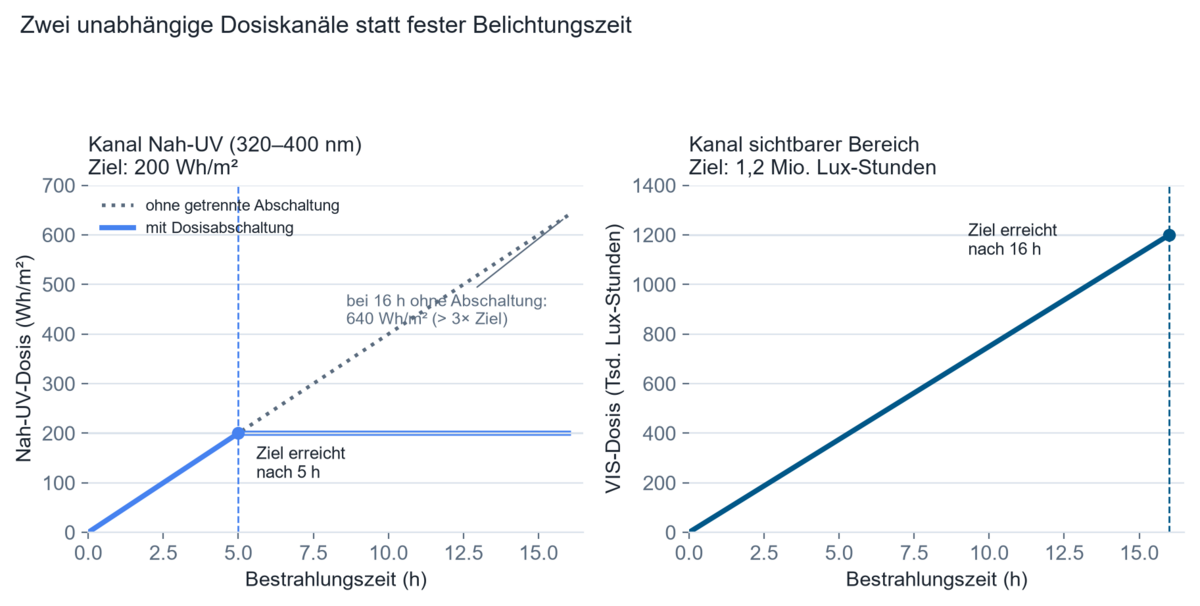
2. Model. Dose H = irradiance E × time t, calculated separately for UV (target 200 Wh/m²) and VIS (target 1.2 million lux-hours).
3. Calculation.
UV channel: t(UV) = 200 Wh/m² ÷ 40 W/m² = 5 h
VIS channel: t(VIS) = 1,200,000 lux·h ÷ 75,000 lux = 16 h
4. Result. The UV target is already reached after 5 hours, while the VIS target is only reached after 16 hours.
5. Technical interpretation. If both channels are monitored independently and switched off automatically once each reaches its target dose, this is unproblematic. If, instead, a single, fixed exposure duration of 16 hours is applied to both channels, the sample receives around 640 Wh/m² in the UV range – more than three times the required target dose. This is a practically relevant reason for differing degradation profiles between laboratories that nominally work "per ICH Q1B" but use different control logic. It underlines why separately controlled, continuously measured dose channels are preferable to fixed time control, as implemented in the BS-02+.
Where is photostability testing used?
Pharmaceutical marketing authorisation (ICH Q1B). For every new drug substance and every new finished drug product, photostability-related data is part of the marketing authorisation dossier. The critical process variable here is the comparison between the forced-degradation study (for method development, deliberately exceeding the target value) and the confirmatory study (dosed exactly to the ICH targets), since the two pursue different purposes – identifying degradation pathways versus delivering a regulatorily usable figure.
Biotechnology and biologics. Proteins and other large molecules often degrade photochemically via different pathways (oxidation of aromatic amino acid residues, aggregation) than classical small molecules. The critical process variable here is often less the pure UV dose than the cumulative VIS exposure, since many biologics are stored in vials with limited UV transmission but measurable transmission in the visible range.
Veterinary medicine (VICH GL5). Photostability testing for veterinary drugs follows an independent but methodologically almost identical guideline; what is critical here is the separate registration logic compared with human medicinal products, despite a technically identical test setup (EMA, VICH GL5).
Cosmetics and dermo-pharmaceuticals. Photostability testing is carried out here in a methodologically similar way, but outside a strict ICH framework, for example to confirm UV filter stability or colour change. The critical process variable is often the simulation of real sunlight exposure rather than ICH-specific lux/UV targets.
Contract laboratories (CROs/CDMOs). As the share of outsourced stability studies grows, so does the importance of standardised, GMP-documented irradiation chambers with traceable calibration, since results must remain comparable between different sites.
Packaging development. For the primary and market packaging testing provided for in the ICH Q1B decision tree, the spectral transmission of the pack material itself is the critical process variable – it determines whether a formulation can be approved without an additional light-protection statement.
Analytical method development. Forced-degradation studies deliberately generate degradation products to validate stability-indicating HPLC methods; what matters here is a sufficiently high, but controlled and documented, overdose to generate relevant degradation products at an analytically evaluable concentration.
How to test biologics, opaque solids, semisolids and combination products?
Photostability under cold-chain conditions. Biologics stored at 2–8 °C often require photostability testing under simultaneously active cooling, since the heat output of classical light sources would otherwise cause an unwanted overlap of thermal and photolytic degradation.
Opaque and coloured solids. For non-transparent solids, only the layer near the surface receives the full irradiance; deeper molecular layers are practically unexposed due to self-shading. Results from such tests therefore primarily characterise surface degradation (e.g. discolouration), not the bulk active substance.
Semi-solid and non-planar dosage forms. Creams, gels, or patches cannot readily be spread into the thin layer intended for solids; adapted sample preparations (e.g. a defined film thickness on a transparent carrier) are required here to meaningfully approximate the ICH Q1B irradiation geometry.
Combination products. For pre-filled syringes, auto-injectors, or other drug-device combinations, the housing material can also react photochemically alongside the active substance (yellowing, embrittlement), requiring an extended evaluation beyond pure active substance analytics.
Which quantities must be measured or monitored?
The starting point for any measurement plan is not a piece of equipment, but the question of which physical quantity is actually needed for the decision at hand. Demonstrating ICH Q1B conformance requires two basic quantities: photometric illuminance (lux) for the visible range, and radiometric irradiance in the 320–400 nm range (W/m²) for the near-UV component, each integrated over time to give the cumulative dose.
Where to measure: At the actual sample position, not at the lamp or chamber wall, and with a cosine-corrected sensor to correctly capture angle-dependent effects.
Which measurement uncertainties are relevant: Calibration uncertainty of the sensor (typically a few percent, traceable to national standards such as PTB/NIST), spectral mismatch between the sensor's response curve and the actual light source, and spatial measurement uncertainty from positional deviation within the sample chamber.
When broadband measurement is sufficient: For ongoing dose monitoring during routine testing, once the spectral conformance of the light source has already been demonstrated during equipment qualification and has not changed significantly since – a calibrated RMD Pro digital radiometer is sufficient for this.
When a spectral measurement is required: During initial qualification of a chamber, when changing lamp type or manufacturer, when spectral drift over the lamp's service life is suspected, and when comparing different chambers or light source types (fluorescent lamp vs. LED), because only then can the distribution across the 320–360 nm and 360–400 nm sub-bands be verified, which a broadband sensor fundamentally cannot do – a spectroradiometer such as UVpad or UVpad E is suited for this.
In qualified irradiation chambers, dose is controlled not by a fixed time span, but by continuously integrating sensors that monitor each spectral channel (VIS and near-UV) independently and automatically end irradiation once the target value is reached. This has technical significance for two reasons: first, it makes the applied dose independent of lamp ageing, contamination, or temperature fluctuations, which would otherwise cause unnoticed under- or overdosing under pure time control. Second, continuous logging produces a complete, GMP-suitable record of the dose actually applied (a dose-versus-time curve rather than a single end value), which is relevant for data-integrity requirements and the IQ/OQ documentation of the test equipment used. In addition, periodic recalibration and requalification of the sensors used is necessary, since measurement sensors are themselves subject to ageing drift – an uncalibrated "automated" control loop otherwise reliably delivers reproducibly wrong, but consistently wrong, values. DAkkS-accredited calibration to DIN EN ISO/IEC 17025:2018-03 establishes this traceability.
When spatial or time-resolved measurements become necessary: Spatial mapping of irradiance is required when qualifying larger or newly installed chambers, to demonstrate homogeneity; time-resolved measurement becomes relevant when dose rates (not just the final dose) matter for interpreting intensity-dependent effects.
What do scientific publications show?
The foundational review by Ahmad and colleagues summarises the photophysical and photochemical mechanisms of drug photodegradation and relates them to ICH requirements:
"Photostability and Photostabilization of Drugs and Drug Products", I. Ahmad, M. A. Sheraz, Sofia Ahmed, Zubair Anwar, M. Sikorski, International Journal of Photoenergy, 2016, DOI: 10.1155/2016/8135608.
Maafi and Al-Qarni examined the photokinetics of dacarbazine and nifedipine under polychromatic irradiation and showed that both substances do not follow a classical reaction order, but a so-called η-order kinetics – direct experimental evidence for the limits of the simple reciprocity concept in the UV range:
"Photokinetics of Dacarbazine and Nifedipine under polychromatic light irradiation and their application as new reliable actinometers for the ultraviolet range", M. Maafi, Mohammed Ahmed Al-Qarni, Scientific Reports, 2022, DOI: 10.1038/s41598-022-11570-5.
Ruiu and colleagues tested finasteride, diclofenac, and naproxen under simulated sunlight per ICH requirements and explicitly quantified the photoprotective effect of different packaging – one of the few papers to experimentally confirm the packaging influence described on this page:
"Photostability and toxicity of finasteride, diclofenac and naproxen under simulating sunlight exposure: evaluation of the toxicity trend and of the packaging photoprotection", D. Ruiu, L. Campanella, M. Sammartino, M. Castrucci, G. Visco, Chemistry Central Journal, 2013, DOI: 10.1186/1752-153X-7-181.
Technical fundamentals and further sources
- ICH Q1B – Photostability Testing of New Drug Substances and Products, ICH Harmonised Tripartite Guideline, Step 4, 1996 (EMA document)
- ICH Q1A(R2) – Stability Testing of New Drug Substances and Products (EMA guideline)
- VICH GL5 – Stability Testing: Photostability Testing of New Veterinary Drug Substances and Medicinal Products (EMA guideline)
- Ahmad, I. et al. (2016): Photostability and Photostabilization of Drugs and Drug Products. International Journal of Photoenergy. DOI: 10.1155/2016/8135608
- Maafi, M.; Al-Qarni, M. A. (2022): Photokinetics of Dacarbazine and Nifedipine under polychromatic light irradiation and their application as new reliable actinometers for the ultraviolet range. Scientific Reports. DOI: 10.1038/s41598-022-11570-5
- Ruiu, D. et al. (2013): Photostability and toxicity of finasteride, diclofenac and naproxen under simulating sunlight exposure. Chemistry Central Journal. DOI: 10.1186/1752-153X-7-181
FAQ on pharma photostability
How does photostability testing under ICH Q1B work?
The drug substance and finished product are exposed to defined amounts of visible light and near-UV radiation, while a light-protected control sample runs under the same thermal conditions. Appearance, assay, and degradation products of both samples are then compared to separate the photolytic effect from the thermal effect.
Which light source is suitable for ICH Q1B testing?
Option 1 sources with a D65/ID65-like spectrum (e.g. filtered xenon or metal halide lamps) or Option 2 combinations of a cool white source and a separate near-UV source with a maximum between 350 and 370 nm are both permitted. Both options are regulatorily equivalent but differ in practical dose control.
What dose is required for a confirmatory photostability test?
At least 1.2 million lux-hours in the visible range and at least 200 Wh/m² of integrated near-UV energy (320–400 nm), measured at the sample position.
What is the difference between forced degradation and confirmatory testing?
Forced-degradation studies deliberately use higher doses to identify degradation pathways and develop analytical methods. Confirmatory studies adhere exactly to the ICH targets and provide the comparative data usable for the marketing authorisation dossier.
Why does a chamber not perform reliably despite nominally sufficient lamp power?
Because electrical lamp power says nothing about the actual irradiance at the sample position. Lamp ageing, contamination, and geometry change the real dose independent of rated power; only a measurement at the sample position provides a reliable answer. Why a power rating is not a measurand in principle is derived under radiometric quantities.
How is the applied light dose measured?
Via calibrated radiometers (irradiance, 320–400 nm range) and lux meters (illuminance) at the sample position, alternatively or in addition to a validated chemical actinometer system (e.g. a quinine hydrochloride solution), which indicates the integrated dose via a defined change in absorbance.
What role does the packaging material play in photostability?
The spectral transmission of the packaging determines what proportion of the light even reaches the sample. Quartz glass is almost transparent down into the UV range, soda-lime glass attenuates the lower near-UV range, and amber glass blocks broadband up into the visible range – the choice of packaging therefore directly determines the test result.
Does the reciprocity law also apply to photostability testing?
Only to a limited extent. It assumes that the effect is determined solely by the product of irradiance and time. For several drug substances studied, however, intensity-dependent deviations from simple kinetic models have been demonstrated, so identical total doses at different dose rates do not necessarily produce identical degradation profiles.
Related application fields
Photostability testing borders on several neighbouring fields: Photobiology & Biotechnology examines the effect of radiation on living systems rather than a finished product, and UV Bonding, Potting and Encapsulation uses UV light as a manufacturing tool rather than a testing instrument. The fundamentals of accelerated material ageing outside the pharmaceutical ICH framework are summarised under UV Aging, Color Fastness & Photostability.
Author: Dr. Mark Paravia
Dr.-Ing. Mark Paravia is the managing director of Opsytec Dr. Gröbel GmbH in Ettlingen and heads the accredited calibration laboratory. Following his research on pulsed xenon excimer discharges at the Institute of Lighting Technology at KIT, his current focus is on optical radiation measurement technology. He is a recognized UV expert, vice-chair of the DIN Standards Committee FNL 7 “Optical Radiation,” and a member of the DVGW Project Group on UV Disinfection.
Not sure whether the right dose reaches the sample position?
Not sure whether the UV-A and visible-light dose specified in the test protocol actually reaches the sample position in the chosen setup – or only the lamp power is documented? For confirmatory testing per ICH Q1B/VICH GL5 with automatic, separate dose cut-off for UV-A and the visible range, the BS-02+ is available; for forced-degradation studies and UV/daylight material testing with flexibly configurable spectral ranges, the BS-02. For initial spectral qualification of a light source and demonstrating the distribution across the ICH Q1B sub-bands, UVpad and UVpad E are suitable, and for ongoing broadband dose monitoring in routine operation of qualified chambers, the RMD Pro. Get in touch about your testing task.