
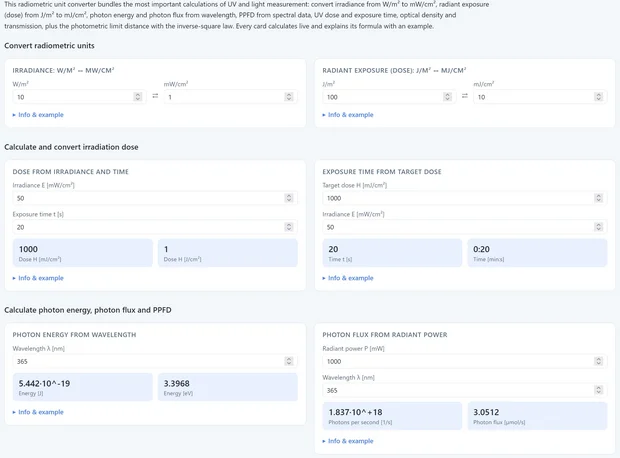
This radiometric unit converter bundles the most important calculations of UV and light measurement: convert irradiance from W/m² to mW/cm², radiant exposure (dose) from J/m² to mJ/cm², photon energy and photon flux from wavelength, PPFD from spectral data, UV dose and exposure time, optical density and transmission, plus the photometric limit distance with the inverse-square law. Every card calculates live and explains its formula with an example. All twelve calculators run entirely in your browser — no registration, no data transfer. Typical applications include designing UV curing and disinfection processes, rating protective filters via optical density, converting between energetic and photon-based quantities for horticultural lighting, and estimating irradiance at a changed working distance. Binding results always come from a measurement with a calibrated radiometer or spectroradiometer — both manufactured and calibrated by Opsytec Dr. Gröbel in its own laboratory. The calculator thus replaces the typical manual conversions of the UV lab: from irradiance conversion and dose calculation for UVC disinfection to photon flux density for grow lights; all constants follow CODATA 2018.
Formulas and examples for the twelve calculators
Both units describe the same quantity — irradiance E (power per area). Since 1 m² = 10,000 cm² and 1 W = 1000 mW:
Formula: 1 W/m² = 0.1 mW/cm² · 1 mW/cm² = 10 W/m²
Example: A UV radiometer reads 50 mW/cm² — that equals 500 W/m².
Radiant exposure H (dose) is energy per area. The conversion factor is the same as for irradiance:
Formula: 1 J/m² = 0.1 mJ/cm² · 1 mJ/cm² = 10 J/m²
Example: A required disinfection dose of 400 J/m² equals 40 mJ/cm².
At constant irradiance the dose grows linearly with time — the basis of every UV process design (curing, disinfection, ageing tests):
Formula: H = E · t · [mJ/cm²] = [mW/cm²] · [s]
Example: 50 mW/cm² for 20 s gives 1000 mJ/cm² = 1 J/cm².
The inverse of the dose formula: how long must you irradiate to reach a required dose?
Formula: t = H / E
Example: 1000 mJ/cm² at 50 mW/cm² takes 20 s; at only 10 mW/cm² it already takes 100 s (1:40 min).
The energy of a single photon follows from Planck's constant h and the speed of light c. The shorter the wavelength, the more energetic the photon — which is why UV radiation is chemically more aggressive than visible light.
Formula: E = h·c / λ · E[eV] ≈ 1239.842 / λ[nm]
Example: A 365 nm photon (UV-A) carries 5.44·10⁻¹⁹ J = 3.40 eV.
Radiant power divided by the energy of one photon gives the number of photons the source emits per second:
Formula: N = P / E_Photon = P·λ / (h·c)
Example: 1000 mW at 365 nm corresponds to 1.84·10¹⁸ photons/s ≈ 3.05 µmol/s.
The photosynthetic photon flux density (PPFD) counts the photons between 400 and 700 nm hitting one square metre per second. It is computed from the spectral irradiance E(λ) by integration (trapezoidal rule over your samples; values outside 400–700 nm are ignored):
Formula: PPFD = ∫ E(λ)·λ dλ / (h·c·N_A)
Example: A flat spectrum of 1 W/(m²·nm) across 400–700 nm (300 W/m² PAR) yields ≈ 1379 µmol/(m²·s).
Optical density (absorbance) is the negative decadic logarithm of the transmission. Each OD step means a factor of 10 less light:
Formula: OD = −log₁₀(T) · T als Bruchteil (10 % = 0.1)
Example: 10 % transmission → OD 1; 1 % → OD 2; 0.1 % → OD 3.
The inverse: from the optical density follows the fraction of light passing a filter or sample:
Formula: T = 10^(−OD) · 100 %
Example: UV safety eyewear with OD 4 at 365 nm transmits only 0.01 % of the radiation.
When light passes several filters, windows or lenses, the transmissions multiply — the optical densities add:
Formula: T_ges = T₁ · T₂ · … · T_n · OD_ges = OD₁ + OD₂ + …
Example: Two windows at 90 % each and a filter at 50 % give 0.9·0.9·0.5 = 40.5 % total transmission.
The photometric limit distance is the minimum distance beyond which an extended lamp may be treated as a point source — only then does the inverse-square law (card below) apply. As a rule of thumb in light and UV metrology (cf. DIN 5032-1), ten times the largest luminous dimension is used; the error of the point-source approximation then stays below about 1 %. For rough measurements five times is often sufficient (an error of a few percent).
Formula: d ≥ 10 · D
Example: An LED panel with a 200 mm diagonal is photometrically point-like only beyond d = 2000 mm = 2 m.
For an (approximately) point-like source the irradiance falls with the square of the distance. The approximation holds in the far field — beyond the photometric limit distance (see card above); close to area emitters E falls more slowly.
Formula: E₂ = E₁ · (d₁ / d₂)²
Example: 100 mW/cm² at 100 mm become 25 mW/cm² at 200 mm (double distance → one quarter).
Frequently asked questions about radiometry
1 W/m² equals 0.1 mW/cm², since 1 m² = 10,000 cm² and 1 W = 1000 mW. A reading of 500 W/m² therefore corresponds to 50 mW/cm². The converter above works in both directions — the same factor applies to the dose (J/m² ↔ mJ/cm²).
The dose (radiant exposure) is the product of irradiance and exposure time: H = E · t. 50 mW/cm² for 20 s gives 1000 mJ/cm² = 1 J/cm². Conversely, the exposure time required for a target dose follows from t = H / E.
Irradiance is an energetic quantity in W/m²; the PPFD counts photons between 400 and 700 nm in µmol/(m²·s). Converting between them requires the spectrum, because the energy of a photon depends on its wavelength — the PPFD calculator integrates your spectral data for this.
Beyond the photometric limit distance — as a rule of thumb ten times the largest luminous dimension of the lamp. Only there may the source be treated as point-like; the error of the point-source approximation then stays below about 1 %.
Author: Dr. Mark Paravia
Dr.-Ing. Mark Paravia is the managing director of Opsytec Dr. Gröbel GmbH in Ettlingen and heads the accredited calibration laboratory. Following his research on pulsed xenon excimer discharges at the Institute of Lighting Technology at KIT, his current focus is on optical radiation measurement technology. He is a recognized UV expert, vice-chair of the DIN Standards Committee FNL 7 “Optical Radiation,” and a member of the DVGW Project Group on UV Disinfection.